
The Fed held rates, but the cost floor moved higher: what small teams should recalculate after the June FOMC
The headline from the June 17, 2026 FOMC meeting looks simple: the Federal Reserve kept the federal funds target range at 3.50% to 3.75%. For small teams, dollar-paying software businesses, global founders, and investors, that is not the main message. The practical message is that the floor under funding costs has moved higher again.
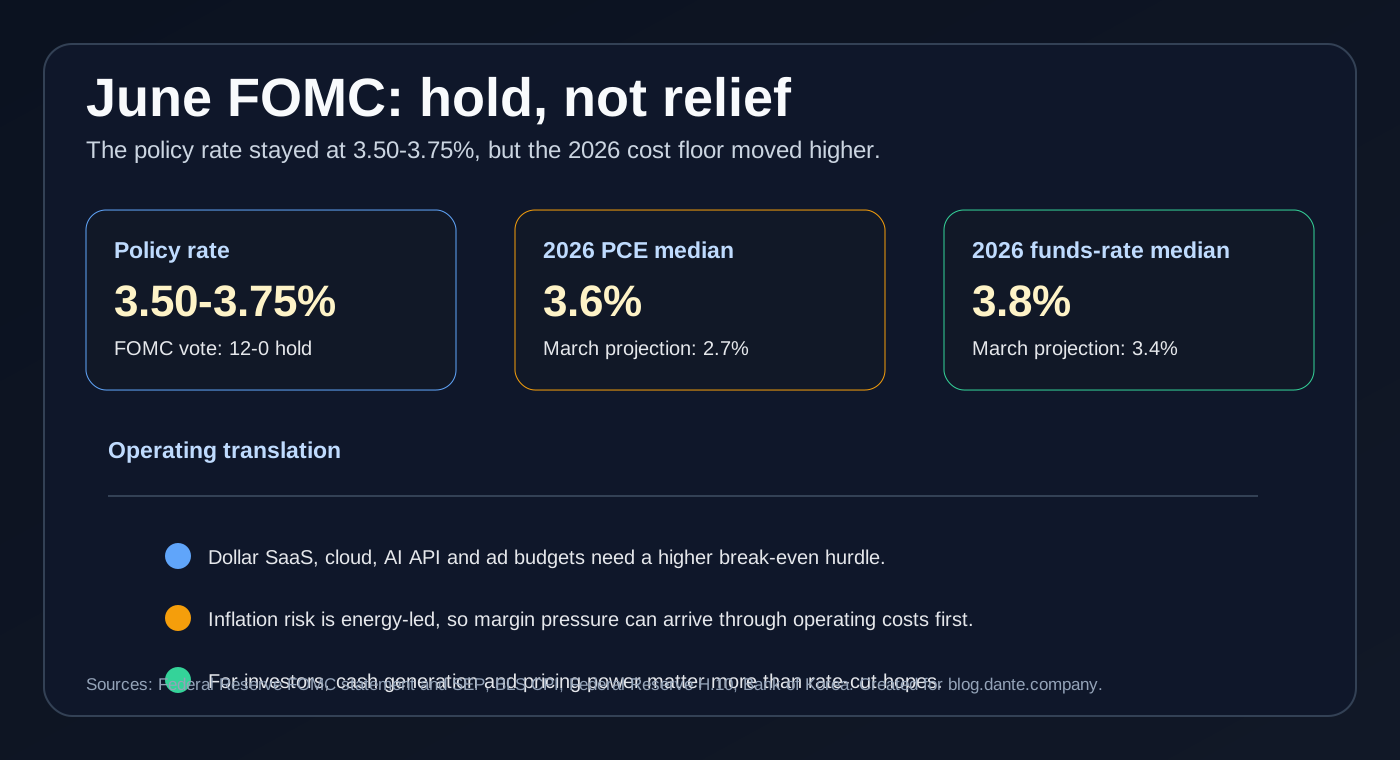
The Summary of Economic Projections raised the 2026 PCE inflation median to 3.6% and core PCE to 3.3%. The median projected federal funds rate for the end of 2026 rose to 3.8%, up from 3.4% in March. This was not a meeting that made rate cuts feel closer. It told operators to plan for a longer period of expensive money, energy-sensitive costs, and tighter valuation discipline.
Confirmed facts
The FOMC voted 12-0 to maintain the target range at 3.50% to 3.75%. The statement said economic activity is expanding at a solid pace despite elevated uncertainty, with job gains broadly keeping pace with the workforce.
The implementation note kept the interest rate on reserve balances at 3.65%, the standing overnight repo rate at 3.75%, and the overnight reverse repo offering rate at 3.50%.
The SEP changed the operating picture. The 2026 real GDP median moved down to 2.2% from 2.4% in March, while PCE inflation rose to 3.6% from 2.7%. Core PCE rose to 3.3% from 2.7%. The 2026 year-end funds-rate median rose to 3.8% from 3.4%.
The May CPI release explains why the Fed is reluctant to declare victory. CPI-U increased 0.5% month over month and 4.2% year over year. Energy was up 23.5% year over year, gasoline was up 40.5%, and core CPI was 2.9%.
For Korean operators, the FX channel matters. The Fed H.10 release showed the won trading around 1,519 to 1,531 per dollar in the latest reported week, while the Bank of Korea kept its base rate at 2.50% on May 28.
| Signal | Confirmed number | Operating meaning |
|---|---|---|
| Federal funds target | 3.50-3.75% | A hold, but not an easing signal |
| 2026 PCE median | 3.6% vs 2.7% in March | Inflation assumptions moved materially higher |
| 2026 funds-rate median | 3.8% vs 3.4% in March | Rate-cut room narrowed |
| May CPI-U | 4.2% YoY; energy +23.5% YoY | Operating costs can stay volatile |
| Korea base rate | 2.50% | Dollar-won funding gap still matters |
Interpretation: watch the cost path before the rate path
The point is not that the Fed hiked. It did not. The point is that the expected path to easier money narrowed. In the dot plot, nine of eighteen participants saw a higher year-end 2026 rate than the current midpoint, eight saw the current level, and only one saw a lower rate.
That matters for payback periods, cloud commitments, ad budgets, dollar debt, AI API bills, and cross-border software subscriptions. Even if demand remains acceptable, a higher cost floor reduces the margin of error for growth experiments.
For investors, the message is similar. “Rates will fall and multiples will recover” is a weaker base case. Free cash flow, pricing power, net cash, refinancing risk, and dollar-cost exposure deserve more weight than headline revenue growth.
Market narrative signal
Tools such as CME FedWatch now frame the discussion less around near-term cuts and more around whether another hike could arrive later this year. That is not a policy promise; it is the market’s current reading of futures prices. Still, it shapes financing conversations immediately.
The founder-level question has also changed. Instead of asking when money gets cheap again, more teams need to ask how much expensive dollar infrastructure can be embedded in pricing without breaking conversion.
Second-order effects
First, cloud and AI infrastructure commitments need a more conservative discount rate. Second, teams with foreign revenue should compare FX benefits against payment fees, server costs, and software subscriptions in the same model. Third, B2B pipelines may stretch as customers keep capital budgets tight.
Fourth, public-equity screens should separate fast growers from companies that can survive longer periods of high nominal rates. Fifth, the gap between Korea’s 2.50% base rate and the U.S. 3.50-3.75% range complicates decisions for anyone holding won assets but paying dollar costs.
Checklist for builders and investors
• Reprice dollar-denominated tools using a won-dollar rate above 1,500.
• Run cloud, AI API, and advertising break-even models without assuming rate cuts.
• Add inflation, FX, or infrastructure-cost adjustment clauses where customer contracts allow it.
• Split cash runway into optimistic, base, and stress cases.
• When screening stocks, prioritize FCF, net cash, debt maturity, and pricing power before revenue growth.
Counterarguments and risks
The hawkish signal could fade if energy shocks reverse and core inflation cools. The Fed also described productivity growth and capital investment as strong, which could cushion downside risk. Futures-implied probabilities change daily and should not be treated as official guidance.
Still, operators do not need to predict the next FOMC move. They need a cost structure that remains viable if relief arrives later than expected.
This article is informational commentary about markets and the economy. It is not financial advice or a recommendation to buy or sell any security.
Sources
- Federal Reserve FOMC Statement, June 17, 2026
- Federal Reserve Summary of Economic Projections, June 2026
- Federal Reserve Implementation Note, June 17, 2026
- U.S. Bureau of Labor Statistics, May 2026 CPI
- Federal Reserve H.10 Foreign Exchange Rates
- Bank of Korea main monetary policy data
- CME FedWatch overview