
GitHub Models retires on July 30: move model experiments before they become hidden production dependencies
The most dangerous AI dependency in a product is not always the SDK imported by production code. It can be the playground used for decisions, the prompt copied from a model catalog, the small eval set nobody exported, or the temporary BYOK path that quietly became part of a demo pipeline.
What happened
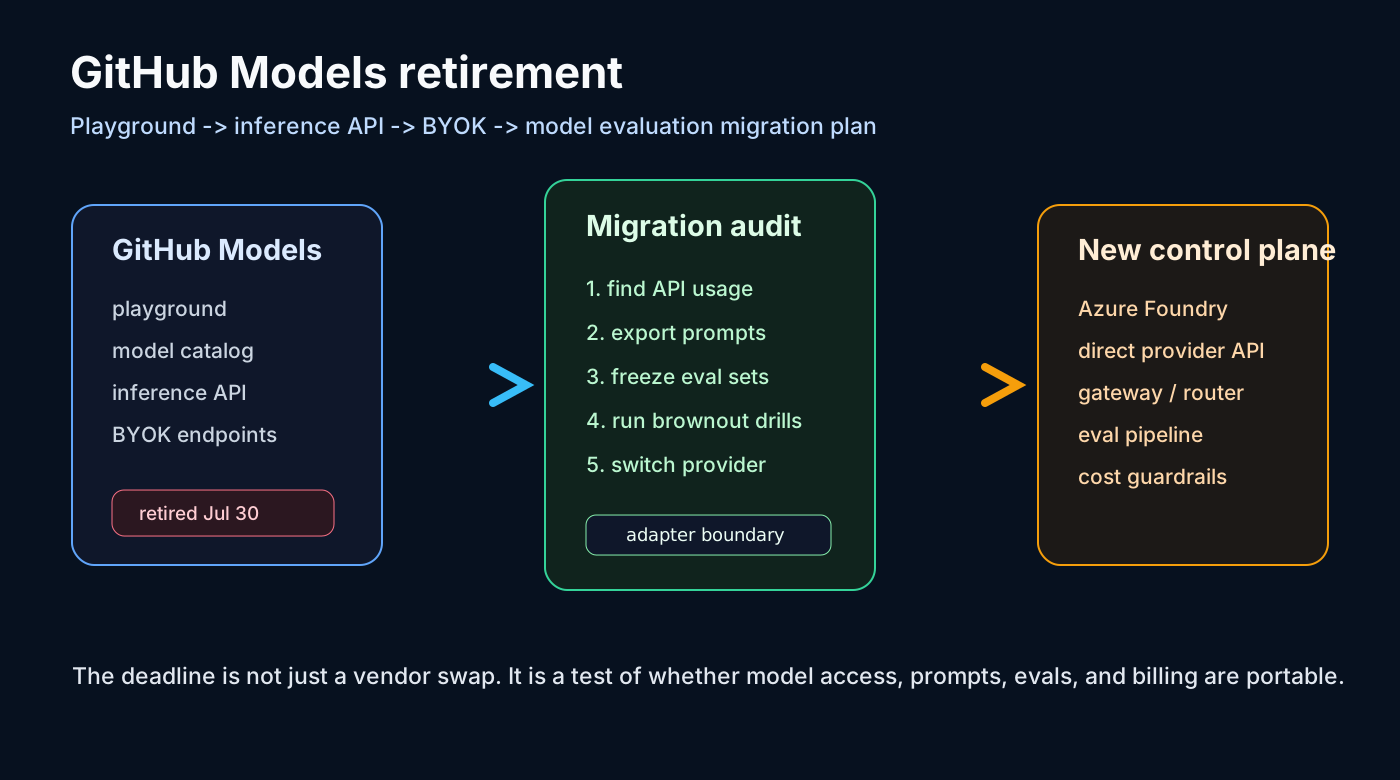
On July 1, 2026, GitHub announced that GitHub Models will be fully retired on July 30, 2026. After that date, the playground, model catalog, inference API, bring your own key endpoints, and related UI will no longer be available.
This follows GitHub’s June 16 announcement that GitHub Models was no longer available to new customers. The June step left existing active users unchanged. The July announcement expands the retirement to every customer, including existing active usage.
GitHub also announced short brownouts on July 16 and July 23, 2026. During those windows, GitHub Models requests will temporarily return errors before service is restored. Treat those dates as migration drills, not just calendar trivia.
Why it matters
GitHub Models gave teams a low-friction place to compare models, try prompts, and run small evaluations near the repository workflow. GitHub Docs described it around a model catalog, prompt management, and quantitative evaluations, which made it useful as a fast product-discovery surface even when it was not the final production platform.
That convenience creates migration risk. A prompt experiment can become a product decision. A model comparison can become a stakeholder-approved default. A temporary inference call can become a CI smoke test. If those artifacts are not owned, exported, and reproducible, the retirement date turns into archaeology.
GitHub points developers who need model access toward Azure AI Foundry, and developers building AI-powered workflows directly on GitHub toward GitHub Copilot. That is guidance, not an automatic migration. Teams still need to redesign API boundaries, authentication, cost ownership, logging, eval storage, and model-selection policy.
Community signal
Developer community reactions are split in a predictable way. Some people valued the convenience of a lightweight model-testing surface inside GitHub. Others read the move as a consolidation into Azure AI Foundry. Those reactions should be treated as audience signals, not as factual sources for the product change.
The practical tension is real. For small teams and solo developers, moving from a GitHub-native experiment surface to a cloud AI platform can reintroduce account setup, procurement, permissions, region choices, and billing controls. For enterprise teams, that same move can be positive if it brings auditability, policy, and budget ownership.
The lesson is not that every model experiment belongs in a heavyweight platform from day one. The lesson is that prompt and eval artifacts should be portable before they matter.
Operational impact
The first audit target should not be only production code. Look for documentation snippets, notebooks, demo apps, CI jobs, QA scripts, internal workshops, and sample repositories. Experimental usage is often the least monitored and the hardest to migrate at the last minute.
Provider-specific calls should be wrapped behind an adapter boundary. Request payloads, streaming semantics, tool calls, structured output, safety settings, rate limits, and error codes differ across providers. A retirement is the right time to define the model control plane instead of replacing one endpoint string with another.
Evals have to move with the code. If GitHub Models was used to compare prompts or models, preserve the input set, expected behavior, forbidden behavior, failure examples, and acceptance criteria. A remembered “model A was better” is not a migration artifact.
A checklist before the July 16 brownout
1. Search repositories for `github models`, `models.inference.ai.azure.com`, token names, sample endpoints, and BYOK configuration.
2. Export prompts, system messages, eval inputs, and comparison notes from the playground into a repository or dedicated eval workspace.
3. Force GitHub Models calls to fail in staging before July 16 and record which demos, tests, and jobs break.
4. Choose the new destination: Azure AI Foundry, direct provider APIs, an AI gateway, or an internal model router.
5. Add a model adapter for `generate`, `stream`, `embed`, `tool call`, `structured output`, retry, timeout, and usage logging boundaries.
6. Freeze an eval set and run it before and after migration. Compare quality regressions, latency behavior, and token usage without inventing unsupported benchmark claims.
7. Separate cost and permission domains. Do not mix personal BYOK, production keys, experiments, and CI tokens in the same bucket.
8. Use the July 23 brownout as the final rehearsal. If anything still breaks, ship a feature flag or fallback before July 30.
Migration priorities
- Search hidden usage across docs, demos, CI, and notebooks
- Move prompts and eval inputs into reproducible storage
- Run a staging failure drill before the July 16 brownout
- Decide the new provider/gateway plus cost and permission boundaries
Risks and counterarguments
The first risk is overreaction. If a team only tried GitHub Models once, this does not need to become a platform migration program. Find actual usage, then decide whether to delete the experiment or preserve it as a real evaluation asset.
The second risk is over-abstraction. A provider-neutral adapter that hides every provider feature will erase important differences in tool calling, files, image input, model policy, and safety settings. Keep common boundaries small and allow provider-specific escape hatches.
The third risk is security. Moving BYOK flows can leave keys in CI logs, local environment files, notebooks, or exported playground notes. The migration should include secret rotation and log review, not just replacement endpoints.
Bottom line
The GitHub Models retirement is not simply a story about one AI product going away. It is a reminder that model experiments, prompts, evals, and cost controls are operational assets. Before July 30, teams should move those assets into a control plane they can audit, rehearse, and replace.
Sources
- GitHub Changelog: GitHub Models is being fully retired on July 30, 2026
- GitHub Changelog: GitHub Models is no longer available to new customers
- GitHub Docs: GitHub Models
- Microsoft Learn: What is Microsoft Foundry?
- Microsoft Learn: Foundry Models sold by Azure
- Reddit r/github discussion as community signal