
Korea’s 3.1% CPI and 40,000-job decline: small teams should watch margin before revenue
Prices are rising while the labor signal cools
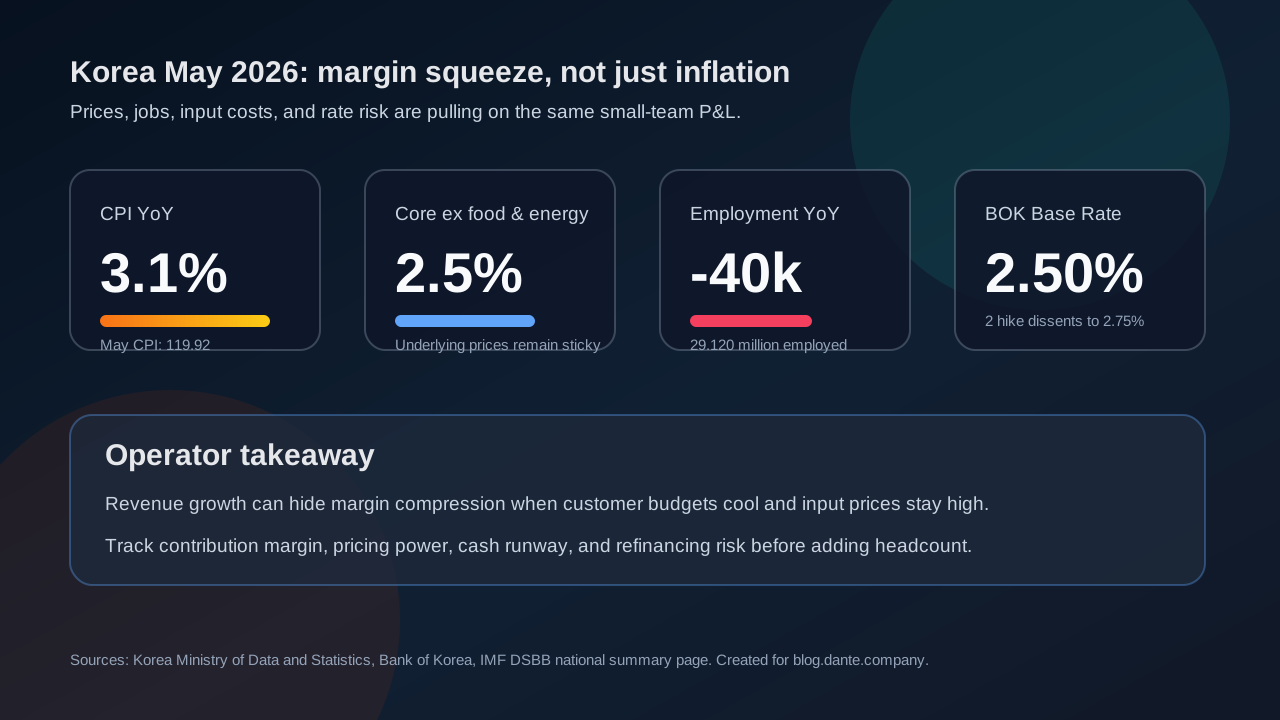
The uncomfortable part of Korea’s latest data is not inflation alone. In May 2026, the Consumer Price Index reached 119.92, up 0.5% from April and 3.1% from a year earlier. In the same month, employment totaled 29.120 million people, down 40,000 from a year earlier. Prices are still rising, while the labor-market signal is cooling.
For small teams, software operators, self-employed businesses, and investors, this is not a trivia point. Customers become more sensitive to price increases, wage and contractor costs rarely reset quickly, and the Bank of Korea kept its base rate at 2.50% while two board members voted for a hike to 2.75%. The practical assumption should be margin pressure, not automatic monetary relief.
| Indicator | Latest reading | Operator read |
|---|---|---|
| Consumer prices | 3.1% YoY | Recheck price resistance and pass-through |
| Ex food and energy | 2.5% YoY | Underlying pressure has not vanished |
| Employment | -40k YoY | Plan demand and hiring more conservatively |
| Base rate | 2.50%, two hike dissents | Do not confuse a hold with easing |
Confirmed facts
- The Ministry of Data and Statistics reported Korea’s May 2026 CPI at 119.92 on a 2020=100 basis. It rose 0.5% month over month and 3.1% year over year.
- The index excluding food and energy was 115.97, also up 0.5% month over month and 2.5% year over year. That means underlying price pressure has not disappeared.
- The May Economically Active Population Survey showed 29.120 million employed persons, down 40,000 year over year. The employment-to-population ratio was 63.3%, down 0.5 percentage point, while the unemployment rate rose 0.1 percentage point to 2.9%.
- The Bank of Korea kept the Base Rate unchanged at 2.50% on May 28. Two of seven board members dissented and proposed a hike to 2.75%. The central bank cited Middle East risks, energy and commodity prices, exchange-rate volatility, housing, and household debt.
- The national summary data page listed Korea’s May Producer Price Index at 129.8, up from 128.8 in the previous period. Operators should therefore look at input costs as well as consumer prices.
Interpretation: unit economics before headline growth
The point is not that Korea has already entered recession. The confirmed data do not support such a simple claim. The Bank of Korea, in fact, noted stronger growth led by semiconductors, investment, and policy support. The problem is that average growth does not protect the P&L of a small team.
When inflation sits above 3% and employment growth weakens, customers become more selective. B2C teams may see basket size, churn, and repeat purchase rates change. B2B sellers may face longer approval chains. At the same time, supplier quotes, logistics, dollar-paid SaaS, cloud bills, and contractor rates rarely fall immediately. Revenue can look acceptable while gross margin deteriorates.
For investors, the same filter matters. Export strength and semiconductor demand can coexist with weak pricing power in domestic consumption, retail, marketplaces, and ad-dependent services. The better screen is pricing power, free cash flow, inventory turnover, net cash, debt maturity, and exposure to wage or contractor costs.
Market and operator narrative signal
The market conversation is moving away from simple rate-cut hope toward whether the Bank of Korea may need to turn more hawkish. That is an expectation, not an official promise. But the existence of two hike dissents immediately affects funding conversations, housing risk, FX expectations, and valuation discipline.
Founder-level questions are shifting too. The useful question is not only whether this month’s revenue is higher. It is whether a price increase triggers churn, whether throughput can rise without new hires, and whether repeat demand survives lower advertising intensity.
Second-order effects
First, teams facing wage, contractor, subscription, and infrastructure increases should review contribution margin weekly. Second, a cooler labor market may reduce hiring pressure, but it can also signal softer customer spending. Focusing only on cost relief can hide demand risk.
Third, a rate hold is not easing. With two board members voting for a hike, refinancing, floating-rate debt, credit lines, and property-linked collateral should be modeled conservatively. Fourth, if producer prices rise while consumer price pass-through is limited, distributors, manufacturers, and services businesses absorb the squeeze first.
Checklist for builders and investors
•Put gross margin, contribution margin, refund rate, and repeat purchase rate beside revenue in the same dashboard.
•Test price increases by plan, segment, or new customers before applying a broad increase.
•Before hiring, measure automation potential, operating bottlenecks, contractor rates, and support cost per ticket.
•Keep both a base-rate-hold scenario and a 25 bp hike stress case in cash-flow planning.
•When screening investments, prioritize pricing power, inventory turnover, net cash, debt maturity, and fixed-cost intensity before revenue growth.
Counterarguments and risks
There are real counterarguments. Semiconductor exports and AI-related investment could keep aggregate growth stronger than expected. If Middle East risks ease and energy prices stabilize, inflation pressure could cool. One month of employment data also does not prove a long-term labor trend.
Still, operators do not need to predict the next macro print. They need a cost structure that can survive when break-even points move. The practical message from the May data is clear: even when revenue looks fine, simultaneous pressure from prices, jobs, and rates means margin comes first.
This article is informational commentary about markets and the economy. It is not financial advice or a recommendation to buy or sell any security.
Sources
- Korea Ministry of Data and Statistics, Consumer Price Index in May 2026
- Korea Ministry of Data and Statistics, Economically Active Population Survey in May 2026
- Bank of Korea, Monetary Policy Decision and Opening Remarks, May 28 2026
- Korea Ministry of Data and Statistics, IMF DSBB National Summary Data Page