
Korea’s $427.4 billion reserve buffer: why won-cost risk is still a company-level problem
A higher reserve number can sound comforting. The more useful reading is sharper: Korea has a national dollar buffer, but your startup, portfolio, or household still needs its own won-to-dollar operating plan.
Confirmed facts: the headline rose, but the mix is defensive
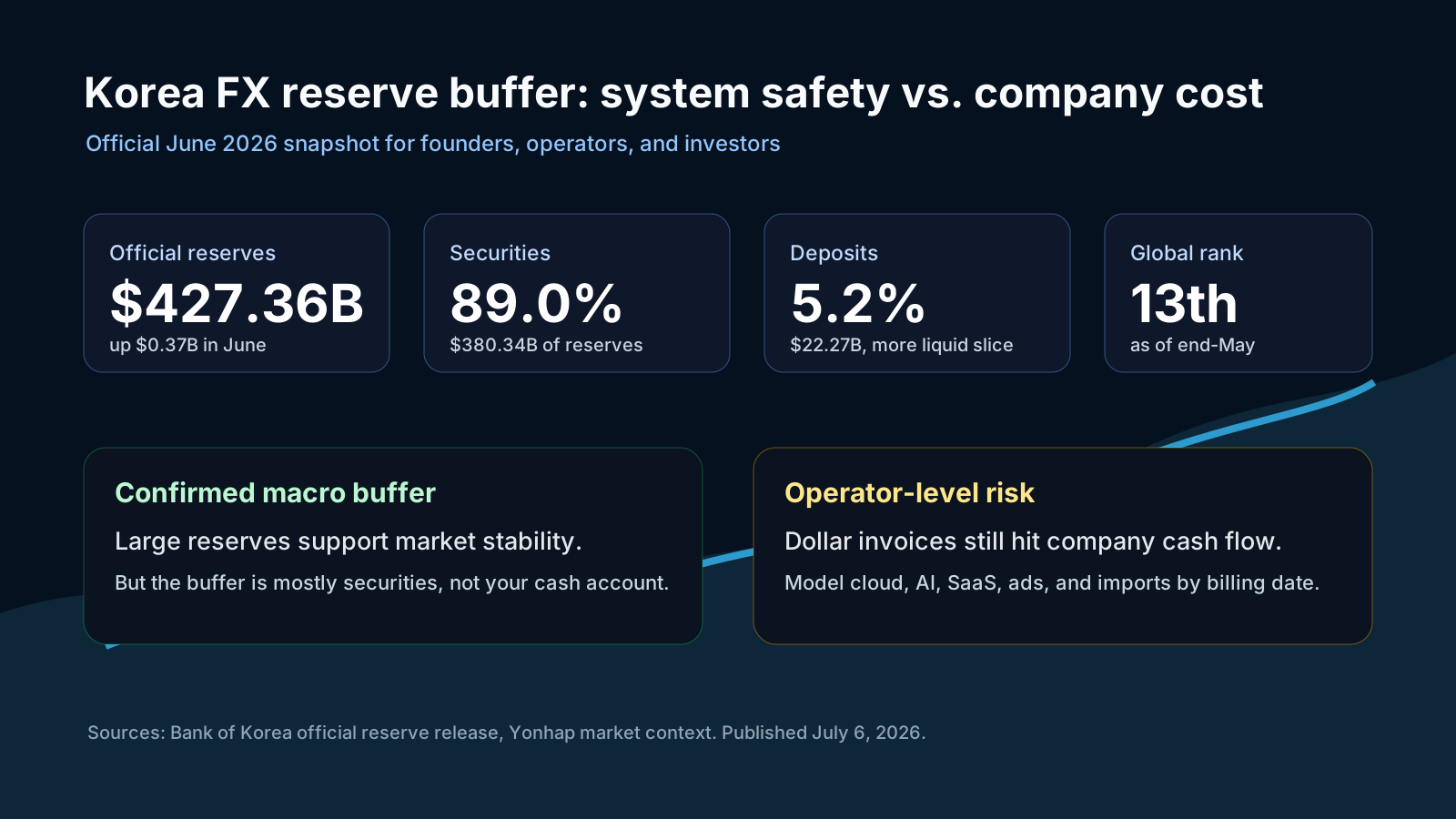
- The Bank of Korea reported official foreign reserves of $427.36 billion at the end of June 2026, up $0.37 billion from May.
- The reserves consisted of $380.34 billion in securities, equal to 89.0% of the total, $22.27 billion in deposits, $15.64 billion in SDRs, $4.79 billion in gold, and a $4.31 billion IMF position.
- During June, securities fell by $0.33 billion while deposits rose by $0.92 billion. The important signal is not a large increase in total reserves, but a modest shift toward more deposit liquidity.
- As of the end of May 2026, Korea ranked 13th globally in official foreign reserves, just behind Singapore.
- Yonhap reported that the won traded well beyond 1,500 per dollar in June and reached 1,549.4 won per dollar at month-end, the weakest level since March 2009.
Interpretation: national reserves are not your company’s hedge book
Foreign reserves matter because they support external payment capacity and give authorities tools to smooth disorderly market moves. They do not automatically protect a company paying AWS, GPU rentals, U.S. SaaS subscriptions, imported components, or dollar-denominated ad spend with won revenue.
The composition matters. Securities are the bulk of the reserve portfolio, while deposits are a small but more liquid slice. For operators, the equivalent question is: how much near-cash dollar capacity do we have before the next billing cycle?
The June deposit increase is constructive, but it does not erase the operating pressure from a weak won. Teams with won revenue and dollar costs should separate the country’s macro buffer from their own cost currency mismatch.
Reserve snapshot
$427.36 billion reserves, 89.0% securities, 5.2% deposits, 13th global rank, and 1,549.4 won per dollar at the end of June in the Yonhap market report.
Market narrative: both easy comfort and panic are incomplete
The simple bullish story is that reserves rose despite currency-market stabilization measures. The simple bearish story is that Korea’s ranking fell and the won is trading at crisis-era levels. Neither is enough for a practical decision.
For builders, the better question is whether dollar invoices, cloud usage, AI API calls, and overseas marketing spend can be repriced or reduced before the next cash crunch. For investors, the question is whether reported returns are coming from asset quality or from currency translation.
This is best read as an operating signal, not as a trading call: map cost currency, revenue currency, payment dates, and cash runway before making macro conclusions.
Second-order effects small teams may feel first
| Dollar invoices | Cloud, AI, SaaS, and ad costs become heavier versus won revenue. Billing-date FX matters more than monthly averages. |
| Export revenue | Dollar revenue can provide a natural hedge, but timing mismatches between receipts and costs can still create cash volatility. |
| Import and commerce margins | If imported costs cannot be passed through, FX eats gross margin directly, especially when inventory turns slowly. |
| Portfolios | Separate currency gains from underlying asset performance. A weak won can make weak foreign assets look better in local currency. |
This week’s checklist
• Split dollar costs into fixed monthly, usage-based, and one-off purchases, then model 1,500, 1,550, and 1,600 won per dollar.
• Audit overseas SaaS and AI API spend by feature-level ROI; remove idle seats and duplicate tools first.
• Match dollar receipts and dollar payments where possible to increase natural hedging.
• For import-heavy products, keep inventory cost and pricing rules in the same operating sheet.
• For portfolios, track FX contribution separately from underlying asset returns.
Risks and counterarguments
Foreign reserves alone do not set the exchange rate. Rate differentials, trade flows, overseas investment, foreign portfolio flows, and geopolitical risk all matter.
Korea’s reserves remain large and rose in June, so using one ranking move to claim an immediate FX crisis would be excessive.
The opposite mistake is assuming the national buffer removes company-level dollar risk. Small teams should manage payment structure, pricing, and cash runway before trying to forecast the exchange rate.
This article is for informational economic context only and is not financial advice. Any investment decision should reflect your own objectives, time horizon, and risk tolerance.