
Next.js 16.3 Turbopack: faster builds now require cache operations
The Turbopack work in Next.js 16.3 Preview is easy to summarize as “faster builds,” but that misses the more useful lesson. The release reduces long-running dev server memory pressure, exposes persistent filesystem cache for next build, adds an experimental Rust React Compiler path, and expands Turbopack compatibility with APIs such as import.meta.glob.
For working teams, the decision is operational. How will CI save and restore cache? Should Windows developers enable the preview immediately? If a restored cache makes a build faster, how will the team detect stale output, excessive disk use, or branch-switching edge cases? The closer Turbopack gets to the default path, the more a bundler upgrade becomes cache operations rather than a one-line dependency bump.
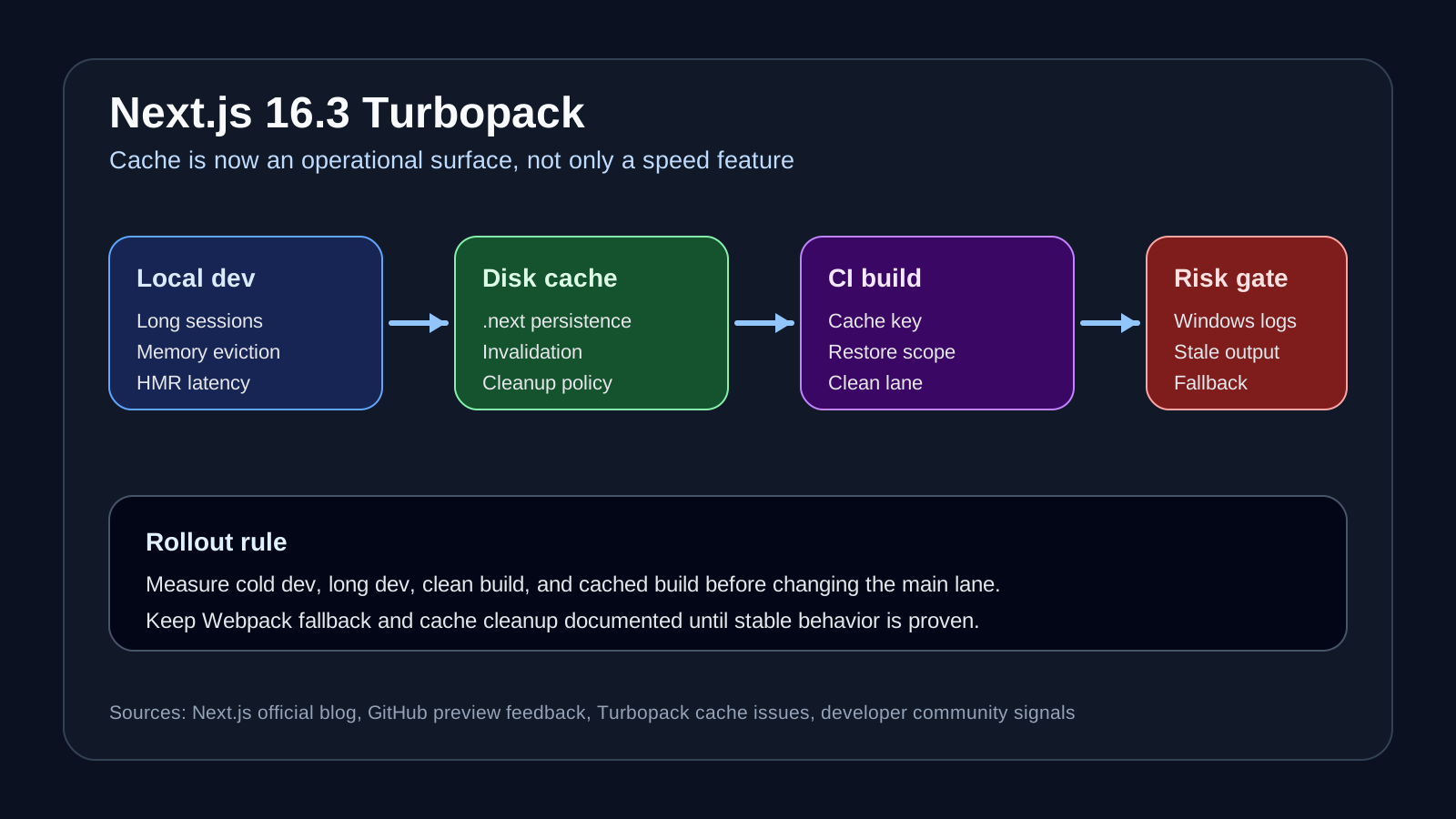
What happened
On June 29, 2026, the Next.js team published the Turbopack update for Next.js 16.3 Preview. The official post says this release focuses on compiler performance and calls out lower dev server memory use, persistent filesystem cache for builds, experimental Rust React Compiler support, import.meta.glob, and HMR/startup improvements.
The headline figures are large but should be read carefully. The post shows the Vercel dashboard using 2GB after compiling 50 routes, down from 21.5GB, and nextjs.org using 840MB, down from 4,600MB. It also shows cached build improvements on nextjs.org and Vercel sites. The same post explicitly says there is no single reduction percentage for every app; results depend on route graph size, touched routes, and session length.
The mechanism matters. Turbopack avoids recompiling unchanged work by caching prior results. In 16.3, filesystem persistence lets Turbopack evict much of that in-memory cache. In other words, the performance story is not magic. It is a trade between memory, disk persistence, invalidation, and rebuild scope.
Why it matters
Developer machines are crowded. A Next.js dev server usually runs next to an IDE, TypeScript language service, ESLint, test watchers, Docker, browsers, and now often an AI coding agent. The official post explicitly mentions coding agents, IDEs, typecheckers, and linters as sources of development-time memory pressure. If the dev server grows every time a route is visited, the bottleneck becomes the entire laptop, not just compilation time.
CI changes the risk profile. A filesystem cache for next build can reduce repeat build time, but a restored cache also becomes part of the build input. Teams now need cache keys, restore policy, branch isolation, invalidation rules, and clean-build fallbacks. Without those, the faster path can become harder to reason about than the slower one.
Community signals
In the Next.js 16.3 Preview feedback discussion, a developer asked whether the Turbopack memory improvements could ship in a stable patch without waiting for the full release. A maintainer answered that backporting many pull requests into 16.2.x would carry too much risk, and recommended canary or preview for teams that do not want to wait. That is an important adoption signal: use the preview only if you accept preview-channel risk.
Other community signals are more cautionary. A cache feedback discussion reports a possible stale prerender output case when a large app restored .next/cache from another build state. A Windows issue reports deterministic dev cache commit failures that prevent memory eviction from engaging. These reports do not invalidate the official release notes; they show which failure modes teams should monitor during rollout.
Reddit discussion shows a more everyday concern: people are trying to separate “up to 90% smaller memory” from “90% faster,” and they still ask about disk growth and Webpack fallback. That confusion is useful. Your internal rollout note should explain the expected benefit, the disable path, cache cleanup, and fallback command in plain language.
Development and operations impact
For local development, teams should measure long sessions, not only startup. Open realistic route sets, navigate through dynamic pages, run edits that trigger HMR, and track RSS, CPU spikes, HMR latency, and .next disk growth. If AI agents modify code repeatedly, include watch rebuild count and repeated route compilation in the test.
For CI, cache policy becomes part of release engineering. Decide whether .next or .next/cache is restored only inside a branch, whether OS, Node version, package-manager lockfile, Next.js version, and Turbopack flags are included in the key, and whether restore-keys are allowed to pull older cache states. Keep a clean-build lane available when output looks suspicious.
There is also a longer-term ecosystem signal. import.meta.glob support and a native Rust React Compiler experiment make the Turbopack-native path more attractive. Internal templates and libraries should reduce brittle Webpack-loader assumptions, dynamic require patterns, and custom config that only works by accident.
Practical rollout checklist
A safe 16.3 Preview rollout should be boring, measurable, and reversible.
• Pick one representative app with real route complexity, but avoid the highest-risk production app for the first test.
• Fix the measurement scenario: same branch, Node version, lockfile, cold dev, long dev session, clean build, and cached build.
• Define cache boundaries. Include OS, Node, lockfile hash, package manager, Next.js version, and Turbopack flags in CI cache keys.
• Keep restore policy conservative during preview. Avoid broad cross-branch .next/cache reuse until output determinism is proven.
• Validate Windows separately and check logs for cache commit failures that would disable persistence and memory eviction.
• Keep a Webpack fallback path for loader compatibility, debugging, and release blocking issues.
• Document cleanup. Make it obvious when developers should remove .next or the Turbopack cache and rerun a clean build.
Risks and counterarguments
The strongest counterargument is simple: this is still a Preview. The official post expects a stable release in the coming weeks; it does not say every team should put the preview into the main production build lane today. Teams with near-term deadlines, many Windows developers, or heavy Webpack customization may rationally wait.
Cache can also hide problems. A fast cached build does not prove the clean build is healthy. Lower dev memory does not prove route design, data fetching, or Suspense boundaries are well structured. Turbopack can improve the feedback loop, but it does not replace reproducible CI, small changes, clear ownership, and measured rollout.
The practical conclusion is not “upgrade immediately.” It is “start treating your Next.js build cache as an operating asset.” Fast cache is valuable only when the team owns invalidation, fallback, platform testing, and disk-use monitoring.