
U.S. Housing Is Moving Again: The 6% Mortgage Is Becoming a Cost Floor
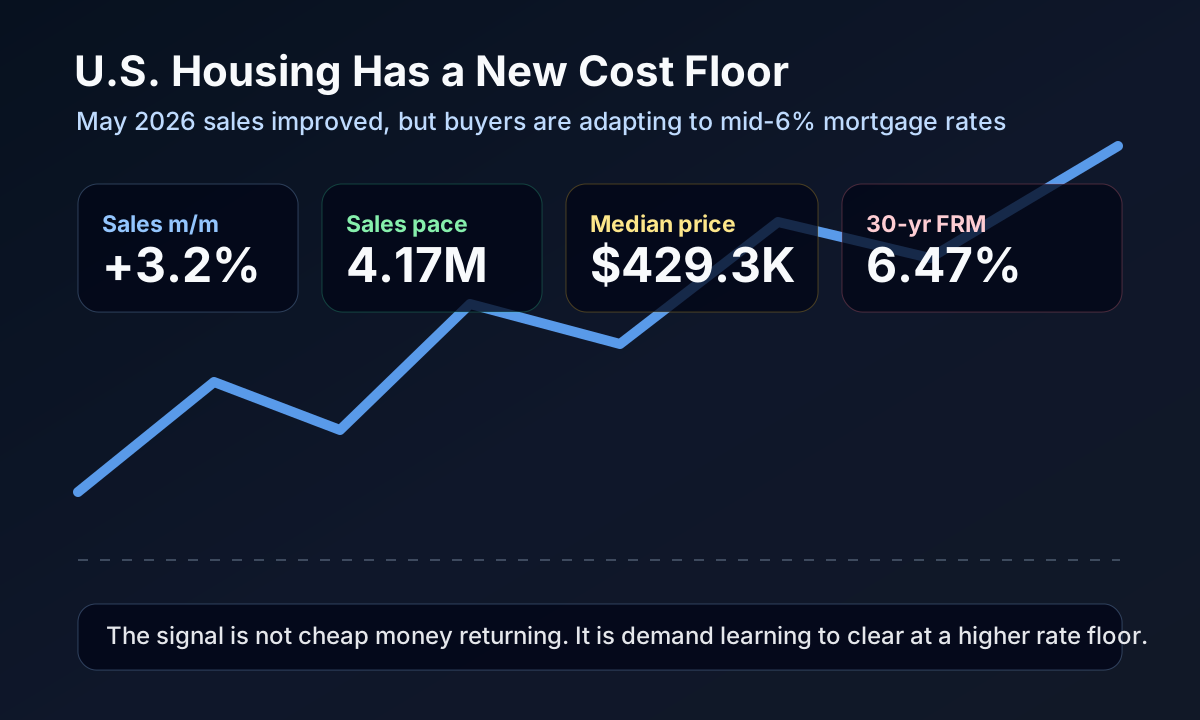
U.S. housing is moving again, but the story is not that cheap money has returned. Existing-home sales rose 3.2% in May 2026, and the sales pace reached 4.17 million annualized units. Place that beside a 6.47% average 30-year fixed mortgage rate and the signal changes: demand did not disappear; more buyers are learning to clear the market with mortgage rates in the mid-6% range.
This is not a call to buy houses or housing stocks. It is a practical read for founders, solo operators, SaaS teams and investors. Housing turnover is a transmission channel into moving services, repairs, furniture, insurance, local advertising, mortgage software and consumer cash flow. If the 6% mortgage becomes a durable cost floor, pricing, hiring, rent pressure and customer budgets need to be recalculated.
Confirmed facts
- The National Association of REALTORS reported that U.S. existing-home sales increased 3.2% month over month in May 2026. Sales rose in the Northeast, Midwest and South, and were unchanged in the West.
- NAR’s May 2026 housing snapshot showed 4.17 million sales, a median sales price of $429,300 and 4.5 months of inventory.
- NAR’s latest pending home sales reading was +3.8%. That index is based on signed contracts for existing single-family homes, condos and co-ops.
- Freddie Mac’s Primary Mortgage Market Survey showed the 30-year fixed-rate mortgage averaged 6.47% as of June 18, 2026, down from 6.52% the prior week and 6.81% a year earlier. The 15-year fixed-rate mortgage averaged 5.81%.
- The Federal Reserve held the target range for the federal funds rate at 3.50% to 3.75% on June 17, 2026.
- On BEA’s PCE price index page, the latest listed April 2026 PCE price index was up 3.8% from a year earlier, with the next release scheduled for June 25, 2026.
Interpretation: adaptation matters more than rebound
The key message is not that housing suddenly became affordable. A more useful read is that some buyers no longer treat 6% mortgage rates as a temporary shock. Owners locked into 3% mortgages still have a strong reason not to move. That keeps inventory turnover constrained and limits how far prices can fall. Yet sales rising anyway suggests that pent-up demand, income growth, life events and local price differences are enough to restart transactions in parts of the market.
This is different from a simple monetary-policy signal. The Fed can hold the policy rate steady while mortgage rates move with long-term yields, inflation expectations, MBS spreads and lending conditions. The cleaner operating assumption for small teams is not “rates will soon rescue affordability.” It is “mid-6% mortgages may remain the base case long enough to shape customer behavior.”
Market narrative: not optimism, a debate about the new normal
The recurring market question is whether buyers are really coming back or simply accepting high prices because inventory is still tight. A second question is where housing-related spending recovers first if 6% mortgages become normal. A third is whether modest housing resilience gives the Fed more room to wait for inflation evidence before easing. These narratives are not confirmed facts, but they are useful signals for interpreting customer behavior.
Housing turnover does not stop at the closing table. A transaction can trigger moving, repairs, security, furniture, insurance, taxes, financing and local services. If transaction volume has passed its worst point, local service demand may respond before national aggregates look strong. The risk is that higher monthly payments crowd out other spending, especially in regions where prices have not adjusted.
| Indicator | Latest signal | Practical read |
|---|---|---|
| Existing-home sales | May 2026 +3.2%, 4.17M annualized | Turnover can lift moving, repair and local-service demand before broad consumer data improves. |
| Median sales price | $429,300 | The adjustment is occurring through buyer budgets, not a clean national price reset. |
| Inventory | 4.5 months | More supply helps, but local scarcity can still limit price relief. |
| 30-year fixed mortgage | 6.47% | Buyers are budgeting around higher payments instead of assuming a quick return to cheap debt. |
Second-order effects for builders and investors
Checklist after this housing print
• Local-service teams: split lead volume, quote conversion and order value by region, not just national traffic.
• B2B SaaS: watch whether real-estate, insurance, lending and home-service customers increase ad spend or demand higher-quality leads.
• Fintech products: rate comparison, refinancing alerts, DTI calculators and full-payment simulations may become more valuable.
• Investors: read housing volume, price, inventory and mortgage rates together; a single headline can mislead.
• Personal finance: treat a 6% mortgage as a real cash-flow constraint, including taxes, insurance and maintenance.
The first effect is local advertising reallocation. In regions where turnover improves, brokers, moving companies, remodelers, insurers and home-service firms may resume buying leads. But under high mortgage rates, lead quality matters more than raw clicks. Small marketing teams should watch ZIP-code-level inventory, income and affordability, not just national housing headlines.
The second effect is rent and labor cost. If some renters move into ownership, rental pressure may ease in pockets. But in markets where prices remain high, rent pressure can persist. Founders hiring distributed teams or running local operations should connect housing affordability to wage demands, churn and commute patterns.
The third effect is rate-cut expectations. If housing activity stabilizes while inflation remains above target, markets may become more careful about assuming aggressive easing. That has second-order implications for growth-stock valuations, long-duration bonds, the dollar and emerging-market funding conditions.
Risks and counterarguments
The main counterargument is that one month does not make a trend. May’s improvement could reflect seasonality, a temporary dip in mortgage rates, regional inventory changes or a release of pent-up demand. Existing-home sales also do not explain the full housing system: new homes, rentals, credit quality and regional affordability can diverge sharply.
The second risk is confusing transaction recovery with household comfort. More closings can happen even when households are accepting heavier monthly payments. That may lift some housing-linked businesses while reducing discretionary spending elsewhere. The confirmed fact is that transactions improved; the interpretation is that the market may be adapting to a higher financing cost floor.
Disclaimer: This article is for informational purposes only and is not financial advice or a recommendation to buy, sell or hold any security, bond, property or financial product. Make investment and housing decisions independently based on your own financial situation and risk tolerance.