
Vercel Services turns full-stack deployment into a service graph
Most products feel like one app to users. Inside the repo, they are often a Next.js frontend, a Python API, a Go worker, a Hono edge service, cron jobs, queues, and a few internal services. Splitting code is not the problem. The problem starts when deployments, previews, rollbacks, logs, and internal calls are owned by different systems, so operational judgment becomes slow and blurry.
What happened
On June 30, 2026, Vercel announced Vercel Services. The changelog and launch post describe a model where multiple frontends and backends can live inside one Vercel Project, share a domain, build together, preview together, and roll back together.
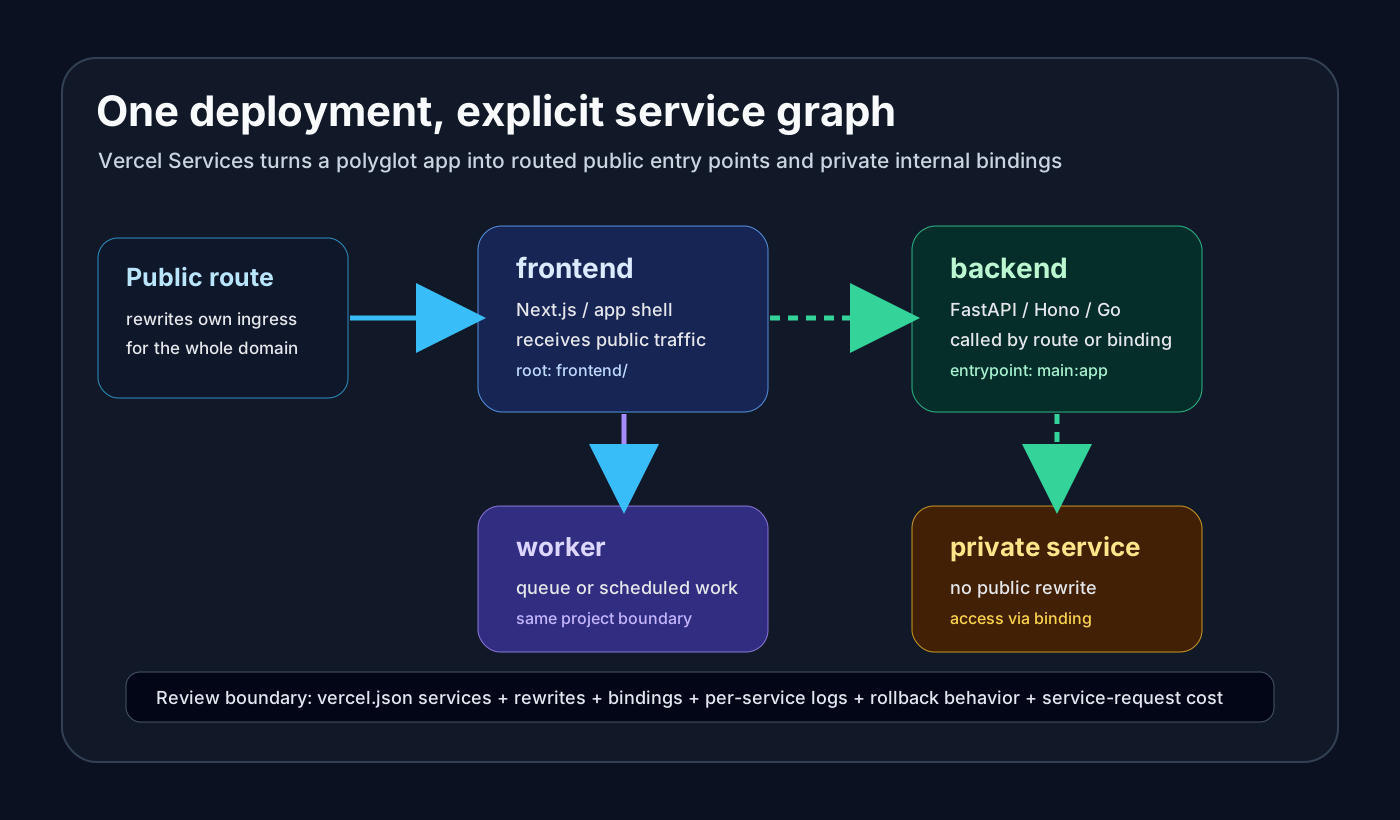
The configuration center is the services key in vercel.json. Each service can define values such as root, framework, entrypoint, runtime, and bindings. Public traffic only reaches a service when a top-level rewrite routes to it. A service without a public rewrite is not directly reachable from the internet.
The second key piece is service binding. A binding lets server-side code in one service call another service without exposing the target service publicly. Vercel generates the URL and grants reachability, and the generated URL is deployment-aware, so a preview service calls the matching service inside the same preview deployment.
Why this matters
Vercel Services is more than “you can run a backend on Vercel.” Many teams already split their system across Vercel for the frontend, another host for APIs, another runtime for workers, and GitHub Actions for scheduled work. That can be flexible, but the product change stops being atomic when preview and rollback boundaries are split.
Services redefine the deployment unit as a service graph rather than a repository folder or a single framework app. If frontend and backend changes build together, appear in the same preview, and roll back together, reviewers can answer a practical question: was this UI change validated against the API change it depends on?
vercel.json therefore becomes more than deployment decoration. It now declares which services are public entry points, which are internal-only, which roots build under which runtimes, and which services may call each other. Code review needs to include services, rewrites, and bindings diffs, not only application code.
Community signal
Next.js developers have debated separate backend servers versus Vercel-hosted backend patterns for years. Reddit discussions around separate backends mention timeouts, cold starts, database pooling, WebSocket support, cron, and platform fit. Those posts are not factual sources for Vercel Services, but they are useful signals about the friction developers want solved.
There is also an opposite signal. Hacker News discussions around Vercel platform trust and past security incidents show a recurring concern: when CI, deployments, secrets, developer tooling, and runtime control concentrate in one platform, the trust boundary becomes more important.
The pragmatic question is not whether Vercel Services is good or bad. It is which service boundaries benefit from one deployment graph, and which boundaries still deserve a separate platform, account, or blast radius.
Engineering and operations impact
The first impact is preview quality. If frontend and backend services share a preview deployment, API contract changes, UI changes, and worker changes can be tested from one environment. But more services also mean preview data, migrations, seed state, and external credentials need stricter rules.
The second impact is routing ownership. Vercel’s Services routing docs say top-level rewrites own public traffic. Requests route to the first matching service and do not fall through to another top-level rewrite if the selected service returns not found. Rule order becomes an operations concern, especially with /api/(.*) and catch-all routes.
The third impact is private communication. Bindings reduce public exposure, but they do not replace authentication. The docs explicitly note that application-level authorization remains the service code’s responsibility. Internal URLs are not the same thing as trust.
The fourth impact is cost visibility. Services pricing treats service-to-service calls as service requests, separate from public internet requests. Teams need to understand how many internal calls a user request creates, because fan-out affects both latency and cost.
The fifth impact is local development. The docs say vercel dev runs services together and injects generated binding environment variables. That can make local work more production-like, but service startup time and dependency orchestration become part of developer experience.
A practical checklist
1. Draw service boundaries by rollback and failure domain, not only by folder structure. If two pieces must roll back together, they likely belong in the same graph.
2. Review every public ingress rule in top-level rewrites. Keep catch-all rules last and test which service receives /api/(.*), static paths, and unknown routes.
3. Use bindings instead of hardcoded internal hostnames. Then add application-level auth anyway, because binding grants reachability, not user or service authorization.
4. Add services, rewrites, bindings, runtime, and entrypoint changes to your PR checklist. Platform diffs need the same review discipline as code diffs.
5. Define preview data rules. A shared preview is only useful if migrations, seed data, external tokens, and test users match the services being validated.
6. Observe service-to-service fan-out. One user request that triggers many internal calls can quietly increase latency and cost.
7. Treat Services as beta. Before moving core production workloads, rehearse routing, binding behavior, logs, rollback, local dev, and cost reporting on a non-critical path.
Risks and counterarguments
The first risk is platform concentration. Putting frontend, backend, workers, and internal services under one project can simplify operations, but it also makes account access, secret policy, and platform availability more consequential. Some systems should stay in a separate account, project, or cloud.
The second risk is confusing network privacy with authorization. A binding keeps a service off the public internet, which is useful. It does not verify tenant, role, job source, replay protection, or business permission.
The third risk is cost surprise. Active CPU and service-request billing can be efficient for some workloads and awkward for others. High fan-out APIs, long-running workers, WebSockets, and container services need real usage modeling.
A fair counterargument is that teams already running Kubernetes, Fly Machines, Cloud Run, or ECS may not need this. Services are most compelling for teams that want full-stack changes to live inside Vercel’s preview, domain, and deployment workflow without splitting every backend into another control plane.
Vercel Services adoption checklist
• 1. Draw service boundaries by rollback and failure domain, not only by folder structure. If two pieces must roll back together, they likely belong in the same graph.
Bottom line
Vercel Services is not just a frontend platform adding backend support. It turns vercel.json into an operating contract for a service graph. Before adopting it, teams should inspect public rewrites, internal bindings, rollback units, cost fan-out, and authorization boundaries. Used well, it makes previews and rollbacks clearer. Used casually, it hides too much operational responsibility in one configuration file.
Sources
- Vercel Changelog: Run multiple frameworks in one project with Vercel Services
- Vercel Blog: Vercel Services - Run full stack on Vercel
- Vercel Docs: Services overview
- Vercel Docs: Services routing
- Vercel Docs: Service bindings
- Vercel Docs: Services pricing and limits
- Reddit discussion: separate backend server vs Vercel functions
- Hacker News discussion: platform trust and Vercel security incident