
VS Code Agents window e BYOK: ai team serve un modello operativo per gli agenti
Gli aggiornamenti recenti di VS Code indicano un cambio di fase: Agents window, BYOK, sessioni remote, browser integrato e sicurezza del terminale stanno diventando un unico workflow agentico.
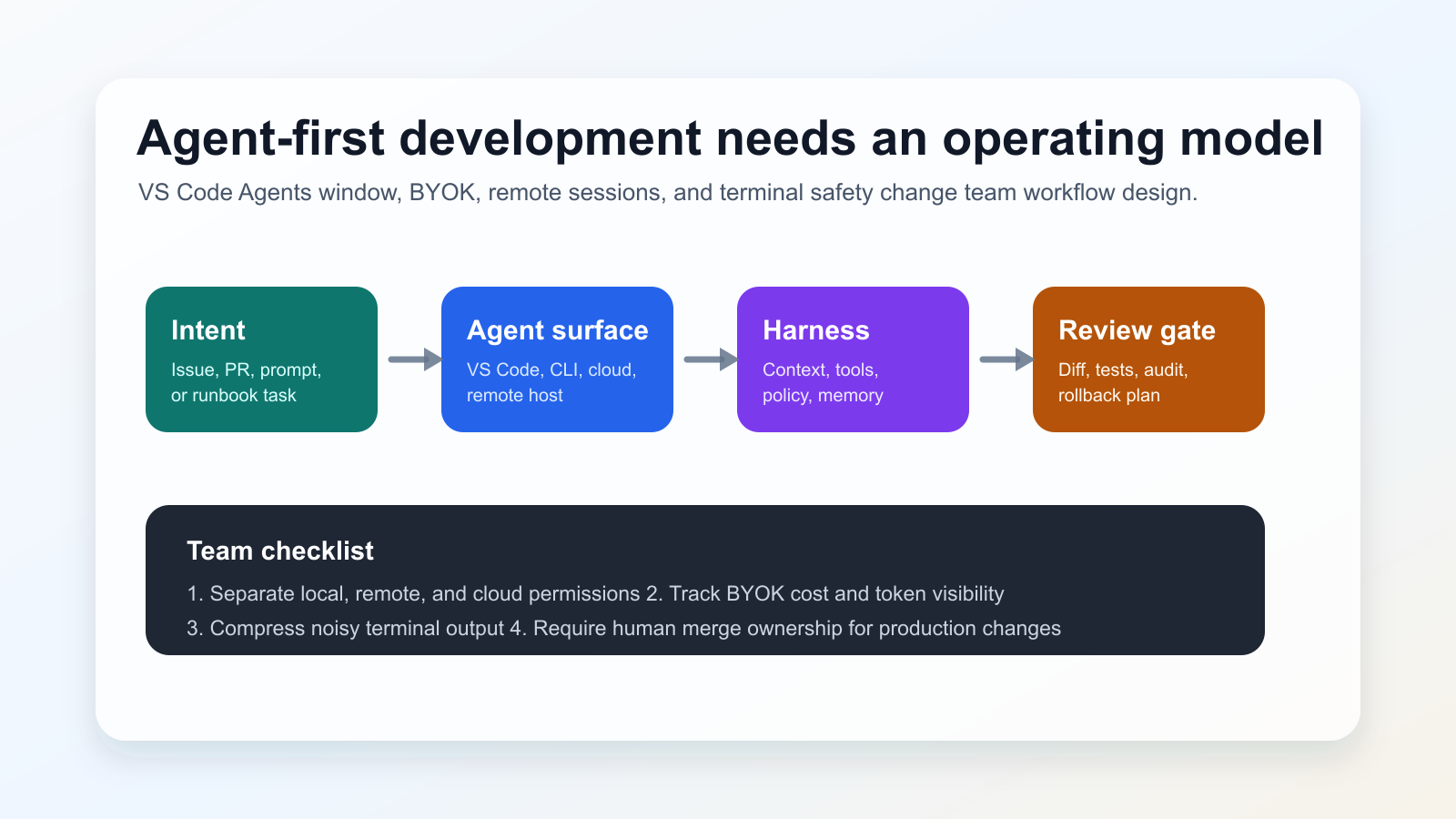
Cosa è cambiato
GitHub’s June 3, 2026 changelog groups VS Code v1.120-v1.123 updates: Agents window in Stable preview, remote agents, Agent Host Protocol work, BYOK improvements, terminal output compression, risk assessment, and the VSCODE_AGENT environment variable. VS Code 1.122 also moves the Custom Endpoint provider into Stable and improves browser-based debugging support.
Perché conta
Non conta solo il modello. Il harness decide contesto, strumenti, permessi, esecuzione e feedback. Per questo gli agenti vanno governati come parte della piattaforma di sviluppo.
Segnale dalla community
Developer discussions around VS Code 1.122 and local-model workflows show interest in BYOK and custom endpoints, but also concern about cost predictability, account policies, connectivity, and how much work should be delegated. These discussions are used here only as signals; factual claims rely on the official links below.
Checklist pratica
- Distinguere agenti locali, remoti e cloud.
- Documentare BYOK, costi, dati e fallback.
- Rendere visibili comandi e diff generati.
- Mantenere ownership umana del merge.
Rischi
The main risk is over-delegation: long remote or cloud sessions can amplify unclear requirements. BYOK also increases operational responsibility because every provider adds policy, logging, quality, and failure-mode questions. Blocking all agent workflows is rarely practical, so teams need clear boundaries instead.
Fonti
- GitHub Changelog: GitHub Copilot in Visual Studio Code, May releases
- Visual Studio Code 1.122 release notes
- VS Code documentation: Use the Agents window
- VS Code documentation: Using agents in Visual Studio Code
- VS Code Blog: The Coding Harness Behind GitHub Copilot in VS Code
- Community signal: VS Code 1.122 discussion on r/GithubCopilot
- Community signal: local model and Agents window discussion on r/LocalLLaMA