
Онлайн-расходы США 16,9%: рост реален, но ценовую иллюзию нужно убрать
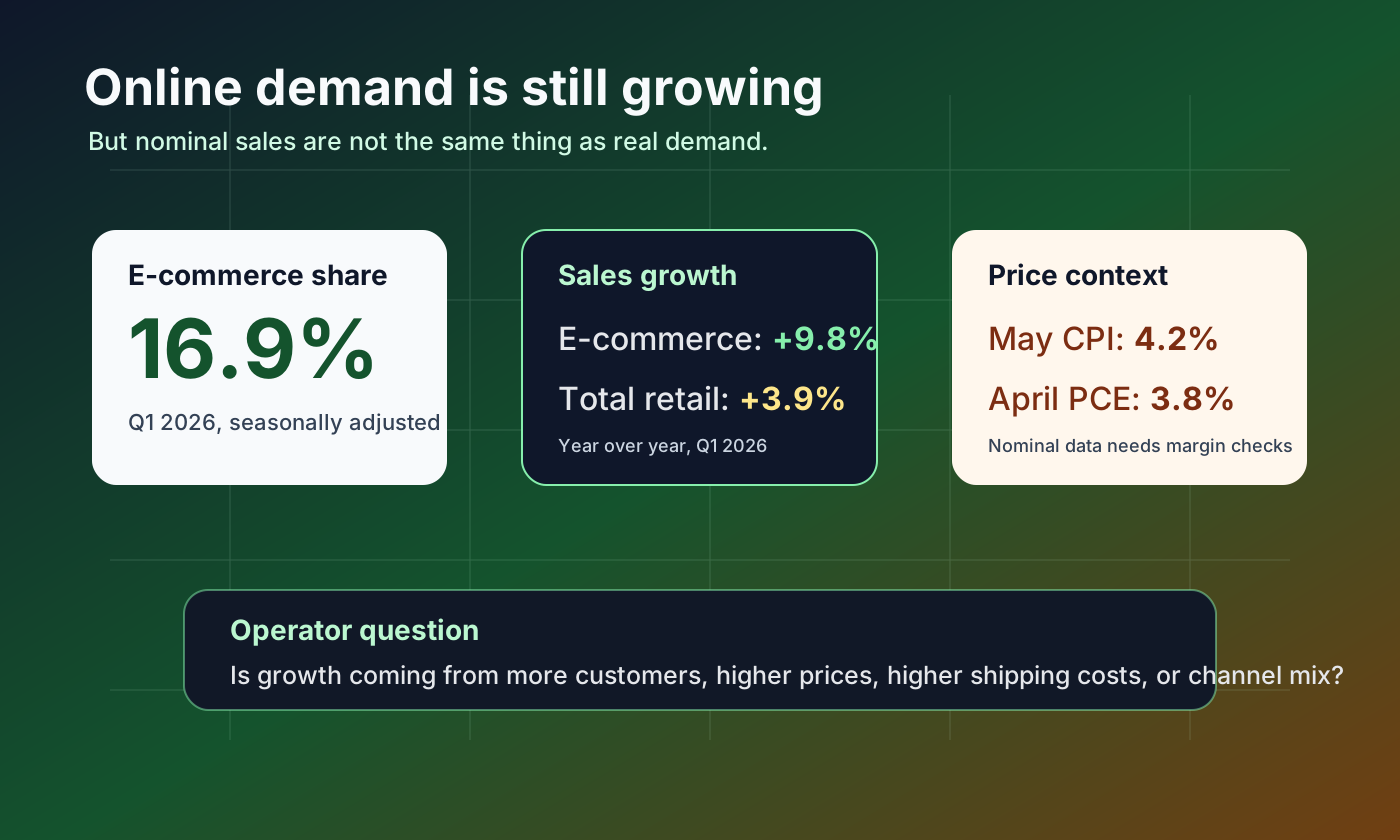
The U.S. consumer is not sending a single signal. Census reported Q1 2026 retail e-commerce sales of $326.7 billion, up 9.8% from a year earlier, with e-commerce at 16.9% of total retail sales.
But these are nominal sales, not adjusted for price changes. With May CPI at 4.2% and April PCE inflation at 3.8%, part of the growth may come from price, shipping, fees, or currency rather than more real demand.
Подтвержденные факты
- Census: Q1 e-commerce sales were $326.7 billion, up 9.8% year over year.
- Total retail sales were $1.929 trillion, up 3.9% year over year.
- E-commerce represented 16.9% of total retail sales, seasonally adjusted.
- April retail and food services sales were $757.1 billion, up 4.9% year over year; nonstore retail was up 11.1%.
- May retail sales are scheduled for release on June 17, 2026, at 8:30 a.m. ET.
- BLS: May CPI rose 4.2% year over year. BEA: April PCE prices rose 3.8%.
- The June FOMC meeting is scheduled for June 16-17, 2026.
Таблица решений
| Signal | Meaning | Action |
|---|---|---|
| E-commerce share: 16.9% | Channel shift is real | Recalculate logistics, payment fees, returns, and ad payback |
| E-commerce +9.8% vs total retail +3.9% | Online is outgrowing total retail | Do not assume every platform captures the same margin |
| CPI 4.2% and PCE 3.8% | Nominal sales can overstate real demand | Separate price, volume, shipping, and FX effects |
| May retail release on June 17 | Next data point can move rate and demand narratives | Read category mix before reacting to the headline |
Интерпретация
The online channel remains strong: 9.8% e-commerce growth is far above 3.9% total retail growth.
Nominal sales do not separate price from volume; inflation means some growth may be price and shipping pass-through.
Small teams should watch contribution margin, because ad costs, returns, payment fees, cloud bills, and AI inference costs can rise with sales.
Сигналы рынка и сообщества
Market notes and founder communities are mixing three narratives: the consumer is not dead, lower-income consumers are under pressure, and AI search or marketplaces are changing ad efficiency. Treat them as questions to test, not as facts.
Вторичные эффекты
- The better operating assumption is channel and basket change, not consumer collapse.
- A higher e-commerce share means logistics, payments, returns, and ad leverage need another look.
- A strong May retail print may cool rate-cut hopes; a weak one may amplify demand-slowdown narratives.
- Non-U.S. teams with dollar costs may feel FX and billing pressure first.
Чеклист для малых команд и инвесторов
•Split the last 90 days of revenue into price, orders, average order value, shipping pass-through, and FX.
•Measure ad spend by contribution-margin payback per new customer.
•Calculate free shipping, returns, and coupon impact by SKU or plan.
•For AI features, place inference cost and conversion lift in the same table.
•After the May retail release, separate nonstore retail, food services, autos, and gasoline.
Контраргументы и риски
The counterargument is clear: e-commerce is still only one slice of retail, Q1 estimates are preliminary, and channel growth does not guarantee margin expansion for any platform or retailer. The point is to separate nominal sales, real demand, and margin.
Отказ от ответственности
This article is informational economic and business commentary, not financial advice.
Источники
- U.S. Census Bureau, Quarterly Retail E-Commerce Sales, 1Q 2026
- U.S. Census Bureau, Advance Monthly Retail Trade Report, April 2026
- U.S. Census Bureau, Monthly Retail Trade release schedule
- U.S. Bureau of Labor Statistics, Consumer Price Index, May 2026
- U.S. Bureau of Economic Analysis, PCE Price Index
- Federal Reserve, FOMC meeting calendars and information
- FRED, E-Commerce Retail Sales as a Percent of Total Sales