
Fed’in yeni enflasyon değişkeni: AI yatırımı maliyet tabanını yükseltiyor
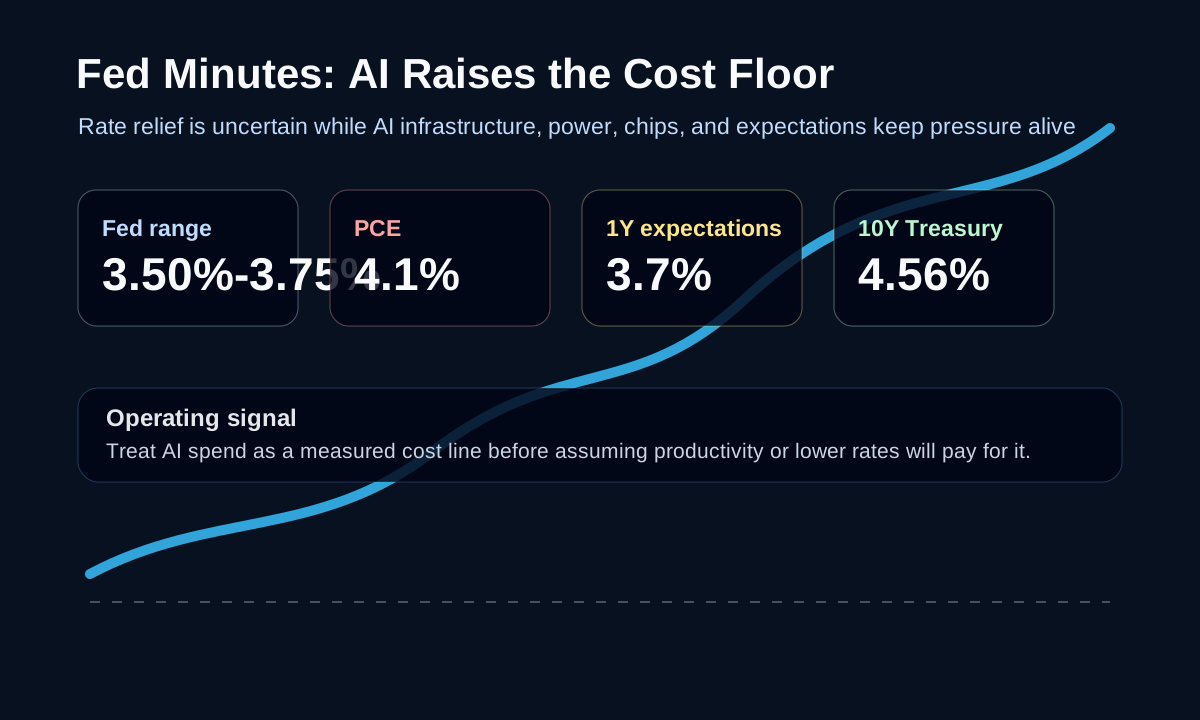
Pratik sinyal faiz indirimi beklemek değil. AI altyapı talebi, verimlilik marja yansımadan önce elektrik, çip, bulut ve ekipman maliyetlerini yükseltebilir.
Confirmed facts: the vote was unanimous, but the cost map widened
- The Fed kept the federal funds target range at 3.50%-3.75% on June 17, 2026, and the decision was approved by a 12-0 vote.
- The minutes released on July 8 cited April PCE inflation of 3.8% and core PCE inflation of 3.3%. Based on CPI and PPI data available at the meeting, staff estimated May PCE at 4.1% and core PCE at 3.4%; BEA’s May pages now show those same year-over-year readings.
- The BLS May CPI report showed headline CPI at 4.2% year over year and the energy index up 23.5%. The June CPI release is scheduled for 2026-07-14.
- The June SEP moved the 2026 median federal funds rate projection to 3.8%, the 2026 PCE inflation median to 3.6%, and the core PCE median to 3.3%.
- The New York Fed’s June Survey of Consumer Expectations showed one-year inflation expectations at 3.7%, three-year expectations at 3.3%, and five-year expectations unchanged at 3.0%.
- The U.S. Treasury daily curve showed the 2-year yield at 4.21% and the 10-year yield at 4.56% on July 8, 2026.
| Signal | Latest | Operating read |
|---|---|---|
| Fed target range | 3.50%-3.75% | Policy relief has not arrived |
| 2026 SEP funds median | 3.8% | Higher than the current midpoint |
| May PCE / core PCE | 4.1% / 3.4% | The Fed’s preferred inflation gauge is still high |
| NY Fed 1Y / 3Y expectations | 3.7% / 3.3% | Expectations risk is not only an energy story |
| 10Y Treasury, Jul 8 | 4.56% | Long rates keep funding costs elevated |
Interpretation: AI is a cost story before it is a productivity story
The headline fact is simple: the Fed held rates steady. The operating signal is more complicated. Officials were not only debating tariffs, energy, and Middle East supply risk. The minutes also treated AI infrastructure demand as a source of upward pressure on technology products and electricity.
That matters because AI tools are not only productivity assets. They are also invoices. API calls, GPU instances, cloud commitments, data-center power, high-performance memory, networking equipment, and engineering time hit cash flow before the productivity gain is easy to measure.
Investors need the same separation. AI capex can lift revenue for chip, power, cloud, and infrastructure companies. The same boom can also keep discount rates elevated if it supports inflation and pushes expected policy rates higher. Strong earnings and a higher cost of capital can exist at the same time.
The minutes also underline a credit split. Financing remained generally available for larger businesses, while conditions were tighter for many small businesses and lower-score households. AI bond issuance by large companies does not make a small team’s working-capital line cheaper.
Market narrative: strong AI earnings and sticky inflation can coexist
The market narrative is split between a long-run productivity story and a near-term cost story. The optimistic version says AI adoption eventually expands supply and reduces unit costs. The harder version says electricity, chips, equipment, rent, and labor can rise before that productivity benefit shows up.
The minutes are important because they keep both ideas alive while separating the timing. Productivity may arrive later; invoices arrive this quarter. Operators should not respond by cutting every AI tool. They should concentrate usage where ROI is visible and cap experimentation elsewhere.
Rates follow the same logic. Waiting for lower rates before repairing the cost structure is a weak plan. The June SEP moved the median 2026 policy rate higher than in March, while short- and medium-term inflation expectations rose. Lower-rate assumptions should not be the default operating case.
Second-order effects small teams may feel first
| AI tool budgets | Experimental API calls, duplicate SaaS seats, and idle credits become cash leakage when rates stay high. |
| Power and infrastructure costs | Data-center and high-performance computing demand can feed later into cloud pricing and contract terms. |
| B2B pricing | Customers face the same pressure. Price increases work better when tied to usage, automation savings, or lower support costs. |
| Portfolios | AI revenue growth must be weighed against free cash flow, leverage, power exposure, and valuation sensitivity to higher yields. |
This week’s operating checklist
• Split AI and cloud spend into direct revenue contribution, internal productivity, and experimentation; put a monthly cap on experimentation.
• Put fixed-rate debt, floating-rate debt, card payment dates, and annual SaaS renewals into one cash-flow calendar.
• Test price changes tied to usage, AI features, or premium support before broad price increases.
• For investments, review free cash flow, net debt, power contracts, chip supply exposure, and data-center commitments alongside AI revenue growth.
• Track rates, FX, failed payments, and cloud usage around 2026-07-14 CPI, the 2026-07-28/29 FOMC meeting, and 2026-07-30 PCE.
Risks and counterarguments
The counterargument is real: AI adoption can eventually raise productivity and lower unit costs. The minutes also acknowledge that productivity gains could expand aggregate supply over time.
Inflation may cool if energy prices and Middle East supply risks ease. The New York Fed survey even showed lower gas-price expectations. It would be too strong to treat AI demand alone as a guaranteed rate-hike trigger.
The practical risk is timing. Small teams do not pay bills with eventual productivity. Until the gain is visible in margins, assume the cost floor is higher and manage runway accordingly.
Disclaimer: Bu içerik bilgilendirme amaçlıdır ve finansal tavsiye değildir.
Kaynaklar
- Federal Reserve, Minutes of the June 16-17 2026 FOMC Meeting
- Federal Reserve, FOMC Statement, June 17 2026
- Federal Reserve, June 2026 Summary of Economic Projections
- Federal Reserve Bank of New York, June 2026 Survey of Consumer Expectations
- U.S. Bureau of Labor Statistics, Consumer Price Index, May 2026
- U.S. Bureau of Economic Analysis, PCE Price Index, May 2026
- U.S. Bureau of Economic Analysis, Core PCE Price Index, May 2026
- U.S. Treasury, Daily Treasury Par Yield Curve Rates, July 8 2026
- Associated Press, Fed minutes inflation split and AI infrastructure context