
Cảnh báo tăng trưởng 2,5%: ưu tiên dòng tiền trước dự báo doanh thu
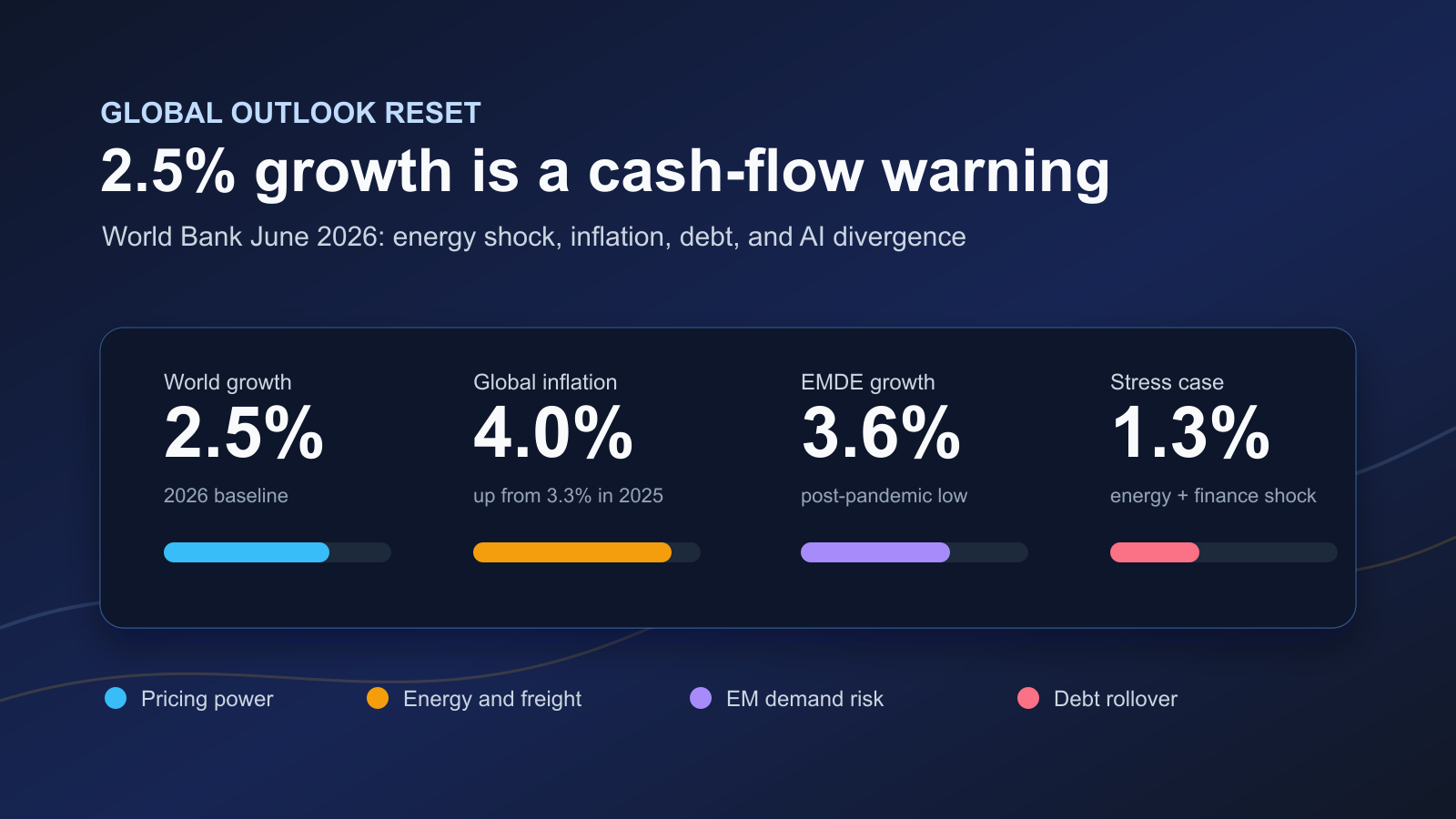
Tăng trưởng thấp hơn có nghĩa là nhu cầu phân hóa, trong khi chi phí năng lượng, logistics, cloud, thanh toán và AI có thể tăng trước khi doanh thu giảm rõ ràng.
Confirmed Facts
- World Bank forecasts 2.5% global growth in 2026, down from 2.9% in 2025.
- Emerging market and developing economy growth is projected to slow from 4.4% in 2025 to 3.6% in 2026.
- Global inflation is expected to rise from 3.3% in 2025 to 4.0% in 2026.
- The downside scenario puts global growth at 1.3% if energy disruptions and financial stress intensify.
- EIA expects Brent crude to average $105 per barrel in June and July under near-term shipping constraints.
| Metric | Previous base | New signal | Meaning |
|---|---|---|---|
| World GDP growth | 2.9% in 2025 | 2.5% in 2026 | World Bank baseline |
| Global inflation | 3.3% in 2025 | 4.0% in 2026 | renewed energy pressure |
| EMDE growth | 4.4% in 2025 | 3.6% in 2026 | post-pandemic low |
| Downside growth case | baseline 2.5% | 1.3% in 2026 | energy disruption plus financial stress |
| Brent oil | 2026 avg. $94/bbl | June-July $105/bbl | World Bank baseline and EIA STEO |
| Euro area growth | 1.4% in 2025 | 0.8% in 2026 | World Bank table |
| Japan growth | 1.1% in 2025 | 0.7% in 2026 | World Bank table |
| U.S. growth | 2.1% in 2025 | 2.2% in 2026 | AI and energy resilience |
Interpretation: the cash-flow order matters more than the headline growth number
For operators, the useful interpretation is cash-flow sequencing. Costs can reset before customers formally reduce spending: cloud commitments, AI API usage, payments, freight, advertising, and imported software are often repriced faster than revenue plans.
AI remains an upside in the report, but the benefit is uneven. Teams with infrastructure, data, capital, and procurement power can turn AI into productivity. Small teams should treat AI as a priced workflow and cap usage where customer value is not explicit.
Market and Community Narrative Signals
The market narrative is shifting from quick rate cuts to a longer period of sticky inflation and selective growth. Central banks must balance weaker activity against renewed energy pressure, while businesses must decide how much cost can be passed to customers.
Danh sách kiểm tra
• Tách doanh thu theo khu vực và tiền tệ.
• Tính lại chi phí cloud, AI API, quảng cáo, thanh toán và logistics.
• Giới hạn tính năng AI miễn phí nếu chi phí biến động lớn.
Rủi ro và phản biện
The optimistic case is still possible: energy supply can normalize, inflation can cool, and AI investment can lift productivity. The practical risk is building a budget that only works in that optimistic path.
Disclaimer
Bài viết chỉ nhằm cung cấp thông tin kinh tế và không phải lời khuyên tài chính.
Nguồn
- World Bank: Global Economic Prospects June 2026 press release
- World Bank: Global Economic Prospects report site
- World Bank: Chapter 1 highlights, The Global Outlook
- U.S. EIA: Short-Term Energy Outlook, June 2026
- European Central Bank: Monetary policy decisions, 11 June 2026
- Federal Reserve: 2026 FOMC meeting calendar
- AP: World Bank lowers global growth forecast, used as market narrative signal