
NVIDIAs Zahlen zeigen die neue Ökonomie der KI-Infrastruktur
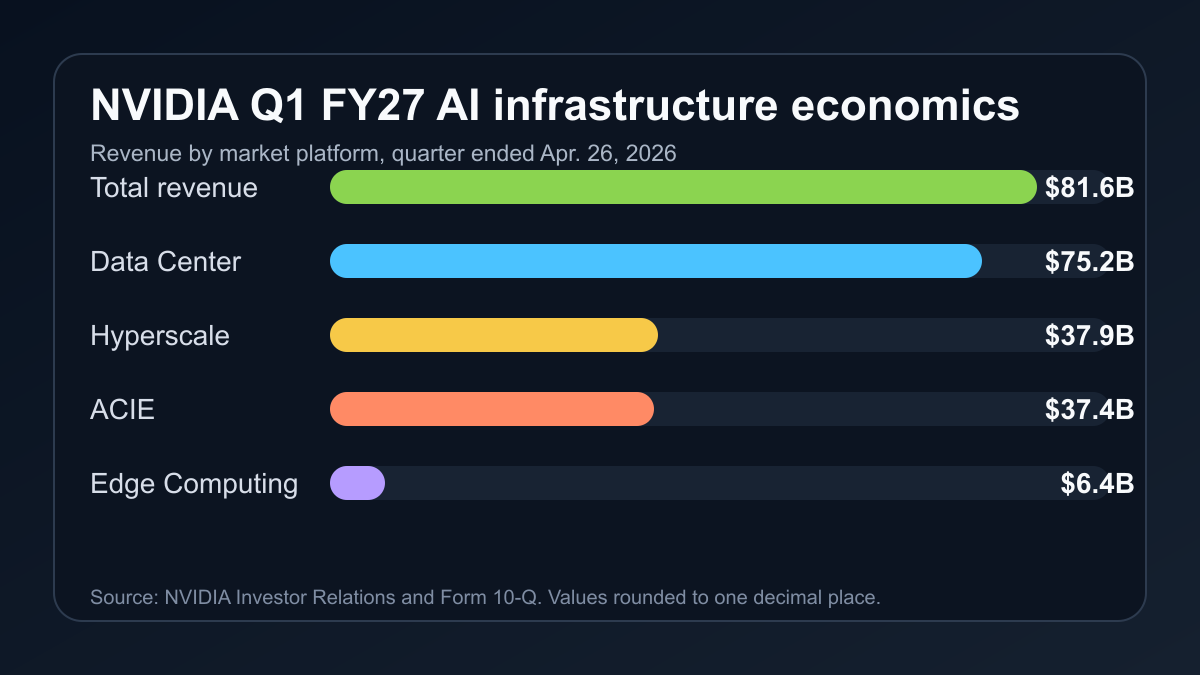
NVIDIA meldete für das am 26. April 2026 beendete Quartal 81,615 Milliarden US-Dollar Umsatz. Der Data-Center-Umsatz lag bei 75,246 Milliarden US-Dollar; innerhalb davon entfielen 37,869 Milliarden US-Dollar auf Hyperscale und 37,377 Milliarden US-Dollar auf ACIE.
Confirmed facts
- NVIDIA meldete für das am 26. April 2026 beendete Quartal 81,615 Milliarden US-Dollar Umsatz. Der Data-Center-Umsatz lag bei 75,246 Milliarden US-Dollar; innerhalb davon entfielen 37,869 Milliarden US-Dollar auf Hyperscale und 37,377 Milliarden US-Dollar auf ACIE.
- NVIDIA also disclosed GAAP gross margin of 74.9%, operating cash flow of $50.344 billion, and a Q2 FY2027 revenue outlook of $91.0 billion plus or minus 2%.
- The Form 10-Q reported three direct customers representing 21%, 17% and 16% of total quarterly revenue.
Interpretation
Die wichtigste Lesart ist nicht nur „mehr GPUs“. KI-Infrastruktur wird zu einem Preissystem für Software. Wenn Cloud-Anbieter Kapital langfristig binden, taucht dieser Aufwand später in API-Preisen, Mindestabnahmen, Nutzungslimits und höheren SaaS-Tarifen wieder auf.
The community narrative around the results focused on the stock reaction, the expanded dividend and buyback authorization, and the fact that China Data Center compute revenue was excluded from the outlook. Those discussions are used here only as signals of market questions, not as sources for the financial numbers.
Checklist
- Teams sollten KI-Kosten pro Feature messen, Modell-Routing früh bauen, keine unbegrenzten KI-Versprechen ohne Kostenkontrolle geben und Cloud-Verträge nicht nur nach Listenpreis, sondern nach Bindung, Credits und Kündigungsregeln bewerten.
- Watch whether AI usage growth outpaces hardware efficiency gains.
- Compare revenue growth with concentration, working capital, inventory and regulatory exposure.
Risks
Der Gegeneinwand bleibt wichtig: Mehr Angebot, effizientere Modelle oder eigene Chips großer Kunden können Preise senken. Außerdem ist offen, wie viel Nachfrage dauerhaft zahlende Endkundennachfrage ist und wie viel strategischer Vorabkauf.
Disclaimer: Dieser Beitrag dient nur der Information und ist keine Finanzberatung oder Empfehlung zum Kauf, Verkauf oder Halten eines Wertpapiers.