
AI SDK 7 HarnessAgent: Coding Agents Are Becoming Swappable Runtimes
For the last few years, the comfortable abstraction in AI application development has been the model provider. If the team could switch from OpenAI to Anthropic, or route both through an internal gateway, the architecture felt portable enough. Coding agents change that boundary. Once an agent edits files, runs commands, holds sessions, asks for permission, and works inside a sandbox, the model call is no longer the whole runtime.
On June 12, 2026, Vercel announced HarnessAgent in AI SDK 7. The feature introduces a unified API for running established coding-agent harnesses such as Claude Code, Codex, and Pi. The practical signal is bigger than a new package name: engineering teams are moving from model abstraction toward harness abstraction.
What changed
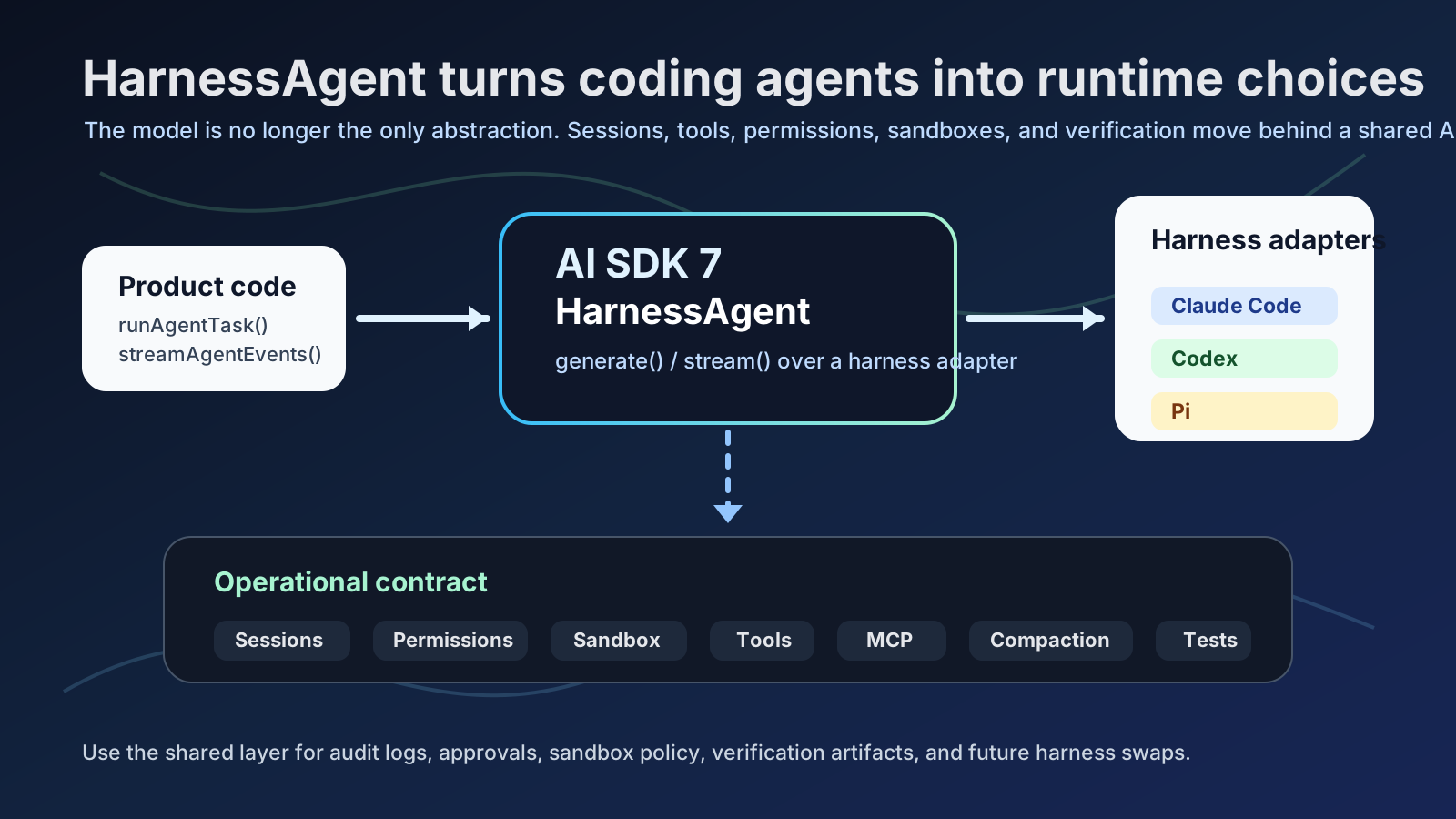
Vercel describes harnesses as the components above a model call: skills, sandboxes, sessions, permission flows, compaction, runtime configuration, and sub-agents. HarnessAgent gives developers generate() and stream() style access backed by a harness adapter, with initial experimental adapters for Claude Code, Codex, and Pi.
This matters because the AI SDK has already become a common TypeScript layer for provider-agnostic model calls, tool usage, streaming, and UI integrations. AI SDK 7 starts pulling the coding-agent execution layer into the same design conversation. It is not a signal to rewrite production workflows overnight; it is a signal to stop treating agent runtimes as one-off integrations.
Why working developers should care
A coding agent is not just a chatbot with better prompts. It reads repositories, modifies files, installs dependencies, executes tests, and may interact with browsers or deployment infrastructure. Once those actions become common, the primary decision is no longer only which model has the best coding benchmark. The sharper question is which runtime contract your organization can govern.
If harness abstraction matures, product teams can preserve a single approval UI, audit log, queue, and verification pipeline while swapping Claude Code, Codex, or another harness behind the scenes. The abstraction will only be as good as each adapter's capability coverage, but the architectural direction is clear: agent execution needs a stable boundary.
| Decision area | Model abstraction | Harness abstraction |
|---|---|---|
| What changes | OpenAI, Anthropic, Google, or another model provider | Claude Code, Codex, Pi, or another coding-agent runtime |
| Main concern | I/O shape, streaming, cost, latency | Sessions, filesystem, terminal execution, permissions, sandboxes, compaction |
| Operational risk | Model quality and cost variance | A tool-using agent creates real changes in code and infrastructure |
| Validation layer | Prompt evals and response samples | Tests, diffs, secret scanning, dependency checks, policy logs |
Community signals
The demand existed before the changelog. A Vercel Community thread about OpenHarness framed the need for a code-first SDK that can handle AGENTS.md, agent skills, MCP servers, subagents, and session management. That discussion is not a factual source for the Vercel release; it is useful evidence of what practitioners are trying to compose by hand.
GitHub's recent direction points to the same operational layer. Copilot cloud and local sandboxes emphasize isolation and policy controls for agentic tool execution. Enterprise-managed plugins in VS Code bring MCP configuration, hooks, and custom agents under organization-level management. Different vendors, same pressure: the next bottleneck is not agent excitement, but agent operations.
Expected development and operations impact
Internal developer platforms should treat coding agents as runtimes, not just UI features. Task creation, approval, logs, retries, cancellation, and verification need their own domain model. If your app streams raw vendor events directly into UI state, every harness change becomes a product migration. A small adapter layer now can save a larger rewrite later.
Security and platform teams also need a richer vocabulary. Allowing a model is not the same as allowing a harness to run shell commands in a repository. Policies should define filesystem scope, network access, secret handling, dependency installation, sandbox persistence, and what must be proven before a human reviews or merges the result.
Practical checklist
• Wrap harness calls behind product-level methods such as runAgentTask, streamAgentEvents, and approveToolCall.
• Split permissions for file edits, shell commands, network access, package installation, and deployment actions.
• Define sandbox defaults by task type: local versus cloud, network restrictions, persistent storage, and allowed ports.
• Require verification artifacts on agent-authored pull requests: tests, dependency diffs, secret scanning, CodeQL or equivalent analysis.
• Evaluate cost and quality at the harness level, not only at the model level; context management and tool policy can change outcomes.
• Keep experimental or canary APIs behind an adapter until the event model and permission semantics stabilize.
Risks and counterarguments
The obvious risk is premature standardization. Coding-agent harnesses are still changing quickly, and shared semantics for events, permissions, sandboxes, and sub-agents are not settled. Treat HarnessAgent as an experiment boundary first, not as a long-term contract you cannot revise.
The second counterargument is that harnesses are intentionally different. One may excel at IDE work, another at asynchronous cloud sessions, another at enterprise policy. A common API can erase useful differences if it only exposes the lowest common denominator. A pragmatic design keeps the core lifecycle common while exposing unique features through capability flags or optional extensions.
What to do now
Do not start with a large migration. Update your internal agent architecture notes so they separate model, harness, sandbox, permission, and verification concerns. Pick one internal tool and pilot HarnessAgent or a similar adapter layer around it. The goal is not to bet on a single package; it is to make your product and operations code less fragile when the preferred coding agent changes.
The short version: AI SDK 7 HarnessAgent is experimental, but the direction is practical. The next abstraction layer for AI developer tools is not the model. It is the harness that turns model output into real work.
Sources
- Vercel changelog: Program Claude Code, Codex, Pi and other agent harnesses with AI SDK
- AI SDK docs: HarnessAgent
- Vercel AI SDK GitHub repository
- AI SDK docs: Getting Started with Coding Agents
- Vercel guide: How to build AI Agents with Vercel and the AI SDK
- GitHub changelog: Cloud and local sandboxes for GitHub Copilot
- GitHub changelog: Enterprise-managed plugins in VS Code
- Vercel Community: OpenHarness discussion