
The Bank of England Held, but the Cost Floor Moved Up
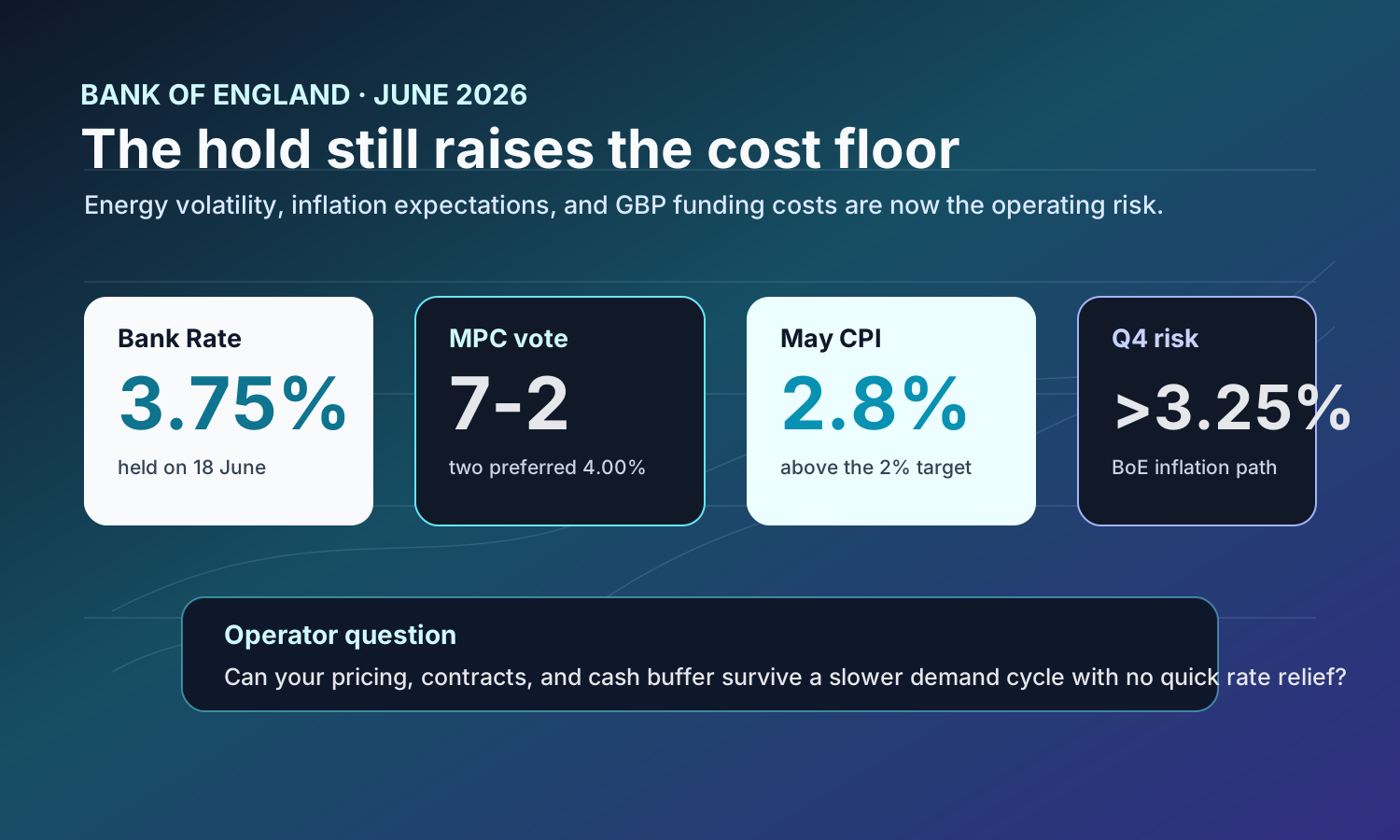
The Bank of England kept Bank Rate at 3.75% on 18 June. The headline sounds like relief: no hike. The minutes are less comfortable. Energy prices have fallen from the spike, but they remain above pre-conflict levels; market rates and lending rates have already moved higher; and two of nine MPC members wanted to raise Bank Rate to 4.00% immediately.
For small teams and investors, this is not only a UK macro story. If you pay for GBP software, sell to London customers, buy European ads, invoice in pounds, or hold UK rate-sensitive assets, the useful question is not “did the central bank hike?” It is “can the plan survive a longer period with no quick rate relief?” This article separates confirmed facts from interpretation using the BoE minutes and ONS data.
Confirmed Facts
- The MPC voted 7-2 to maintain Bank Rate at 3.75% at the meeting ending 17 June 2026. Megan Greene and Huw Pill preferred a 25bp increase to 4.00%.
- The BoE said global energy prices had fallen since the previous meeting, but remained above pre-conflict levels and volatile.
- The minutes said Brent crude and UK wholesale gas had averaged about $100 per barrel and 116 pence per therm since the April Monetary Policy Report; immediately before the June meeting they had fallen to around $79 and 100 pence.
- ONS reported May CPI inflation at 2.8% year over year, unchanged from April; CPIH was 3.0%. Both remain above the BoE’s 2% target.
- The BoE expected CPI to be a little below 3% in Q3 2026 and a little above 3.25% in Q4 as energy effects continued to pass through.
- ONS estimated the UK unemployment rate at 4.9% for February to April 2026. The BoE described the labour market as gradually loosening.
- The BoE said UK two-year OIS rates were around 70bp above pre-war levels; quoted two-year fixed mortgage rates were around 80bp higher; UK investment-grade corporate bond yields were around 50bp higher.
Operating Decision Table
| Signal | Meaning | Action |
|---|---|---|
| Bank Rate 3.75% | No cut relief yet | Re-price borrowing, runway, and annual contracts without assumed cuts |
| 7-2 MPC vote | Some policymakers wanted tighter policy now | Treat “hold” as optionality, not a dovish pivot |
| CPI 2.8%, Q4 risk >3.25% | Inflation can re-accelerate through energy pass-through | Stress-test pricing and wage/contract escalation clauses |
| OIS +70bp, mortgage +80bp, IG yields +50bp | Financial conditions already tightened | Watch customer payment terms and refinancing windows |
Interpretation: a hold is not easing when the cost floor has moved
First, a hold is not easing. If markets remove the expected path of cuts, the actual funding environment tightens even when the policy rate does not change. Operators feel that through working-capital rates, card costs, delayed customer payments, renewal negotiations, and risk premiums before they feel it in an abstract central-bank headline.
Second, the energy shock is not just an oil-price story. The BoE can look through direct energy effects, but it cannot ignore second-round effects if higher costs become embedded in wages and prices. For operators, the same shock can touch SaaS subscriptions, freight, ads, office power, travel, data-center costs, and customer budgets.
Third, the UK is a compact version of a broader global rates problem. The Fed, ECB, and BoJ are all balancing inflation, energy, wages, and currency channels. The 7-2 BoE vote shows that “cuts are coming soon” is no longer the clean base case markets were using before the shock.
Market Narrative Signals
The market narrative inside the official minutes is clear. The June Market Participants Survey median expected Bank Rate to remain unchanged at this meeting and over the year ahead, a roughly 50bp tightening versus the pre-conflict path that had expected cuts. The short-rate curve still sloped upward into year-end 2026, and BoE staff interpreted much of that gap as risk premium rather than pure expected policy rates. Markets are not just pricing a hold. They are pricing uncertainty compensation.
Second-Order Effects
- Teams with GBP revenue may see budget freezes and longer procurement before they see headline demand collapse.
- B2B SaaS renewals into UK and European accounts may face discounting, seat reductions, and longer payment terms.
- Commerce, hardware, and content teams exposed to energy and freight should prioritize cash-conversion cycle over headline gross margin.
- Investors looking at UK banks, REITs, retailers, and utilities should separate deposit costs, refinancing walls, rent pass-through, and arrears risk.
- A weaker or volatile pound can lower some GBP expenses for foreign teams while also signaling weaker customer purchasing power.
Checklist for Small Teams, Builders, and Investors
•Separate GBP and EUR costs by month, then run 5%, 10%, and 15% FX and fee stress tests.
•Map UK and European contracts by renewal month, payment term, refund clause, and price-increase language.
•Measure ads and cloud spend by gross-margin payback, not only as a percentage of revenue.
•Remove assumed rate cuts from hiring, contractor, and annual software commitments before approving them.
•For UK rate-sensitive assets, review debt maturities and refinancing spreads before relying on dividend yield.
•Before the 30 July BoE meeting, update CPI, wage data, energy futures, the OIS curve, and UK PMI together.
Counterarguments and Risks
There is a real counterargument. May CPI at 2.8% is below March’s 3.3%, and the ONS release showed downside news in food and goods. If labour-market slack continues to build and energy prices keep falling, the case for another hike weakens. But for small teams, risk management should start from surviving delayed cuts, not from celebrating that the hike did not happen.
Disclaimer
This article is informational economic and market commentary, not financial advice. It does not recommend buying, selling, or holding any specific asset.
Sources
- Bank of England, June 2026 Monetary Policy Summary and Minutes
- Bank of England, Interest rates and Bank Rate latest decision
- ONS, Consumer price inflation, UK: May 2026
- ONS, Labour market overview, UK: June 2026
- ONS, GDP monthly estimate, UK: April 2026
- Federal Reserve, Summary of Economic Projections, 17 June 2026