
China’s 1.0% CPI hides a factory-cost shock: why 4.1% PPI changes the next quote
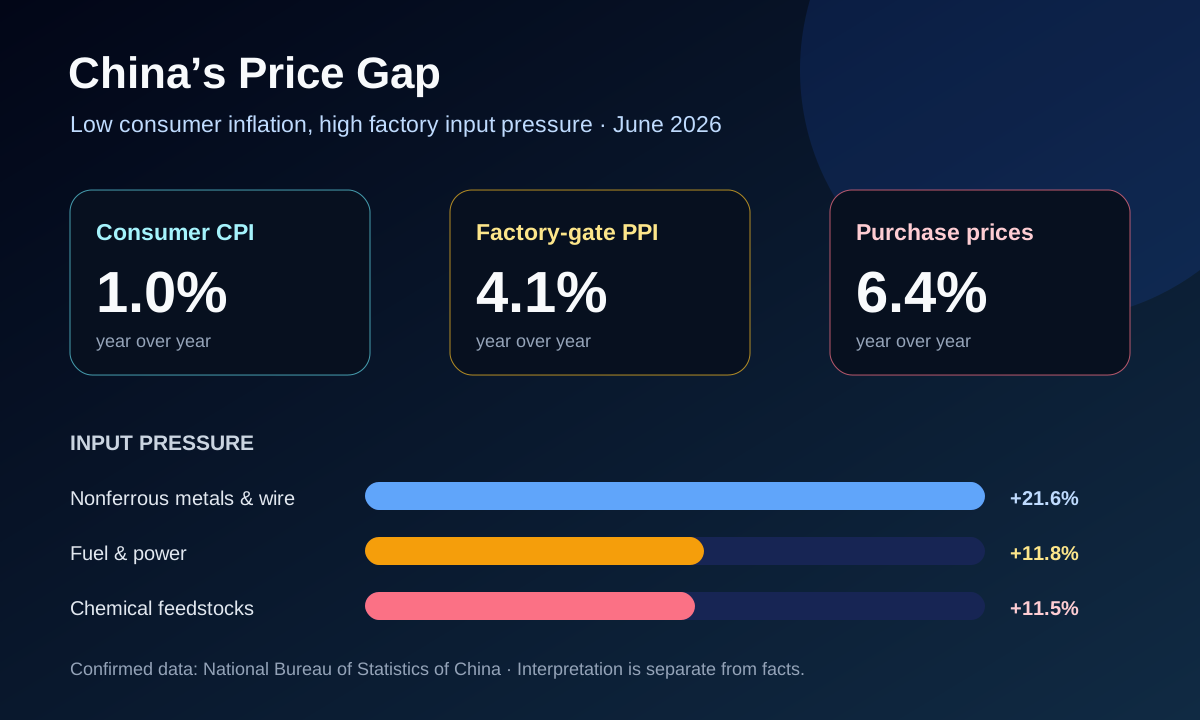
Read China’s 1% inflation rate in isolation and it is tempting to conclude that Asia’s price pressure is mild. The same release cycle says otherwise: factory-gate prices were 4.1% higher than a year earlier and the prices paid by industrial producers were up 6.4%. A three-to-five-point gap has opened between the consumer shelf and the factory purchasing desk.
That gap is not a statistical curiosity. It can change the next quote for Korean and global teams sourcing components and finished goods from China, building electronics or data-center equipment, or selling fixed-price projects with hardware and logistics embedded in the scope.
Confirmed facts: soft consumer prices, hard production costs
- China’s National Bureau of Statistics reports that June 2026 CPI rose 1.0% year over year and fell 0.3% month over month. Food prices fell 1.6% from a year earlier, non-food prices rose 1.5%, and average CPI inflation for January through June was 1.0%.
- PPI rose 4.1% year over year but fell 0.3% month over month. Prices for means of production increased 5.5%, while consumer-goods producer prices fell 0.9%. This is not broad inflation across every item; the pressure is concentrated upstream.
- Industrial purchase prices were 6.4% higher than a year earlier. Nonferrous metals and wire rose 21.6%, fuel and power 11.8%, and chemical feedstocks 11.5%. Building materials and nonmetals fell 4.8%, and agricultural by-products fell 1.3%.
- The manufacturing PMI returned to expansion at 50.3 in June, but the small-enterprise PMI remained in contraction at 48.2, versus 50.7 for large and 50.5 for medium-sized firms. Capacity to absorb higher input costs appears uneven by company size.
- Profits at industrial enterprises above the designated size rose 18.8% year over year in January–May. Yet the distribution was stark: nonferrous smelting profit rose 117.1% and computer, communication, and electronics profit 103.9%, while auto profit fell 19.8% and electrical machinery profit 13.7%. The average does not describe every manufacturer.
Interpretation: pause the “China exports deflation” shortcut
The confirmed point is a sharp divergence between CPI and PPI or purchase prices. A reasonable inference is that higher raw-material costs have not fully reached consumers. Businesses in between must choose among higher prices, lower specifications, longer delivery times, and thinner margins.
For importers, the composition of purchase prices matters more than the headline PPI. Metals and wire feed electronics, batteries, power equipment, and data centers. Fuel and chemicals travel through freight, packaging, plastics, and PCBs. Even when the finished-goods price is unchanged, pressure can appear through minimum orders, deposits, shipping terms, or quality tiers.
The month-over-month PPI decline of 0.3% is an important brake on the story. It prevents us from declaring a continuously accelerating shock. Base effects and divergent materials matter. The useful conclusion is not “Chinese inflation is certain,” but “the cost-pass-through map needs to be checked now.”
Market narrative: which number is real, low CPI or high PPI?
Market conversations often treat low CPI as proof of weak domestic demand and high PPI as a commodity-cycle story. Both can be true. Consumers stay price-sensitive, upstream producers pay more for metals and energy, and processors or distributors in the middle absorb the difference.
A competing narrative says rising producer prices help restore corporate profits. That is visible in selected materials and electronics industries. It is not visible in the same way for autos and electrical machinery. The central question is not whether prices rose; it is who has the power to pass them through.
For investors, 4.1% PPI is therefore neither a single bullish nor bearish call on China. It is a map of margin redistribution from downstream to upstream—and of the firms caught between them.
Second-order effects operators may feel first
Supplier contracts
Quote validity can shorten, with more metal or energy clauses, FX bands, and deposit requirements.
Hardware and commerce
When list prices cannot move, smaller bundles, higher free-shipping thresholds, and tighter warranty or return terms can protect margin.
Cloud and AI infrastructure
Wire, power equipment, and electronics raise the non-GPU cost of server expansion. Model fees alone do not capture AI economics.
Fixed-price services
Three-to-six-month projects that include equipment, travel, or subcontractors can lose development margin as embedded costs rise.
Investing
Pair industry purchase prices with inventory, gross margin, working-capital turnover, and actual quotation data.
Risks and counterarguments
PPI fell month over month. If the upstream shock has peaked, reacting to the annual rate alone could lead to premature price increases or over-ordering.
Weak Chinese demand may prevent suppliers from passing costs through, keeping export competition intense. Buyers need item-level quotes, not macro extrapolation.
China rotated the CPI and PPI base year to 2025 in January 2026. NBS estimates that the CPI rebasing changes monthly year-over-year readings by about 0.06 percentage points on average, which matters for long comparisons.
This week’s operating checklist
Segment China-sourced items into metals and wire, energy, chemicals and packaging, and other inputs; compare the latest three quotes and terms.
Recalculate gross margin under input-cost scenarios of +3%, +6%, and +10%.
Add quote expiry, FX bands, material-index clauses, and substitute-spec approval to fixed-price contracts.
Model the working capital needed if deposits increase and inventory days rise by 15.
Negotiate unit price, MOQ, lead time, payment, defect rate, and freight responsibility as one package.
This article provides economic and market context for informational purposes only and is not financial advice. Make investment and business decisions independently based on your objectives, horizon, cash flow, and risk tolerance.
Sources
- National Bureau of Statistics of China — Consumer Price Index in June 2026
- National Bureau of Statistics of China — Industrial Producer Price Indexes in June 2026
- National Bureau of Statistics of China — Purchasing Managers’ Index for June 2026
- National Bureau of Statistics of China — Industrial profits, January–May 2026
- World Bank — China Economic Update, July 2026