
Copilot Agent Tasks API turns coding agents into an engineering work queue
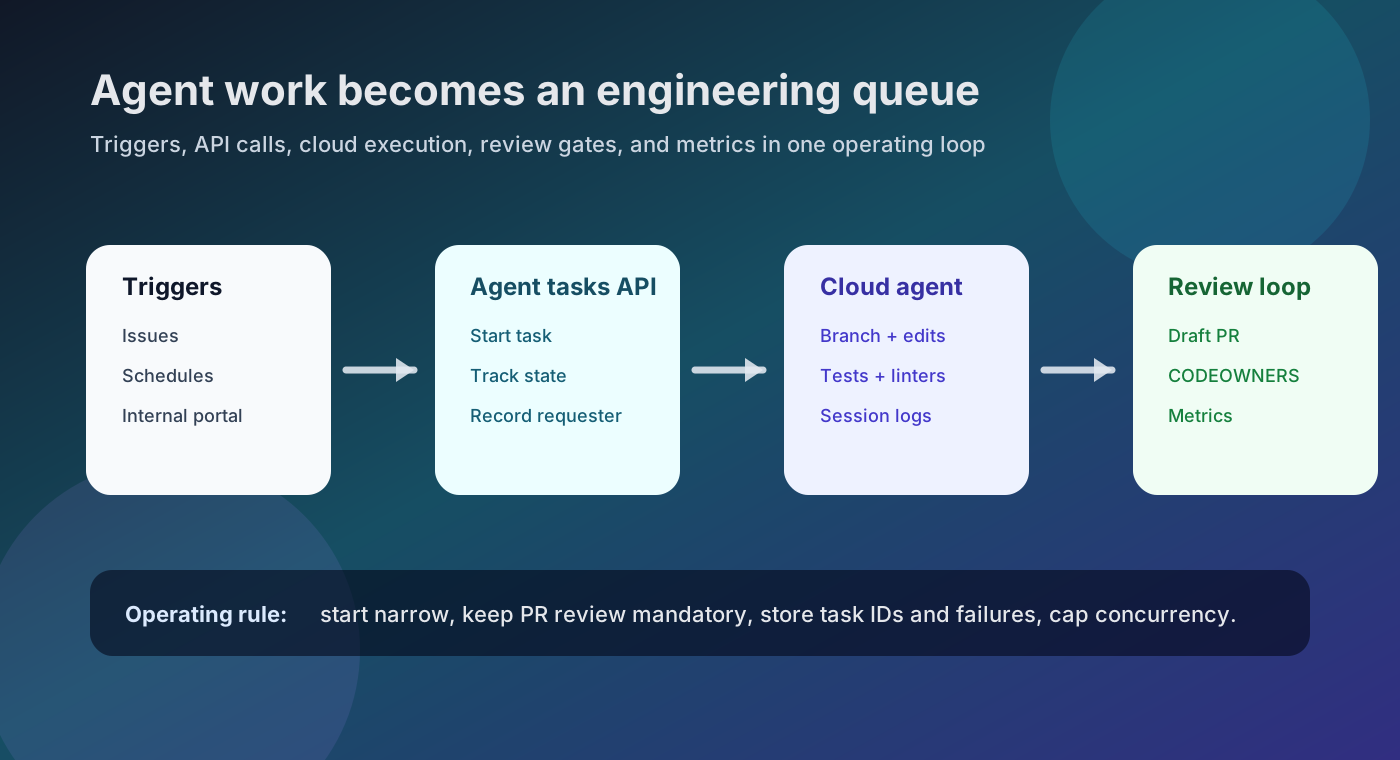
Coding agents are moving out of the side panel. With GitHub Copilot cloud agent Automations and the Agent tasks REST API, the important shift is not simply that an AI tool can write code. The shift is that an engineering platform can now start, track, and route coding work as an API-driven queue.
That changes the adoption question. Instead of asking whether a developer can prompt an assistant, teams now have to ask which repository events should create agent work, who owns the resulting pull request, what permissions the agent receives, how failures are surfaced, and how many automated PRs a review queue can absorb.
GitHub says Automations can run Copilot cloud agent on a schedule or in response to repository events. The Agent tasks REST API lets users programmatically start and track cloud agent tasks. The documentation marks the API as public preview and describes permission and token constraints that matter for platform teams, including Agent tasks read/write permissions for starting work and user-to-server token requirements for API usage.
The cloud agent model is different from local IDE agent mode. Copilot cloud agent runs in its own GitHub Actions-powered environment, explores the repository, creates branches, runs checks, and can open a pull request. That makes it closer to CI, a release bot, or an internal developer portal worker than to a private autocomplete feature.
What Changed
| Area | Decision |
|---|---|
| Trigger | Limit the first workflow to a schedule, issue event, PR event, or internal portal button. |
| Permission | Document the Agent tasks permission set and token authority per repository. |
| Output | Default to draft pull requests, check results, and concise change summaries. |
| Observability | Store task IDs, session states, PR links, failure reasons, and cost signals together. |
| Review | Apply CODEOWNERS, required checks, and security scans to agent PRs like any other PR. |
Why It Matters
Most AI coding rollouts started as individual productivity experiments. The work happened in a local session, and the team only saw the final commit if the developer decided to push it. Scheduled and API-driven agent tasks move that work into a shared operational surface.
This is useful because many engineering tasks are valuable but chronically postponed: dependency update follow-through, release note drafts, test scaffolding, log cleanup, migration preparation, and issue triage. It is risky for the same reason. A weak prompt can create many weak pull requests, and a broad token can turn a convenience workflow into an audit problem.
Community Signals
The community had already been asking for this shape of product. A Reddit thread asked whether Copilot coding agent could run a prompt every Sunday morning. A GitHub Community discussion asked for programmatic access to agent session state and failures so teams could build reliable retries, escalation, and auditability. Those posts are not factual sources for the feature; they are useful demand signals that explain why the official API and automation surface matters.
Operational Impact
For product engineers, the backlog changes. Small refactors, test fixes, documentation updates, and release preparation can be started without waiting for a developer to open an IDE. For platform engineers, the work becomes a governance problem: define triggers, cap concurrency, preserve logs, track cost signals, and route PRs to the right owners.
The teams that benefit first will not be the teams that let agents touch everything. They will be the teams that choose narrow tasks, write repeatable prompts, require normal checks, and measure whether human review time actually goes down.
Practical Checklist
• Declare which repositories and branches the agent may touch.
• Put goal, non-goals, validation commands, and PR format into prompt templates.
• Limit concurrency and retries before enabling scheduled work.
• Link failures and generated PRs back to tickets or an internal dashboard.
• Do not merge to release branches without human review.
Risks And Counterarguments
The strongest counterargument is that public preview automation should not become production dependency too quickly. API shapes can change, model behavior is probabilistic, and agent-generated PRs still need review. Treating the feature as a queue does not remove the need for CODEOWNERS, branch protection, required checks, and security validation.
The second risk is permission confusion. The docs describe specific Agent tasks permissions and user-to-server token support. If an internal portal starts tasks on behalf of developers, the system needs to record who requested the work, which token authority was used, and which repository policy allowed it.
How To Start Small
Start with one private or internal repository and one low-blast-radius task. A good first workflow is “draft weekly release notes” or “open a PR that investigates recurring test failures.” Avoid cross-repository migrations until you can answer three questions: where are task IDs stored, who reviews every PR, and what stops duplicate or stale agent work?
An API-based experiment starts with a small request like this. In a real platform, token scope and requester identity should live outside the prompt.
POST /agents/repos/{owner}/{repo}/tasks
{
  "prompt": "Draft release notes for the changes merged this week. Open a pull request with sources and validation steps.",
  "base_ref": "main",
  "create_pull_request": true
}
Sources
- GitHub Changelog: Schedule and automate tasks with Copilot cloud agent
- GitHub Changelog: Agent tasks REST API now available for Copilot Pro, Pro+, and Max
- GitHub Docs: REST API endpoints for agent tasks
- GitHub Docs: Using Copilot cloud agent via the API
- GitHub Docs: Creating automations with Copilot cloud agent
- GitHub Docs: About GitHub Copilot cloud agent
- GitHub Community discussion: Read-only API for Copilot Coding Agent session status and failures
- Reddit discovery signal: Could Copilot coding agent run on a schedule?