
The Real Signal in 4.2% U.S. CPI: Reprice Energy Costs Before You Bet on Rate Cuts
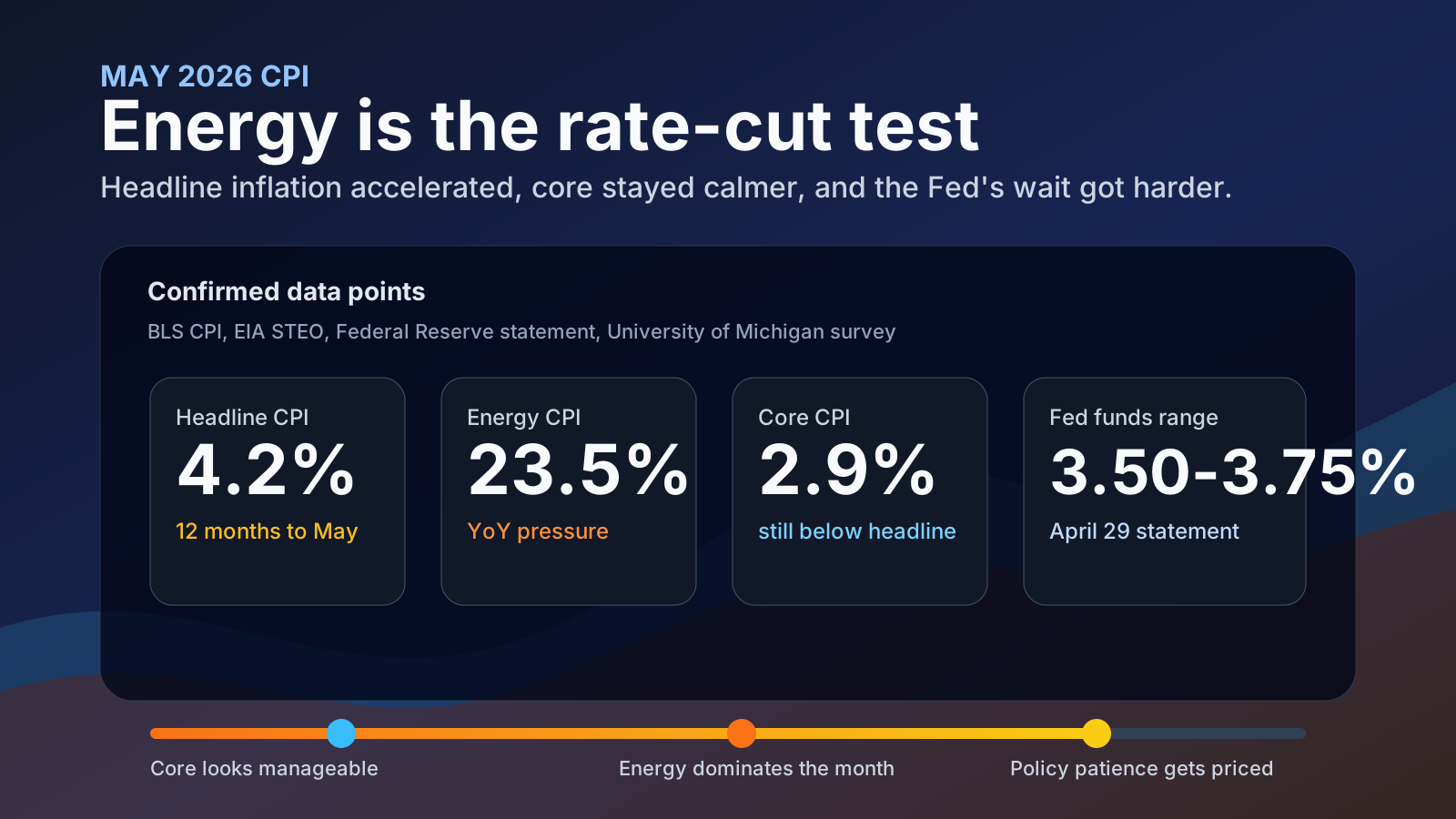
The May U.S. CPI report makes the clean rate-cut story harder to run. The Bureau of Labor Statistics reported that CPI-U rose 0.5% in May on a seasonally adjusted basis and 4.2% over the prior 12 months. The composition matters more than the headline. Core CPI rose a manageable 0.2% month over month and 2.9% year over year, but the energy index rose 3.9% on the month and 23.5% from a year earlier, accounting for more than 60% of the monthly all-items increase.
This is neither a pure demand-overheating signal nor proof that inflation is solved. It is a transmission test. Energy is moving into household budgets, freight, airfare, electricity, cloud infrastructure, AI operating costs, and central-bank patience. For a small team paying dollar cloud bills, a solo builder adding AI features, or an investor holding long-duration growth assets, May CPI is not distant macro noise. It is a cost, currency, and valuation input.
Confirmed Facts
- BLS: CPI-U rose 0.5% month over month in May on a seasonally adjusted basis and 4.2% over the prior 12 months.
- BLS: core CPI rose 0.2% month over month and 2.9% year over year.
- BLS: the energy index rose 3.9% in May and 23.5% year over year; gasoline rose 7.0% in May and 40.5% year over year.
- EIA June STEO: the Strait of Hormuz remains effectively closed in the near term, and Middle Eastern oil output has been cut by more than 11 million barrels per day.
- EIA: Brent crude is forecast to average $95/b in 2026 and $79/b in 2027, with an average of $105/b in June and July.
- The Fed held the federal funds target range at 3.50%-3.75% on April 29; the next FOMC meeting is June 16-17, 2026.
- University of Michigan: year-ahead inflation expectations rose to 4.8%, while long-run expectations climbed to 3.9%.
| Signal | Number | Practical read |
|---|---|---|
| CPI headline | 4.2% YoY | Do not budget only for a quick rate-cut scenario. |
| Energy CPI | 23.5% YoY | Stress-test freight, electricity, cloud, and travel costs. |
| Gasoline CPI | 40.5% YoY | Watch consumer sentiment and wage pressure. |
| Core CPI | 2.9% YoY | The Fed can wait, but cannot ignore expectations. |
| Fed target range | 3.50%-3.75% | Cash and debt duration still matter. |
Why It Matters
The first point is the split between headline and core. A 0.2% core print does not scream immediate policy tightening. But 4.2% headline inflation and 40.5% gasoline inflation flow straight into household behavior, wage demands, consumer sentiment, and political pressure. Central banks can emphasize core measures; customers and voters pay headline prices.
The second point is that EIA’s energy outlook is an operating-budget story, not just a commodity story. Brent near $105 for even a short period pushes through aviation, logistics, chemicals, electricity, and food with a lag. AI teams should not only watch model API pricing and GPU rental rates. They should watch data-center power premiums, regional cloud pricing, and inference cost per free user.
The third point is that the rate-cut hurdle is higher. The Fed has already said Middle East developments are adding uncertainty and that it will assess inflation pressures and expectations. May CPI gives policymakers a mixed picture: core is not alarming, but lived inflation is hot again. That argues for cost durability before directional macro bets.
Market and Community Narrative Signals
Public investing forums, pre-market notes, and market commentary are clustering around phrases such as energy-led stagflation, delayed cuts, AI power costs, and renewed consumer-price pain. Those phrases are not factual sources. They are narrative signals showing what traders and operators may try to price first. The factual base should remain BLS, EIA, Fed, and University of Michigan data.
Second-Order Effects
- Dollar-based operators outside the United States may feel the shock through FX and billing cycles before they feel CPI directly.
- Airfare, shipping, events, and travel are typical lagged pass-through categories after energy spikes.
- AI products need a fresh gross-margin test: more usage does not automatically mean better economics.
- High-multiple growth assets become more sensitive when rate-cut expectations move further out.
- If energy falls quickly, headline CPI can cool again; if expectations rise, central banks may wait longer.
Checklist for Small Teams, Builders, and Investors
- Split the next 90 days of spend into fixed costs, dollar-denominated costs, and usage-linked costs.
- Model server, API, and ad spend under 5% and 10% adverse currency moves.
- For every AI feature, track inference cost per user, free usage, conversion rate, and payback period in one table.
- If pricing must change, start with overage usage, expensive regions, and premium AI features rather than a blunt increase.
- For portfolios, check cash allocation, bond duration, and expensive growth exposure before chasing energy winners.
- Watch the June 16-17 FOMC meeting, upcoming PPI and PCE data, and the June CPI release scheduled for July 14.
Counterarguments and Risks
The counterargument is valid: core CPI rose only 0.2%, so the Fed may still treat this as a temporary supply shock. EIA also expects Brent to fall to an average of $79/b in 2027. If the Hormuz risk fades and energy prices retreat quickly, headline inflation can cool again. The main risk is expectations. If households treat energy inflation as a longer-term price regime, wage setting, pricing, and contracts adjust slowly and can keep the shock alive.
Disclaimer
This article is informational economic commentary, not financial advice. It does not recommend buying, selling, or holding any specific asset.
Sources
- U.S. Bureau of Labor Statistics, Consumer Price Index Summary, May 2026
- U.S. Energy Information Administration, June 2026 Short-Term Energy Outlook press release
- U.S. Energy Information Administration, Short-Term Energy Outlook petroleum products
- Federal Reserve, FOMC statement, April 29, 2026
- Federal Reserve, FOMC minutes, April 28-29, 2026
- University of Michigan Surveys of Consumers, May 2026