
Copilot SDK and agent security validation: governance is now the real developer-tool feature
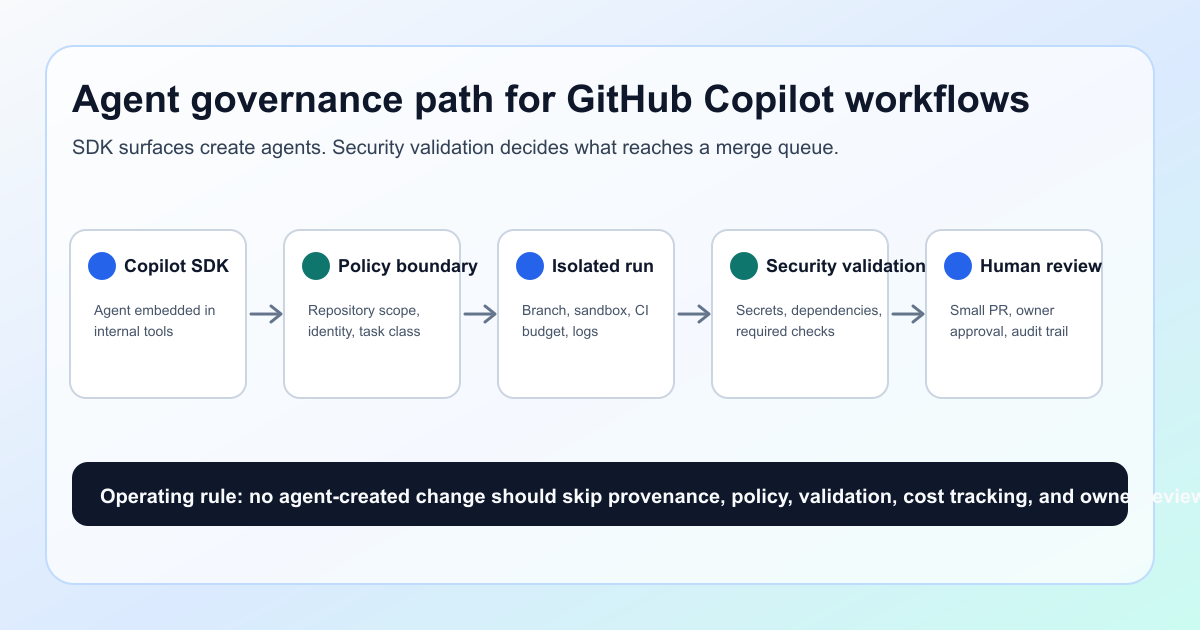
The next phase of AI coding tools is not just about who can generate more code. It is about which generated changes are allowed to touch a repository, under which identity, with which logs, and behind which validation gates. Two GitHub updates from early June 2026 point in that direction: GitHub Copilot SDK reached general availability, and security validation for third-party coding agents also became generally available.
The Copilot SDK gives developers a supported way to embed Copilot-powered agent experiences into their own applications and internal tools. Security validation for third-party coding agents addresses the other side of the lifecycle: what happens when an outside agent participates in GitHub issues and pull requests. Taken together, the message is clear. Teams should stop treating coding agents as only an IDE convenience and start treating them as automated actors in the software delivery system.
What happened
GitHub announced on June 2, 2026 that the GitHub Copilot SDK is generally available. The changelog lists Node.js/TypeScript, Python, Go, .NET, Rust, and Java support, and frames the SDK as a way to embed Copilot’s agentic engine into applications, services, and developer tools.
On June 9, 2026, GitHub announced that security validation for third-party coding agents is generally available. GitHub’s documentation frames third-party coding agents as agents built by external providers that can work with GitHub repositories. That framing matters because it implies an administrative model: organizations need to decide which agents are allowed, where they may operate, and what checks their output must pass.
Why it matters
The pairing matters because one feature accelerates distribution while the other creates control. An SDK makes agents easier to place inside everyday developer workflows. Security validation makes it easier to decide whether the output of those agents should be trusted enough to move toward merge. One is an expansion surface; the other is a governance surface.
The adoption question therefore changes. The useful question is no longer “should we try a coding agent?” It is “which repositories, which permissions, which events, which validation checks, which cost limits, and which human owners are attached to every agent action?” As agents take on dependency updates, test-writing, migration drafts, and documentation fixes, that question becomes platform engineering work, not a side conversation for security alone.
Community signals
Developer reaction around coding agents tends to split into two practical concerns. Teams want backlog reduction, faster test coverage, and more consistent maintenance work. At the same time, they worry about excessive permissions, leaked secrets, runaway CI usage, unclear billing, and pull requests that are too large for humans to review responsibly.
Community discussions are not a factual source for what GitHub shipped; the official changelog and docs are. But those discussions are useful as a map of operator anxiety. If an agent saves two hours of coding but creates an unreadable pull request, hides its prompt context, or triggers ten expensive CI retries, the bottleneck has simply moved.
Development and operations impact
For development teams, the impact is concrete. Internal developer platforms can become AI-assisted control rooms rather than static dashboards. Repository policy needs to record provenance and validation results for both human and automated changes. CI and Copilot usage must be treated as operating cost, because an agent can run repeatedly and silently if the workflow is not constrained.
For operations and security teams, agent pull requests should be managed like a first-class automation path. Branch protection, CODEOWNERS, required checks, secret scanning, dependency review, artifact retention, and audit logs all need to assume that a non-human actor may produce a change. If a third-party agent reacts to repository events, allowlists, revocation procedures, and incident playbooks need to be explicit.
Practical checklist
Before enabling a new agent surface, teams can reduce risk by making these decisions boring and visible.
Practical checklist
•Classify repositories by risk. Customer data, authentication, payments, deployment infrastructure, and regulated workloads should receive the most conservative defaults.
•Define permitted task classes per agent. Documentation edits, test additions, dependency updates, and bug-fix drafts should not share the same permissions.
•Limit pull request size. Use file count, line count, migration presence, and dependency changes as reviewability gates.
•Run validation before human review. Linting, type checks, unit tests, dependency review, secret scanning, and license checks should be baseline requirements.
•Track cost by workflow. Measure Copilot usage, Actions minutes, external model calls, retries, and failed runs by team, repository, and task type.
•Standardize audit language. Pull request descriptions should state which agent acted, what input triggered it, which permissions were used, and what evidence was produced.
Risks and counterarguments
There is a real counterargument: not every team needs to build its own agent experience with the Copilot SDK. Smaller teams may get enough value from the default GitHub and IDE surfaces. A custom agent UI can create more support burden than leverage if the workflow is not already mature.
Security validation also does not guarantee good design. It can tell a team more about whether a change passed policy; it cannot prove that the feature is the right product decision. The practical conclusion is not “agent everything.” It is “decide whether your change-management system is ready for automated contributors.” The enduring quality levers remain small pull requests, strong tests, clear ownership, cost visibility, and responsible human review.
Sources
- GitHub Changelog: Security validation for third-party coding agents is generally available
- GitHub Docs: About third-party coding agents
- GitHub Changelog: GitHub Copilot SDK is now generally available
- GitHub repository: github/copilot-sdk
- GitHub Docs: Usage-based billing for Copilot
- GitHub Community discussion signal: Copilot coding agent workflows