
The ECB Hike Risk Says the Rate Floor Is Not Falling Yet
The most uncomfortable signal for markets is not simply that rate cuts may arrive later. It is that a major central bank may be forced to hike again. That is why the European Central Bank debate matters in early June 2026. Euro area inflation has moved back above 3%, energy remains the hottest component, and services inflation is no longer behaving like a clean disinflation story.
Confirmed facts
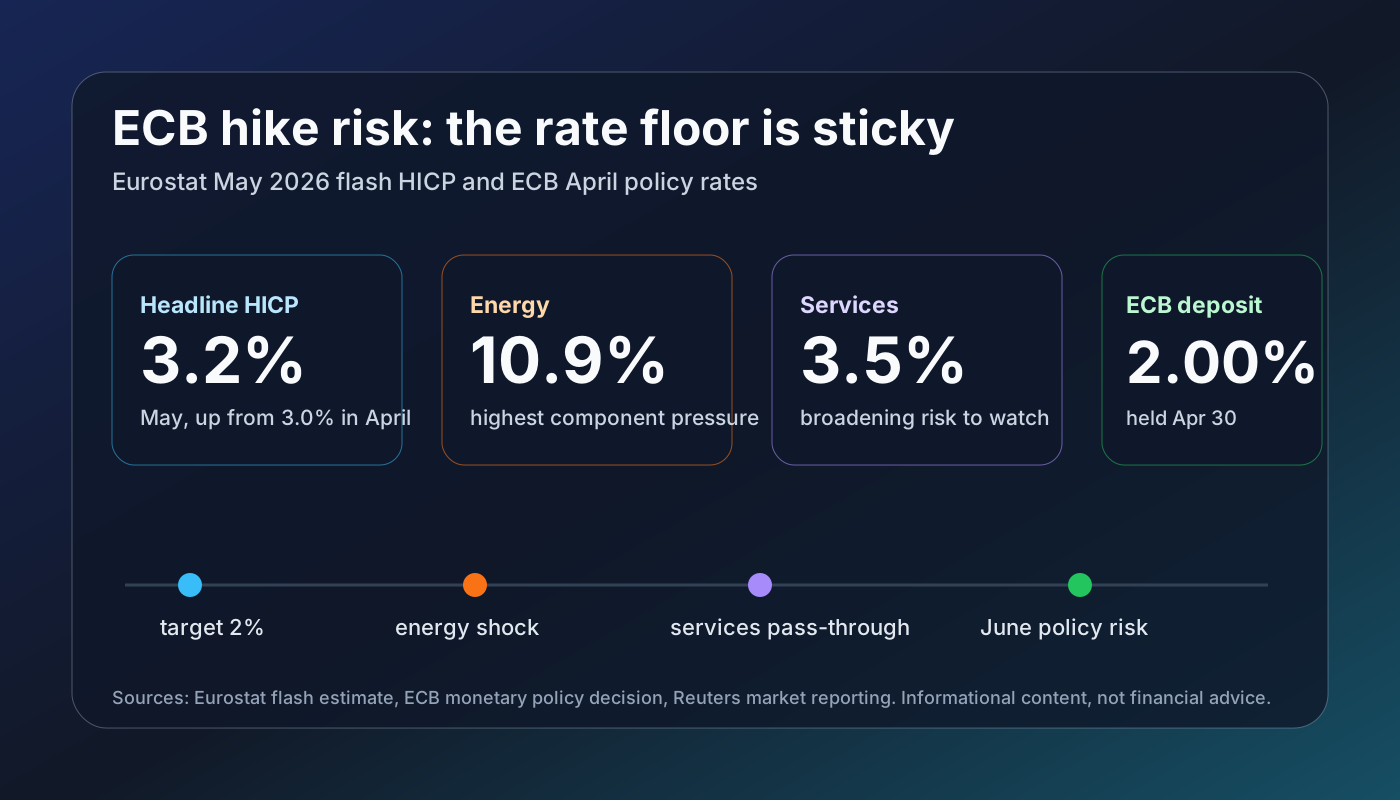
- Eurostat’s 2 June 2026 flash estimate put euro area annual inflation at 3.2% in May, up from 3.0% in April.
- Energy inflation was estimated at 10.9%, services at 3.5%, food, alcohol and tobacco at 2.0%, and non-energy industrial goods at 0.9%.
- On 30 April 2026 the ECB kept the deposit facility rate at 2.00%, the main refinancing operations rate at 2.15%, and the marginal lending facility at 2.40%.
- The ECB said the Middle East war had pushed up energy prices, raised inflation pressure, and weighed on economic sentiment, while stressing that it was not pre-committing to a rate path.
- Reuters reported on 5 June that the ECB was expected to hike at the next meeting, while traders saw one or two further moves this year mainly as a credibility signal.
Interpretation: watch the rate floor, not just the next cut
For builders and investors outside Europe, the ECB story is a reminder that the global cost of capital is not falling in a straight line. If a supply shock can push a central bank back toward tightening, discount rates, FX assumptions, credit spreads and customer budgets all deserve another pass.
This is especially relevant for small teams. Cloud bills, euro-denominated revenue, cross-border SaaS subscriptions, payment fees, and data-center energy exposure can all move before a founder sees it in headline revenue. A business plan that assumes easier money by default may be too optimistic if central banks are still defending credibility.
- Teams with European customers: separate energy, FX and payment-fee assumptions in Q3 pricing.
- Teams with USD or EUR costs: rebuild the monthly fixed-cost model and add a two-to-three-month FX buffer.
- Investors: test rate-cut beneficiaries against margin resilience, pricing power and debt maturity, not only multiple expansion.
- AI and cloud operators: track whether GPU, power and data-center costs can be passed through to customers without churn.
Market and community narrative
The debate has split into two narratives. One side says the ECB has to move early to protect inflation expectations. The other worries that hiking into an energy shock repeats Europe’s old policy mistakes: tighter money just as growth weakens. Public market forums are asking the same question in simpler language: can a central bank fix an oil shock with interest rates? The answer is not clean, and that uncertainty is itself the market signal.
Second-order effects
- European private credit and bank lending may become more cautious, lengthening B2B sales cycles.
- If services inflation stays firm, central banks may wait less patiently for wage data before acting.
- The Federal Reserve and Bank of Korea may also sound less eager to ease while their own inflation data remain sticky.
- AI infrastructure businesses face a double test: power costs and capital costs at the same time.
Risks and counterarguments
The counterargument is strong. If energy prices normalize quickly, a June ECB hike could be mostly symbolic. Eurostat’s May number is still a flash estimate; the full May HICP release is scheduled for 17 June. Reuters also notes that clear second-round effects in wages and long-term expectations have not yet appeared. So the takeaway is not “Europe is entering a long hiking cycle.” It is narrower and more useful: do not loosen your cost model just because the market wants rate cuts.
Bottom line
For small teams and individual investors, sensitivity beats prediction. Whether the ECB hikes once or pauses, the May inflation data show that energy, services, FX and policy credibility are connected again. In a weak-growth, high-cost environment, a good product can lose margin through poor pricing, and a good asset can lose support if the discount-rate story changes.
Disclaimer: This article is for informational purposes only. It is not financial advice and is not a recommendation to buy or sell any security or financial product.
Sources
- Eurostat May euro area inflation flash estimate: May 2026 euro area HICP flash estimate and component rates.
- ECB monetary policy decision, 30 April 2026: 30 April 2026 monetary policy decision and current key rates.
- Reuters ECB June meeting preview: June 2026 market expectations, policy debate and second-round inflation discussion.
- Public investor community discussion: Used only as a public narrative signal, not as a source for factual claims.