
Node.js 24.16 LTS and 26 Current: runtime upgrades are now checklist work
Node.js upgrades are no longer a simple “new version, should we bump?” decision. As of June 8, 2026, the official release page lists Node.js 24.16.0 as the latest LTS and Node.js 26.3.0 as the latest Current release. Read together, they tell a practical story: the LTS line now has small production-friendly improvements, while the Current line exposes the breakpoints teams should find before Node 26 becomes LTS in October.
What changed
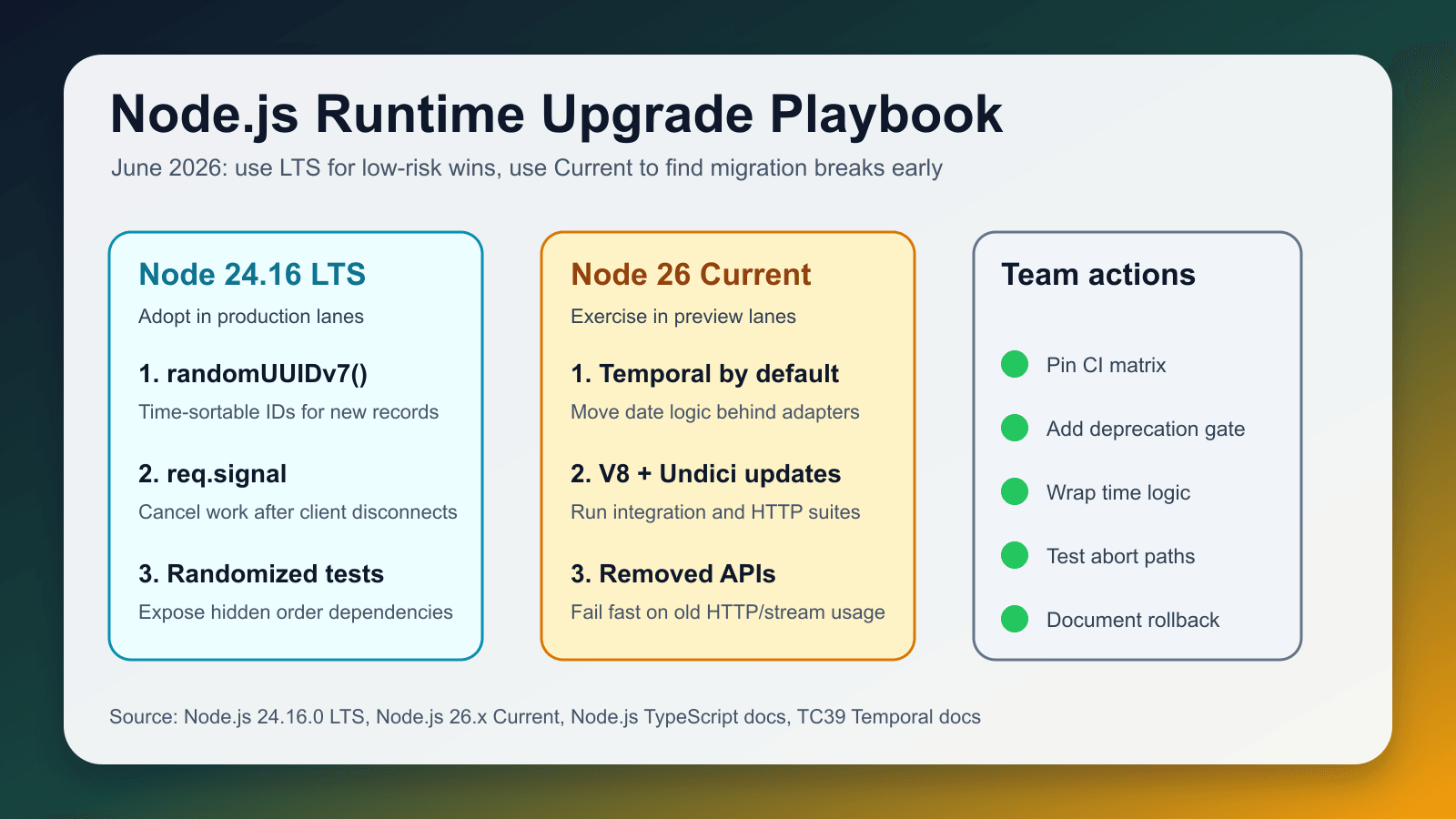
Node.js 24.16.0 LTS shipped with a useful set of incremental backend features: crypto.randomUUIDv7(), req.signal on IncomingMessage, and test runner order randomization. None of those require a rewrite. They are exactly the kind of runtime affordances that reduce operational drag: sortable IDs for new records, less wasted work after client disconnects, and a cleaner way to uncover hidden test order dependencies.
Node.js 26.0.0 is the bigger preview. It enables the Temporal API by default, updates V8 to 14.6 and Undici to 8.0.2, and removes long-deprecated APIs such as http.Server.prototype.writeHeader() and legacy _stream_* modules. Node 26.3.0 then adds more Current-line signals, including a warning that macOS universal binary availability may become harder to maintain over the full Node 26 lifetime, plus smaller runtime features such as permission.drop and an HTTP header validation option.
Why working developers should care
Runtime upgrades are quiet until they are not. A framework migration usually fails near the surface; a runtime migration can fail inside date logic, HTTP cancellation, stream compatibility, native dependencies, CI images, or build scripts. That is why this release cycle should be treated as an upgrade playbook, not a headline feature tour.
Temporal is the clearest example. It is not just nicer syntax around Date. The TC39 documentation frames it as a set of separate types for exact instants, calendar dates, wall-clock time, time zones, and DST-safe operations. That distinction matters in products that schedule jobs, calculate billing windows, retain logs, or show regional reports. The safest path is to put time logic behind domain-specific adapters now, then migrate call sites gradually.
Community signal
The practitioner reaction is mixed in a useful way. In Node community discussions, developers are excited that Temporal is finally available by default, but several also point out that real projects will still need small helper layers because the API is intentionally granular. Other threads focus on whether Node 26 is “ready” or whether benchmark results should drive adoption. Treat those posts as a signal of what people are worried about, not as evidence by themselves: the facts should come from the Node.js release notes and docs, while your decision should come from your own CI and production traces.
Expected engineering impact
- ID generation: try
randomUUIDv7()on new write paths where time-sortable IDs help logs, admin screens, or indexes. Do not treat it as a free migration for old tables. - Request cancellation: use
req.signalto stop expensive downstream work after disconnects, then verify that databases, fetch clients, queues, and file operations actually observe the signal. - Test reliability: run test order randomization in a nightly job first. The value is the failure pattern it reveals, not flipping every CI lane at once.
- Time modeling: wrap date calculations before replacing them. Decide when your domain needs
Temporal.Instant,Temporal.PlainDate, orTemporal.ZonedDateTime. - Legacy dependency audit: search direct code and transitive packages for removed HTTP and stream APIs before attempting a Node 26 production rollout.
This week's checklist
- Add a CI matrix that separates production Node, Node 24 LTS, and Node 26 Current.
- Run a deprecation gate with runtime warnings collected as artifacts.
- Pick one new entity or event stream to test
crypto.randomUUIDv7(). - Trace client disconnects and propagate
AbortSignalthrough one expensive request path. - Create a tiny time module so application code stops calling
new Date()everywhere. - Review Node's TypeScript documentation before relying on built-in type stripping: it performs no type checking, ignores many
tsconfig.jsonfeatures, and rejects syntax that requires transformation.
Small example
import { randomUUIDv7 } from 'node:crypto'

const eventId = randomUUIDv7()

export async function handler(req, res) {
  const upstream = await fetch(upstreamUrl, { signal: req.signal })
  res.end(await upstream.text())
}
Risks and counterarguments
The conservative argument is valid: Node 26 is still Current, so production defaults should depend on your platform, native modules, compliance posture, and support window. Temporal is also not a search-and-replace migration. It requires agreement on how your product represents dates, instants, time zones, and persisted strings. Even UUIDv7 should be introduced with index and ordering behavior measured in your own database.
The practical conclusion is therefore balanced: harvest the low-risk wins in Node 24.16 LTS now, and use Node 26 Current as a rehearsal lane. The teams that make runtime upgrades boring will be the teams that turn them into checklists before the LTS deadline arrives.