
The Fed stress test signal: banks are strong, but credit will still flow selectively
All 32 large U.S. banks passed the Fed’s 2026 stress test. That sounds like a simple risk-on headline. For founders, operators, and investors, the better question is sharper: if banks have capital flexibility, does it flow into lending, buybacks, M&A, or tighter credit selection?
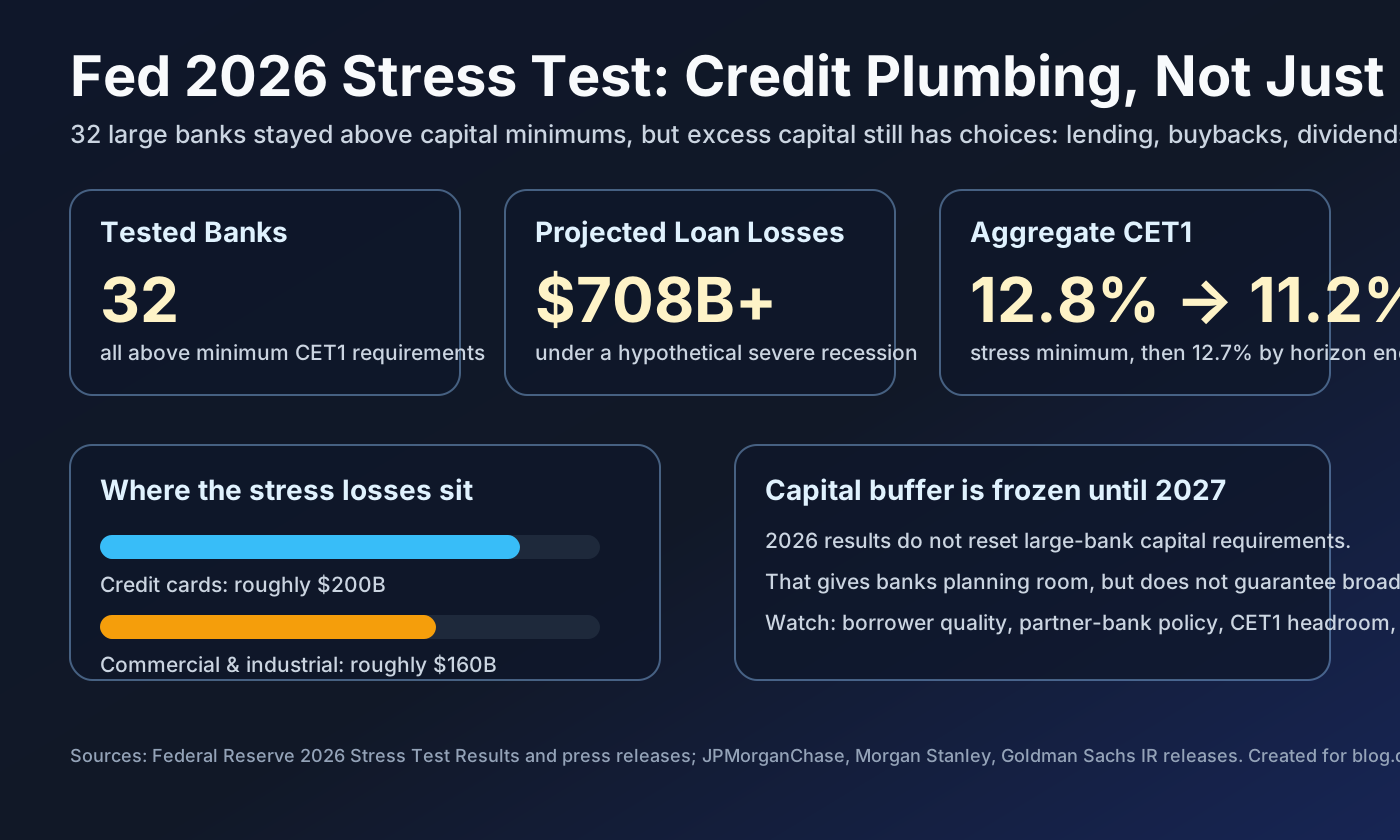
On June 24, 2026, the Federal Reserve released the results of its annual large-bank stress test. The 32 banks subject to the test stayed above their minimum common equity tier 1 requirements under a hypothetical severe recession that included a 39% drop in commercial real estate prices, a 30% decline in house prices, and unemployment peaking at 10%. The Fed estimated more than $708 billion in total loan losses, yet aggregate CET1 fell only 1.6 percentage points, from an actual 12.8% in the fourth quarter of 2025 to a stressed minimum of 11.2%.
The surface conclusion is that the banking system is resilient. The practical conclusion is about credit plumbing. The Fed said the 2026 results will not affect large-bank capital requirements because the Board voted in February to maintain current stress capital buffer requirements until 2027, when new requirements can be calculated using models that incorporate public feedback. With that near-term capital uncertainty reduced, several large banks quickly announced dividend increases and share repurchase programs.
This is not a bank-stock recommendation. The useful question for founders, solo builders, SaaS operators, and investors is not whether the banking system can survive a stress scenario. It is which borrowers receive balance-sheet capacity, which borrowers pay up for it, and which bank partners become more selective even while the system looks stable.
Confirmed Facts
- The Federal Reserve released the 2026 stress test results on June 24, 2026 and said all 32 tested large banks remained above their minimum CET1 requirements under the hypothetical recession scenario.
- The scenario included a 39% decline in commercial real estate prices, a 30% decline in house prices, and unemployment rising to a peak of 10%.
- The Fed results PDF shows aggregate CET1 falling from an actual 12.8% in 2025:Q4 to a stressed minimum of 11.2%, before rising to 12.7% at the end of the projection horizon. The minimum regulatory CET1 ratio is 4.5%.
- The Fed said projected loan losses exceeded $708 billion. It also identified roughly $200 billion in credit card losses, $160 billion in commercial and industrial loan losses, and $75 billion in commercial real estate losses.
- On February 4, 2026, the Fed voted to maintain current stress capital buffer requirements until 2027. As a result, the 2026 stress test results do not reset large-bank capital requirements this year.
- JPMorganChase announced plans to increase its quarterly common dividend from $1.50 to $1.65 per share and authorized a new $50 billion common share repurchase program effective July 1, 2026.
- Morgan Stanley announced it would increase its quarterly common dividend from $1.00 to $1.15 per share and reauthorized a multi-year common equity repurchase program of up to $20 billion.
- Goldman Sachs said it intends to increase its common dividend from $4.50 to $5.00 per share and that its 3.4% stress capital buffer will remain in place through September 30, 2027.
Interpretation: excess bank capital does not automatically become easy credit
Passing the stress test reduces tail risk in the financial system. That matters. It supports depositor confidence, business continuity, and market functioning. But the next step is capital allocation. When banks have room, they do not automatically expand riskier lending. They compare lending against dividends, buybacks, fee businesses, secured credit, high-quality corporate exposure, and potential acquisitions.
The frozen stress capital buffer makes 2026 a transitional year. It gives banks a more predictable capital-planning runway, but it does not mean the regulatory framework is finished. The Fed is reviewing stress-test transparency, accountability, and public feedback on its models. A better reading is: capital planning is more visible until the 2027 recalculation, not that bank regulation has permanently loosened.
For small teams, this means bank resilience should not be confused with easy access to working capital. The Fed’s loss categories are a reminder that credit cards, commercial and industrial lending, and commercial real estate remain central stress points. Banks may be healthy at the system level while still pricing risky borrowers aggressively.
Market Narrative: resilience and shareholder returns moved together
The market did not only read the Fed release as a lending-capacity story. It also read it as a capital-return story. Large-bank dividend and buyback announcements followed quickly. That matters because it shows how capital actually moves: through expected return, regulatory certainty, risk-weighted assets, and shareholder pressure.
The better investor debate is not “all banks passed, therefore banks are safe.” It is whether the test was less binding, whether earnings power is genuinely stronger, how much interest income supported the result, and how 2027 model changes could alter requirements. The Fed itself said higher interest income helped offset factors that would otherwise have reduced aggregate capital more.
Second-order effects for builders and investors
First, the spread between high-quality and weaker borrowers may matter more. Even with capital headroom, banks will still ration balance sheet where risk-weighted assets are expensive. Teams with clean revenue history, reliable margins, receivables data, and low customer concentration can benefit more than volatile early-stage borrowers.
Second, bank partner risk matters again for fintech and B2B SaaS. Card programs, embedded lending, payment flows, and sponsor-bank relationships depend on partner banks’ capital policy and risk appetite. If banks allocate more capital to buybacks or lower-risk businesses, approval for new high-risk programs can slow.
Third, bank investors should look past the pass/fail result. Capital returns can support per-share metrics, but credit costs, provisions, and deposit competition still matter if the economy weakens. The useful checklist includes CET1 headroom, the stress capital buffer, loan growth, net interest margin, and exposure to cards, C&I, and commercial real estate.
Fourth, for the real economy, crisis prevention and credit expansion are different things. A stress test asks whether banks can continue lending under stress. It does not guarantee cheaper capital for every borrower. For small teams, the more actionable metrics are debt service coverage, monthly cash flow, receivables aging, churn, customer concentration, and covenant flexibility.
Checklist for founders, operators, and investors
• If you rely on working-capital lines, cards, receivables finance, or embedded finance, identify the underlying bank partner and its risk constraints.
• Before seeking new credit, prepare monthly revenue, gross margin, churn, receivables, cash burn, and customer-concentration data in a lender-readable format.
• Compare covenants, early repayment terms, collateral, personal guarantees, and account-freeze language before comparing headline interest rates.
• For bank investments, look beyond announced buybacks and dividends to CET1 headroom, stress capital buffer, card/C&I/CRE loss sensitivity, and 2027 regulatory reset risk.
• For fintech and embedded-finance startups, make sponsor-bank program approvals, risk-policy change notices, settlement protection, and reserve rules explicit in contracts.
Counterarguments and risks
The positive counterargument is real. Well-capitalized banks and stable near-term requirements reduce the risk of a system-wide credit crunch. High-quality borrowers may gain bargaining power, and bank stability is a genuine public good for businesses and households.
But the test is a hypothetical scenario, not a forecast. The Fed explicitly frames stress scenarios as severe hypothetical conditions rather than predictions. The 2026 results also do not reset requirements because the Fed is reviewing models and public feedback. New requirements can be calculated in 2027.
The main operating risk is overgeneralization. Strong banks do not always mean cheap money for risky borrowers. The more direct response for small teams is to improve the company’s credit file before capital is needed.
This article is informational commentary on markets, regulation, and business conditions. It is not financial advice or a recommendation to buy or sell any security.
Sources
- Federal Reserve Board, 2026 stress test press release, June 24 2026
- Federal Reserve, 2026 Federal Reserve Stress Test Results PDF, June 24 2026
- Federal Reserve Board, 2026 scenarios and stress capital buffer extension, February 4 2026
- Federal Reserve, Dodd-Frank Act Stress Tests 2026 resource page
- JPMorganChase, dividend increase and $50 billion repurchase authorization, June 24 2026
- Morgan Stanley, dividend increase and $20 billion repurchase reauthorization, June 24 2026
- Goldman Sachs, CCAR 2026 results statement, June 24 2026