
Next.js 16.3 AI Improvements: the end of blind agent edits
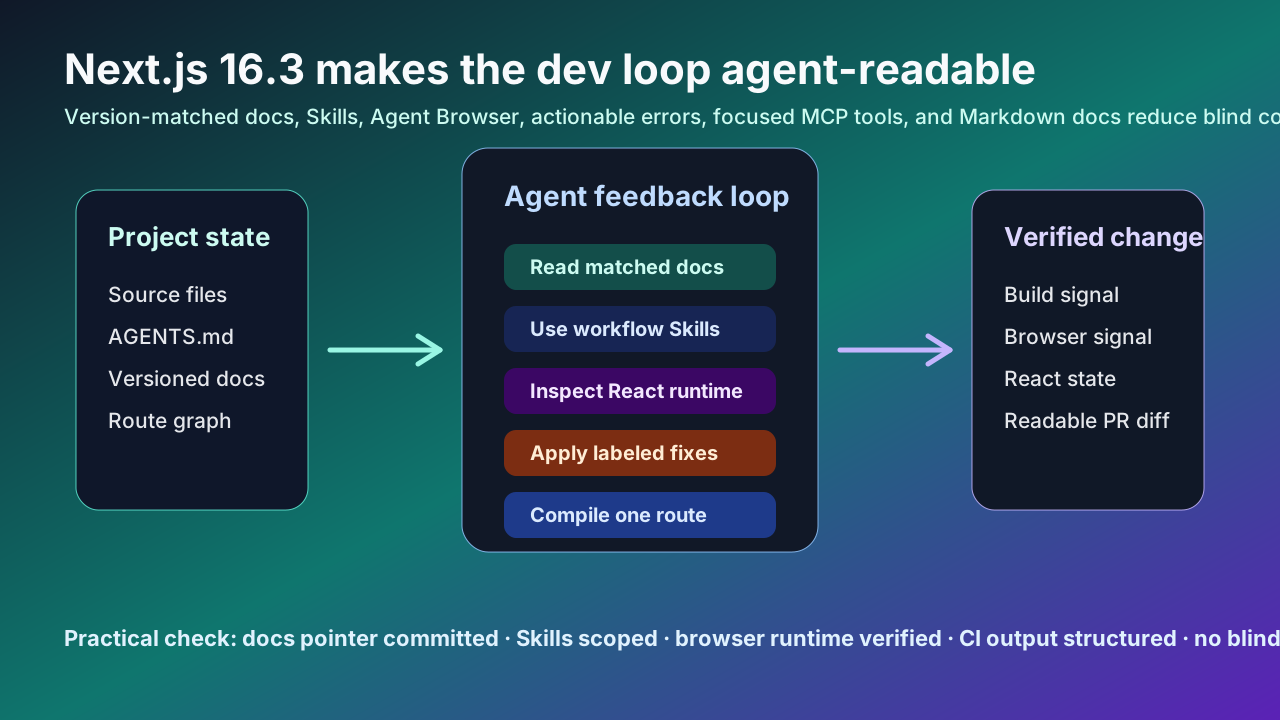
AI coding agents often fail on frontend work for a boring reason: they edit from partial evidence. They remember an older Next.js API, read a build error without checking the browser, place a Suspense boundary too high, or treat a Cache Components trade-off like a syntax fix. The June 26, 2026 Next.js 16.3 AI Improvements post is important because it makes the framework feedback loop legible to agents instead of asking agents to guess.
Agent-readable framework loop
The practical message of Next.js 16.3 AI Improvements is not that agents can write more Next.js code. It is that frameworks are starting to expose docs, errors, browser state, React runtime state, and compilation status as one readable feedback loop. Frontend productivity will depend less on model cleverness and more on whether the repo gives agents verifiable evidence.
What happened
The Next.js team published the 16.3 Preview under the @preview tag. The June 25 post covered Instant Navigations; the June 26 post focused on AI Improvements. The distinction matters. Instant Navigations introduces choices that make server-driven apps feel instant. AI Improvements explains how humans and agents can apply those choices with better evidence.
The release introduces six agent-facing surfaces. next dev can manage a version-matched docs pointer inside AGENTS.md when it detects an AI coding agent. First-party Skills cover multi-step workflows such as next-dev-loop, next-cache-components-adoption, and next-cache-components-optimizer. The experimental next-browser work merges into the broader agent-browser CLI, with React DevTools introspection in version 0.27. Instant Insights provides labeled fixes, terminal output, linked docs, and Copy as prompt. The DevTools MCP server becomes smaller and more diagnostic-focused. Finally, Next.js docs are readable as Markdown through .md, llms.txt, and llms-full.txt.
This is not just a list of AI conveniences. It is a framework deciding which evidence an agent should read before it changes code: local versioned docs, browser state, React component state, route compilation results, and error docs that explain patterns, trade-offs, and gotchas.
Why this matters to working developers
The first practical issue is version drift. Next.js has many surfaces whose meaning changes across releases: App Router behavior, Cache Components, Server Components, route segment config, Instant Navigations, and diagnostics. If an agent relies on training data, it can mix old APIs with new conventions. A managed AGENTS.md block tells the agent to read the docs bundled with the installed framework version.
The second issue is verification. A frontend change is not done when TypeScript passes. The browser may render the wrong shell, a component may receive unexpected props, a Suspense fallback may hide too much of the page, or a client interaction may break after hydration. Agent Browser with React introspection gives agents commands for component trees, component inspection, render profiling, suspense inspection, DOM, console, network, and Web Vitals.
The third issue is error semantics. Instant Insights does not merely say that an async read is invalid. It gives choices: Stream, Cache, or Block. Those are product decisions involving UX, freshness, loading UI, and caching policy. The useful part of the AI work is that the overlay, terminal, prompt copy, and documentation all push the agent toward a bounded fix instead of a broad rewrite.
The fourth issue is tool shape. The DevTools MCP server dropping broad knowledge tools and adding focused compilation tools is a strong signal. Knowledge belongs in versioned docs and Markdown. Running-state questions belong in small diagnostics tools such as get_compilation_issues and compile_route. Good agent integration is a set of narrow feedback channels, not one oversized magical tool.
Community signal
The official GitHub Discussion for the 16.3 Preview is already showing the questions that matter during adoption: build performance, static export limitations, partial prefetching, canary differences, and memory behavior. This should not be treated as benchmark data. It is useful as a narrative signal: teams are not only asking whether the feature is clever; they are asking whether it fits their build, deployment mode, routing model, and resource budget.
The direction also continues the 16.2 AI work. That release added agent-ready create-next-app, browser log forwarding, a dev server lock file, and experimental Agent DevTools. 16.3 turns the idea into a fuller loop: docs pointer, workflow Skills, React runtime inspection, actionable errors, MCP diagnostics, and Markdown docs.
For most teams, the question is no longer whether someone will use a coding agent. They already will. The question is whether the repository gives that agent the right docs and runtime evidence, or whether reviews are left cleaning up changes made from stale assumptions.
Development and operations impact
AGENTS.md becomes operational metadata. If the framework writes a managed rules block, code review should treat it as more than prompt decoration. It determines what the agent trusts when editing the app. Team-specific guidance should live outside the managed markers so upgrades can update the framework block safely.
Refactoring should become smaller and more verifiable. Cache Components adoption and Instant Navigation optimization are best handled route by route, with visible decisions about Stream, Cache, and Block. First-party Skills point in that direction by emphasizing incremental adoption, per-feature loops, browser inspection, and rollback when screenshots do not match expectations.
Local feedback and CI should divide responsibilities. Running next build after every edit is slow; editing without runtime checks is unsafe. Route-level compilation diagnostics from the dev server can provide fast local feedback, while CI remains the final broad guarantee.
Security also needs attention. Browser automation and MCP diagnostics can read console output, network requests, React state, cookies, and local app data. Teams should define agent-safe accounts, seed data, environment boundaries, and credentials before giving agents deep runtime access.
A practical checklist
1. Try Next.js 16.3 Preview on a branch before production and inspect the managed AGENTS.md block.
2. Keep team-specific agent rules outside the framework-managed markers.
3. Split Cache Components or Instant Navigation work by route and document why you choose Stream, Cache, or Block.
4. Require a browser verification loop with Agent Browser or Playwright after agent edits.
5. Do not close runtime issues such as hydration, Suspense, re-renders, or Web Vitals with source-only review.
6. Prefer focused MCP diagnostics such as compilation issues and single-route compile checks over broad knowledge tools.
7. Make terminal and CI output readable enough for agents, then constrain pasted prompts so they do not expand scope silently.
8. Use agent-safe test accounts and keep production credentials out of browser automation sessions.
Risks and counterarguments
The first risk is preview maturity. The official post says 16.3 Preview is ready for public testing and that a polished stable release is expected later. The right move today is rehearsal, not a rushed fleet-wide migration.
The second risk is over-trusting the agent. Copy as prompt and Skills can make fixes look mechanical, but Stream, Cache, and Block are still product decisions. An agent can apply a pattern; a developer still needs to own the UX, freshness, and data model trade-off.
A fair counterargument is that this is useful even without agents. That is exactly the point. Markdown docs, clearer error pages, route compilation diagnostics, and browser runtime inspection are good developer tools. Making feedback machine-readable often makes it clearer for humans too.
Feedback loop map
| Problem | Next.js 16.3 surface | Operational effect |
|---|---|---|
| Version drift | Managed AGENTS.md docs pointer | Agents read docs bundled with the installed framework version. |
| Workflow adoption | First-party Skills | Cache Components and instant navigation work move route by route. |
| Runtime truth | agent-browser React introspection | Agents inspect DOM, console, network, React tree, renders, and Suspense. |
| Fix choice | Actionable errors and Copy as prompt | Stream, Cache, and Block stay explicit product decisions. |
| Fast diagnostics | Focused DevTools MCP tools | Route compilation status can come from the running dev server. |
| Readable docs | .md, llms.txt, llms-full.txt | Agents get structured documentation without scraping UI pages. |
Next.js 16.3 Agent Loop Checklist
• Try Next.js
• 3 Preview on a branch before production and inspect the managed AGENTS.md block.