
GitHub Code Coverage merge protection: decide the rollout contract before the number
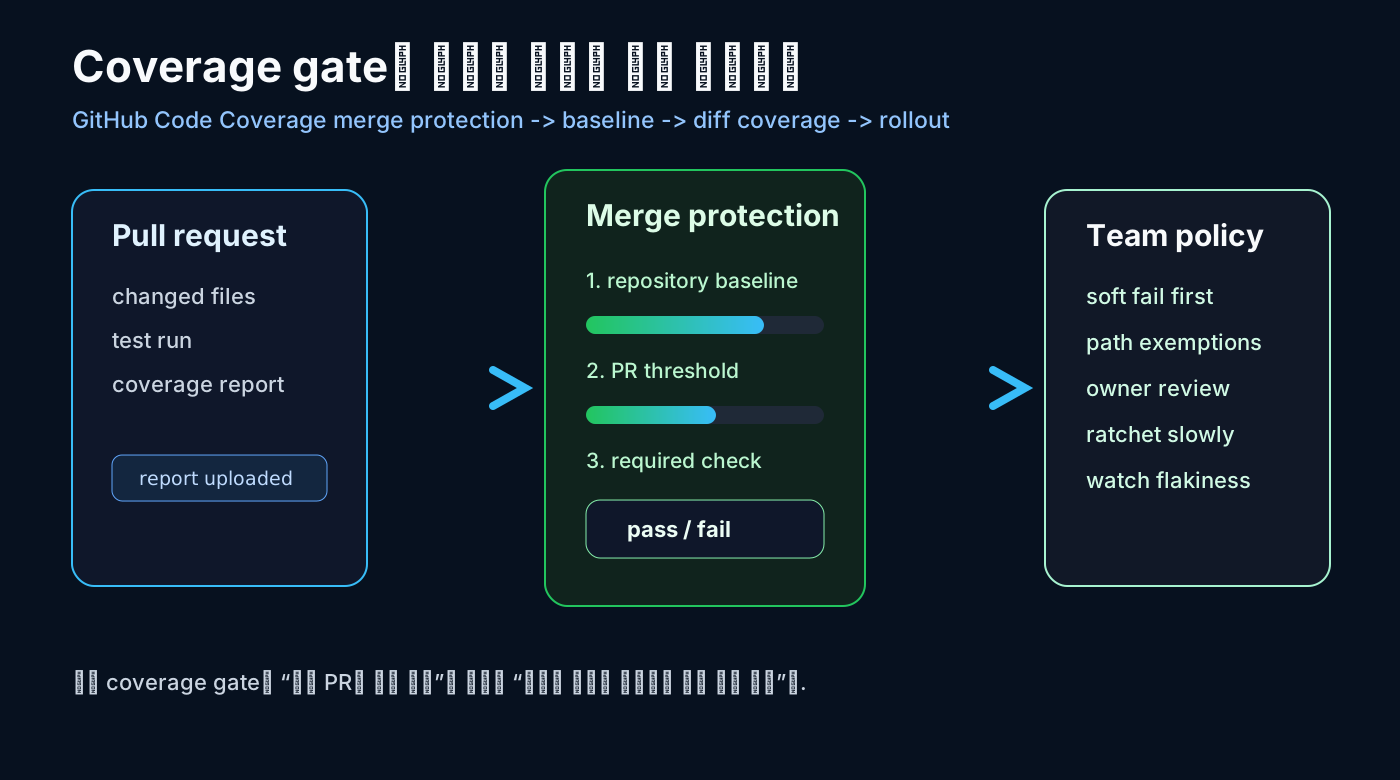
A coverage threshold can mature a team quickly, or it can create a factory of low-value tests written only to turn a check green. GitHub’s new Code Coverage merge protection brings that decision directly into repository policy.
What happened
On June 30, 2026, GitHub announced merge protection for pull requests through GitHub Code Coverage. The practical change is that repositories can configure pull request thresholds for code coverage or code quality, then block merges when a PR does not satisfy the configured rule.
GitHub’s documentation describes this as a pull request threshold workflow. Repository or organization administrators configure thresholds in GitHub Code Quality and connect the resulting check to rulesets or branch protection. Coverage therefore moves from a dashboard metric to a merge condition.
Teams should be precise about availability and permissions. The docs describe this in the context of GitHub Team or GitHub Enterprise Cloud and require appropriate repository or organization admin permissions. It should not be treated as a universal default on every GitHub repository.
Why it matters for working developers
Most engineering teams already run tests in CI. But “the test suite ran” and “this change did not weaken the test safety net” are different statements. A PR can touch important branches or error paths while the aggregate repository coverage barely moves.
The GitHub change matters because the coverage conversation now sits next to code review. Reviewers see the failing check on the pull request, authors need to explain the gap or add tests, and exceptions can be recorded in the same ruleset and review flow rather than scattered across chat.
It also reduces policy ambiguity. When quality checks live in separate CI products, engineers have to infer which failures block merge. When those checks are attached to branch protection or rulesets, the definition of a mergeable change becomes easier to understand.
Community signal: coverage gates are always political
Coverage thresholds have been controversial for years in developer communities. Hacker News and Reddit discussions repeatedly surface two valid concerns: high coverage does not prove high quality, while unbounded coverage regression creates long-term test debt. These discussions are useful as audience signals, not as factual sources for the GitHub feature itself.
The recurring worries are practical. Legacy codebases cannot jump to high thresholds overnight. UI and integration tests can be flaky. A strict number may incentivize shallow assertions that exercise lines without proving behavior.
So the useful question is not “what percentage should we require?” It is “which changes are not allowed to reduce coverage, which paths deserve exceptions, who can approve a drop, and how slowly do we ratchet the threshold upward?”
Operational impact
Once coverage is part of merge protection, it becomes deployment policy rather than a QA metric. If the policy is too weak, it becomes noise. If it is too strict, it blocks small changes and encourages workarounds. Monorepos, generated files, migration scripts, experimental packages, and platform-specific code make a single global number especially fragile.
A better operating model separates total coverage from diff coverage. Total coverage describes long-term health. Diff coverage describes whether the current change adds untested code. GitHub rulesets can carry the enforcement surface, but the threshold design still needs to reflect path, package, and risk level.
The second impact is review behavior. If every failure means “add tests or no merge,” developers optimize for the check. If exceptions require an explanation, an owner, and a recorded approval, teams can preserve both quality and delivery speed.
Rollout checkpoints
• Freeze the baseline before enforcing an aspirational target.
• Track diff coverage separately and apply stricter attention to new code.
• Record generated-code, migration, and fixture exclusions in review policy.
• Observe with soft fail before switching to hard fail.
A practical checklist
1. Save the current main-branch coverage as a baseline before enforcing an aspirational target.
2. Separate total coverage from changed-line or diff coverage, and apply stricter attention to new code.
3. Explicitly exclude generated code, schema migrations, locale bundles, fixtures, and files where coverage has little meaning.
4. Keep flaky and slow integration suites from undermining the coverage gate. Developers will not trust an unstable policy.
5. Define who can approve a coverage drop: code owners, platform leads, release managers, or a specific review group.
6. Ratchet thresholds gradually. Start by preventing regressions, then raise goals in small increments after the signal is stable.
7. Make failure messages actionable. A useful gate points to affected files, missing lines, and the exception path, not just a percentage.
Risks and counterarguments
The first risk is false confidence. High coverage does not guarantee meaningful assertions, realistic integration paths, or correct behavior under production data. Coverage gates supplement test quality; they do not replace it.
The second risk is development speed. Large repositories may pay significant CI time and compute cost when every PR produces full coverage reports. Changed-file reports, caching, parallelization, and package-level jobs can reduce the pain.
The third risk is organizational friction. If a hard merge blocker appears without context, teams will search for bypasses. A safer rollout starts with soft fail, observation, documented exceptions, and then hard enforcement once the signal is trusted.
Bottom line
The point of GitHub’s change is not “make every repository enforce 80% coverage.” It is that coverage thresholds can now become part of the pull request operating contract. Strong teams will define baseline, diff rules, exclusions, exception approvals, flaky-test handling, and rollout phases before choosing the number.
Sources
- GitHub Changelog: GitHub Code Coverage merge protection for pull requests
- GitHub Docs: Setting pull request thresholds for code quality and coverage
- GitHub Docs: Setting up code coverage for your repository
- GitHub Docs: About GitHub Code Quality
- GitHub Docs: About status checks
- GitHub Docs: About protected branches
- GitHub Docs: Interpreting code quality results