
Copilot billing moved to AI Credits: engineering teams now need AI FinOps
The most important Copilot change this week is not a new model picker or a slicker agent surface. It is the moment Copilot became an operational cost system. As of June 1, 2026, GitHub Copilot billing is live on GitHub AI Credits across all plans, and Copilot code review can consume GitHub Actions minutes in addition to AI Credits for private repositories. For engineering teams, the relevant question is no longer just “should we enable AI coding?” It is “which workflows deserve expensive model context, which reviews should run automatically, and who owns the monthly variance?”
What changed
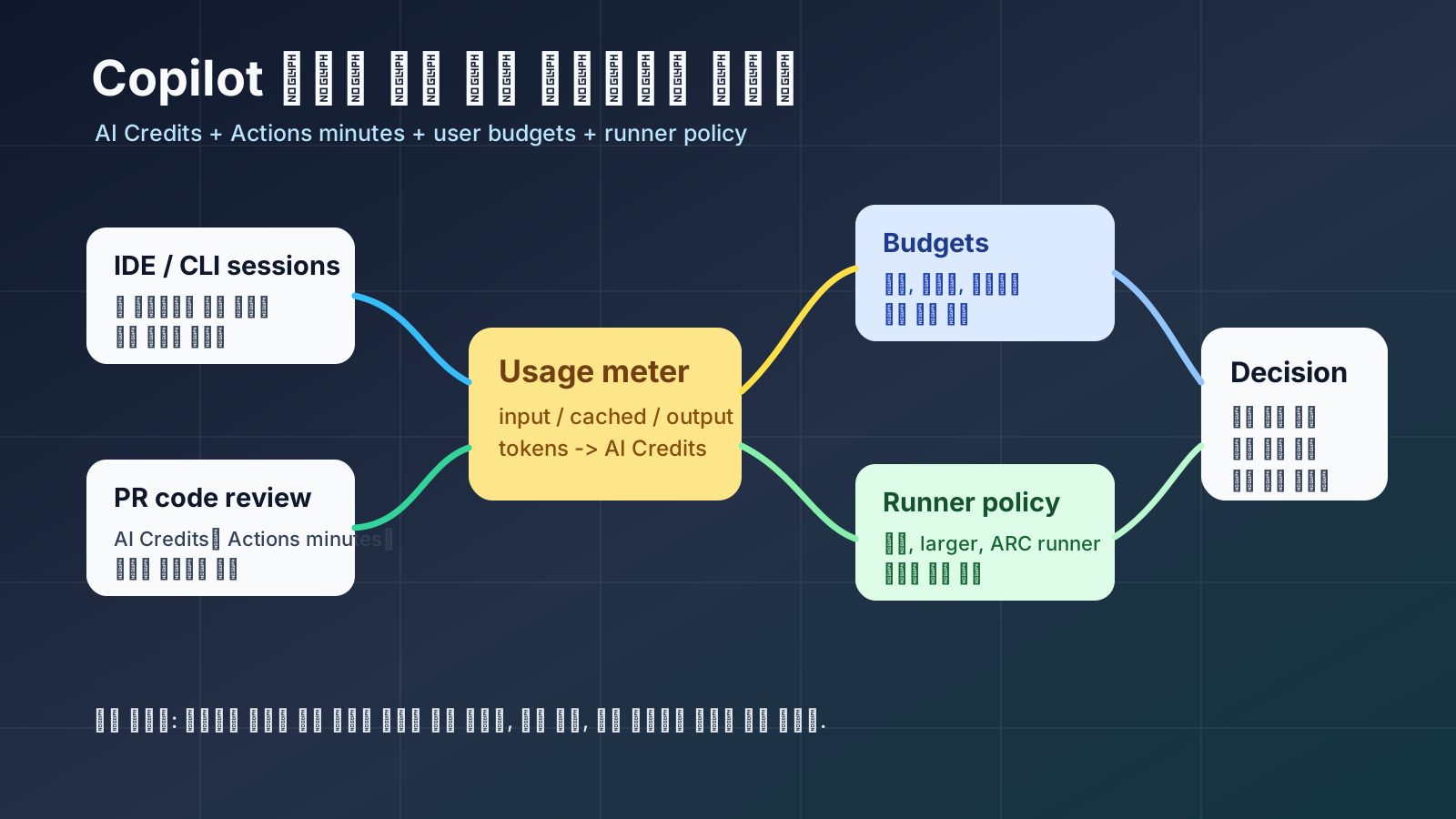
GitHub now measures Copilot usage in GitHub AI Credits. The billing documentation defines 1 AI Credit as 0.01 USD, with each plan carrying a monthly allowance. For organizations and enterprises, included credits can be pooled at the billing entity level, which means the cost model is shifting from a simple seat-count conversation to a portfolio of team behavior, model choice, context size, and agent usage.
Copilot code review adds a second operational surface. GitHub says code review uses GitHub Actions to run agentic capabilities such as full project context gathering. Starting June 1, 2026, each Copilot code review is billed as Copilot usage and also consumes Actions minutes for private repositories. The runner documentation matters here: the default is a standard GitHub-hosted runner, but admins can configure organization-level defaults, larger GitHub-hosted runners, or ARC-managed self-hosted runners. That makes code review policy a DevOps decision, not just an IDE preference.
Why it matters
AI coding cost is becoming proportional to workflow shape. Long CLI sessions, large repository context, high-end models, repeated agent retries, and automated PR reviews all have different cost behavior. A team that treats every task as a giant context window will see a different bill from a team that keeps prompts scoped, routes routine work to cheaper paths, and reserves frontier models for hard design or debugging work.
This changes incentives. Under a flatter request model, it was easy to standardize on the strongest available model and let developers experiment freely. Under usage-based billing, model selection becomes a policy lever. Teams need norms for when to ask an agent to inspect the whole repo, when a focused diff is enough, when Copilot review should be required, and when human review plus CI gives a better cost-to-signal ratio.
Community signal: the real issue is predictability
Recent coverage and community discussions show anxiety around possible bill increases and comparisons with other coding tools. These anecdotes should not be treated as universal pricing data, because they depend heavily on model choice, session length, repository size, and whether screenshots reflect comparable workloads. They are still useful signals. Developers are not only reacting to price; they are reacting to uncertainty. If the tool feels like a blank check attached to everyday work, adoption becomes politically fragile even when the feature is useful.
The double accounting for code review is another source of confusion. A developer experiences one action: request a Copilot review. The organization has to account for two resources: model inference through AI Credits and runner execution through Actions minutes. Unless those are shown together in internal dashboards, engineering managers will struggle to explain why a workflow became more expensive.
Expected impact on engineering operations
- PR review automation needs a gate. Running Copilot review on every private-repo PR may be convenient, but it is no longer cost-neutral. Consider labels, changed paths, risk tiers, or author opt-in rules.
- Model choice becomes budget design. Reserve stronger models for migrations, incident debugging, security-sensitive analysis, or complex architecture work. Use cheaper paths for explanations, commit messages, and small edits.
- Prompt hygiene becomes a team habit. Smaller task slices, relevant logs, focused diffs, and explicit acceptance criteria reduce token burn while often improving answer quality.
- Platform teams need a Copilot control plane. Budgets, runner defaults, usage metrics, and review policy should be visible together. AI coding is now part of developer platform operations.
A practical checklist for this week
- Separate Copilot AI Credit usage from GitHub Actions minutes in your billing review.
- Confirm organization, enterprise, user-level, or cost-center budgets before heavy agent adoption expands.
- Decide whether Copilot code review runs on all PRs or only on selected labels, paths, repository tiers, or risk classes.
- Review private-repository Actions minute headroom before increasing automated code review usage.
- Set a default runner policy and document exceptions for larger runners or ARC-managed self-hosted runners.
- Define when expensive models are justified and when default models or ordinary completions are enough.
- Add monthly reporting for AI Credits, Copilot review count, Actions minutes, and representative use cases by team.
Risks and counterarguments
Usage-based billing is not inherently irrational. Long-running agent sessions and quick completions do not have the same provider cost, and a usage model can make room for more capable tools. Pooled credits and user budgets can also be fairer than a one-size-fits-all allowance if a team has a small number of heavy users doing valuable work.
The risk is unmanaged ambiguity. Blocking AI tools outright will leave productivity gains on the table. Leaving every feature open without observability will create budget surprises and security edge cases. The pragmatic middle ground is to keep the tools available while adding measurement, budget limits, approval paths, and model routing.
Bottom line
Copilot’s June 2026 billing shift is a preview of agent-era developer operations. AI coding tools now need the same treatment as CI, cloud infrastructure, and observability: default policies, ownership, logs, budgets, and exception handling. The teams that handle this well will not be the ones that ban agents or blindly trust them. They will be the ones that turn agent usage into an observable, reviewable engineering system.
Sources
- GitHub Changelog: June 1 Copilot billing and plans update
- GitHub Docs: Copilot billing
- GitHub Docs: Configuring runners for Copilot code review
- GitHub Changelog: Copilot code review Actions minutes notice
- GitHub Docs: Copilot models and pricing
- GitHub Docs: Copilot usage metrics
- TechCrunch: developer reaction to token-based Copilot billing
- Reddit r/GithubCopilot: practitioner discussion on usage-based billing