
Korea’s Chip Cycle Split: Output Fell, but the Capex Signal Did Not Disappear
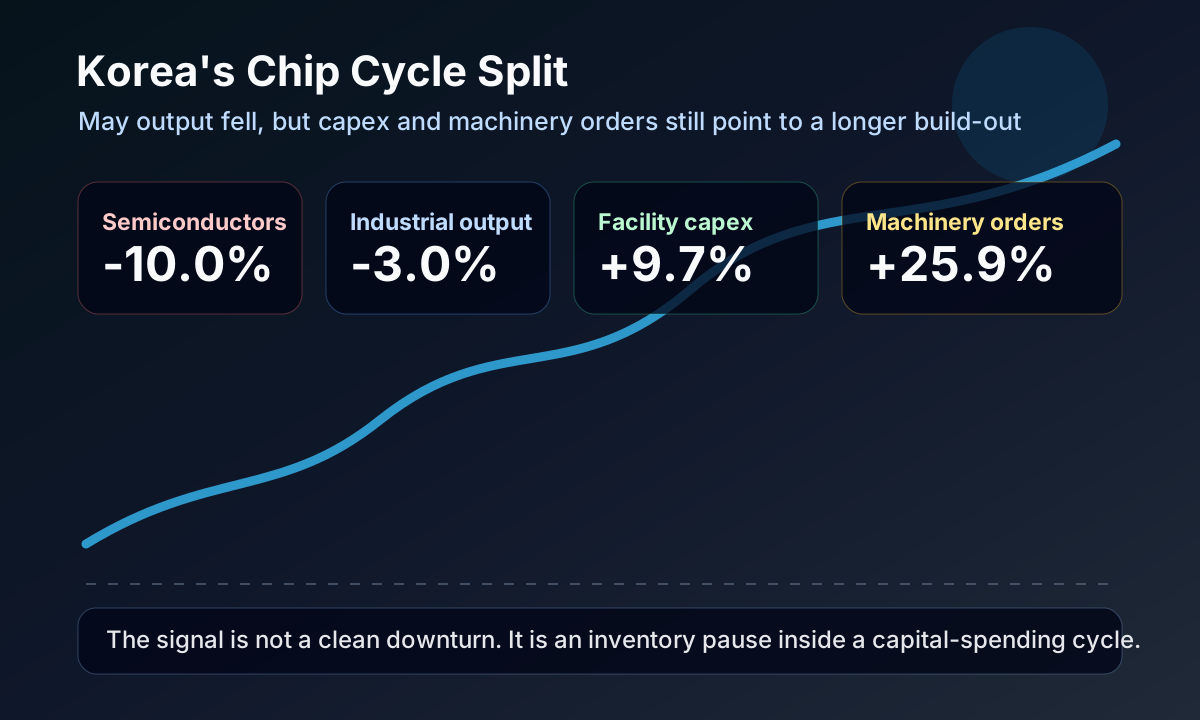
Korea’s factory data cooled sharply in May, but it did not send a clean recession signal. The Ministry of Data and Statistics reported on June 30, 2026 that all-industry production fell 0.3% month over month, while industrial production dropped 3.0%. The most visible move was semiconductors: output fell 10.0% from the prior month. Yet the same report showed facility investment up 9.7% from a year earlier and domestic machinery orders up 25.9%.
That combination matters more than the headline decline. The practical read is not “Korea’s chip cycle is over” and not “AI demand fixes everything.” It is that inventory, shipment timing and utilization can push current production lower while capital spending and machinery demand still reflect a longer build-out. For founders, solo operators, B2B SaaS teams and investors, the useful question is where cash flow sits in the chain: today’s production, tomorrow’s capacity, or the customer’s inventory.
Confirmed facts
- All-industry production fell -0.3% month over month in May 2026.
- Industrial production fell -3.0%, and semiconductor output fell -10.0%.
- Services output rose +0.1%, while retail sales rose +0.5%.
- Facility investment increased +9.7% from a year earlier, and domestic machinery orders increased +25.9%.
- Manufacturing inventories rose +1.5% month over month, and the average manufacturing utilization rate was 71.1%.
- The coincident composite index cyclical component rose +0.2p, while the leading composite index cyclical component rose +0.1p.
Interpretation: weaker output and higher capex are not contradictory
A 10% monthly drop in semiconductor production is a serious number, but semiconductor production is not a clean one-for-one proxy for final AI demand. Inventory, shipment schedules, customer qualification, product mix and price expectations all move the monthly series. A plant can slow output while the broader investment program keeps moving because the equipment cycle was committed months or years earlier.
That distinction is useful for small teams. If you sell software, components, data, training, logistics or energy-efficiency tools into semiconductor customers, one monthly production number should not decide your pipeline view. A production pause can coexist with active equipment budgets. The reverse is also true: strong revenue months can still hide inventory pressure that makes customers more conservative on payment terms.
Market narrative: AI demand meets inventory timing
The market story around Korea remains dominated by AI servers, HBM, data-center investment and large semiconductor clusters. AP’s reporting on Korea’s chip-cluster policy context captures the long-cycle build-out narrative. The May industrial activity report adds the operating reality: that narrative does not convert into a straight line every month. AI demand can be structurally strong while orders, inventories, utilization and supplier cash flow still move unevenly.
This is not a stock call. It is a reminder to separate confirmed data from interpretation. Confirmed: output fell, inventories rose, and investment indicators stayed positive. Interpretation: May looks like an inventory and timing pause inside a capital-spending cycle, not a simple demand collapse.
| Indicator | Latest signal | Practical read |
|---|---|---|
| All-industry production | -0.3% m/m | The headline was pulled down by manufacturing volatility rather than broad weakness alone. |
| Semiconductor output | -10.0% m/m | A monthly inventory and shipment signal, not proof that final AI demand collapsed. |
| Facility investment | +9.7% y/y | Longer-cycle capacity spending has not disappeared. |
| Domestic machinery orders | +25.9% y/y | Equipment, parts and automation demand can lag production data. |
| Manufacturing inventories | +1.5% m/m | A cash-flow signal that can pressure pricing, margins and payment terms. |
Checklist for builders and investors
What to check after this release
• B2B teams selling into manufacturing should check customer inventories and utilization before updating revenue plans.
• Equipment, parts and automation suppliers should separate weak current production from still-active capex segments.
• SaaS teams should track budget approval cycles, payment terms and proof-of-concept conversion rather than leaning on the phrase “AI demand.”
• Investors should read output, inventories, orders, capex and leading indicators together, not as isolated signals.
• Small companies should model how power, FX, wages and financing costs around chip clusters affect local operating costs.
The first second-order effect is payment discipline. When inventories rise, customers have a stronger reason to preserve cash. Suppliers should watch days sales outstanding, upfront payment ratios, cancellation terms and renewal language before celebrating booked revenue.
The second effect is regional cost pressure. Long-cycle chip investment can keep demand high for engineers, power, cooling, logistics and housing even when one month of production slows. A production pause does not immediately remove the local infrastructure squeeze.
The third effect is valuation dispersion. A production drop can weigh on near-term earnings expectations, while positive machinery orders and facility investment can support parts of the equipment, materials and automation chain. The question is less “chips up or down” and more “where in the chain does cash convert fastest?”
Risks and counterarguments
One month does not define a cycle. Semiconductor output can swing because of base effects, product mix, process adjustments and shipment timing. Facility investment and machinery orders also react with a lag because they reflect projects decided earlier. If inventories keep rising and utilization keeps falling, the May decline could become more than noise. For now, the confirmed fact is a split signal, and the interpretation is that Korea’s chip economy is managing inventory inside an ongoing investment cycle.
Disclaimer: This article is informational content for understanding markets and economic data. It is not financial advice and is not a recommendation to buy, sell or hold any security, bond, property or financial product.