
Korea’s credit split: household loans +₩8.3tn, SME bank lending only +₩1.7tn
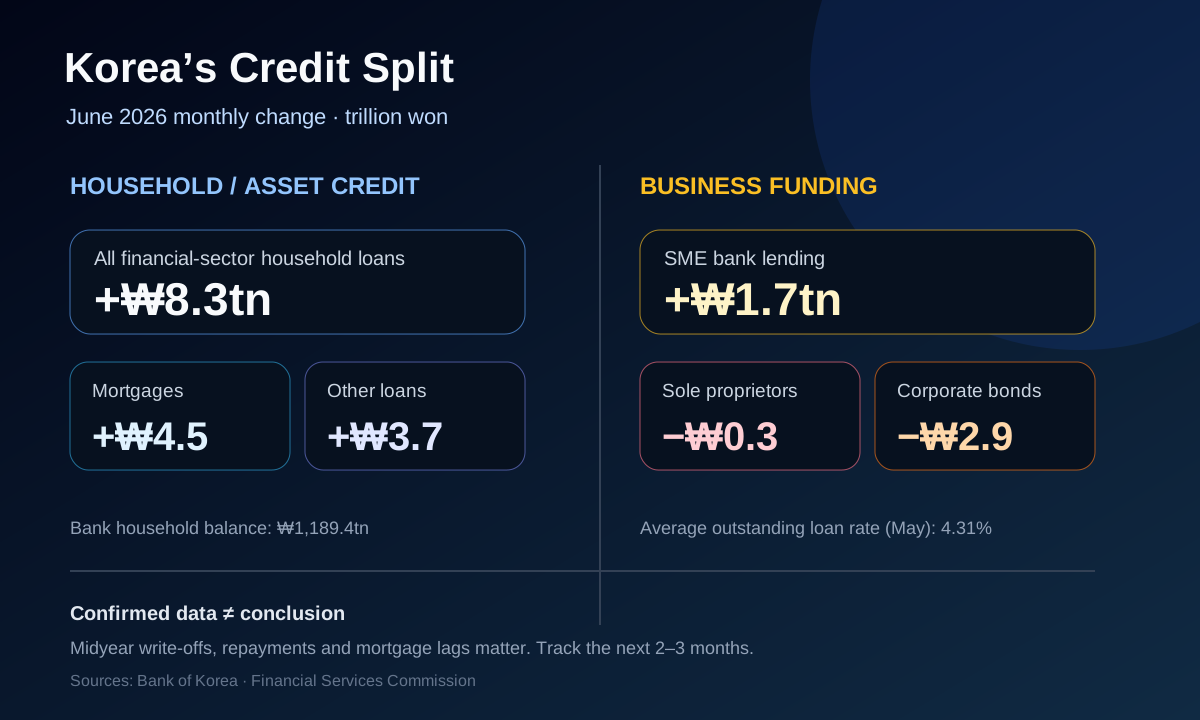
Korea’s June credit data displays two economies on one screen. Household loans across the financial system increased by ₩8.3 trillion, including ₩7.6 trillion at banks. Mortgages rose, but so did other borrowing that includes unsecured credit. On the other side, the monthly increase in bank lending to SMEs slowed from ₩5.4 trillion in May to ₩1.7 trillion in June, while loans to sole proprietors fell by ₩0.3 trillion.
It would be too strong to conclude that banks abandoned business to finance homes and stocks. Midyear write-offs, balance-sheet management, and the lag between housing contracts and mortgage drawdowns all affect the month. The decision-useful question remains: when asset prices attract collateralized credit, what happens to teams that must borrow against revenue and cash flow rather than property?
Confirmed facts: ₩8.3tn to households, a ₩1.7tn SME flow
- The Financial Services Commission reports that total financial-sector household loans increased by ₩8.3 trillion in June 2026. That was below May’s ₩9.3 trillion but above the ₩6.5 trillion increase in June 2025. Mortgages rose ₩4.5 trillion and other loans ₩3.7 trillion.
- Bank household loans rose ₩7.6 trillion, while non-bank loans rose ₩0.7 trillion. System-wide unsecured credit growth slowed from ₩3.6 trillion in May to ₩2.6 trillion in June but remained strongly positive.
- The Bank of Korea puts bank household-loan balances at ₩1,189.4 trillion at end-June. Housing-related loans increased ₩4.3 trillion and other loans ₩3.3 trillion. The BOK explicitly cited expanded personal stock investment and unsecured borrowing as contributors.
- Bank corporate lending increased ₩5.1 trillion, down from ₩10.6 trillion in May. The SME component slowed from ₩5.4 trillion to ₩1.7 trillion. Loans to small corporations rose ₩1.9 trillion, while lending to sole proprietors fell ₩0.3 trillion.
- Market funding was not an easy substitute: public corporate bonds recorded net redemption of ₩2.9 trillion and commercial paper or short-term notes net redemption of ₩1.7 trillion. The BOK cited higher issuance costs and midyear balance-sheet management.
- The price of credit remains material. The BOK held its policy rate at 2.50% on May 28. Average rates on new loans were 4.19% in May and the average on outstanding loans was 4.31%. Total household credit stood at ₩1,993.1 trillion at end-March.
Interpretation: credit did not disappear; it tilted toward collateral and momentum
The confirmed point is the divergence in monthly flows. The inference is about underwriting. Housing offers collateral, while a rising brokerage account makes momentum visible. Software, teams, customer relationships, and future recurring revenue are harder to seize or value. Under uncertainty, lenders can favor assets with a clearer recovery path.
For a founder, this shows up before an outright rejection: a smaller limit, more collateral, a personal guarantee, a shorter maturity, or the use of personal credit to bridge payroll before customer cash arrives. Household and corporate balance sheets then reconnect through the founder.
Investors should focus on the direction of leverage. Borrowed money can amplify volume and valuations in an upswing, but principal and interest do not fall when asset prices do. That asymmetry is why the FSC specifically warned about leveraged investing and unsecured-credit volatility.
Market narrative: liquidity boom or poor credit allocation?
Two popular stories compete: “liquidity is back” and “money is leaking from the real economy into assets.” Each is incomplete. Bank deposits increased by ₩28.8 trillion in June, yet asset-manager inflows fell by ₩11.7 trillion, and foreign investors sold a net ₩57.5 trillion of Korean shares. This looks less like uniform abundance and more like rapid reallocation.
Nor does one weak SME month prove a credit crunch. Write-offs, reduced lending by some policy banks, and seasonal repayments mattered. A structural signal would require several months of weak SME and sole-proprietor lending alongside rising rates or delinquencies.
Second-order effects small teams may feel first
Founder balance-sheet risk
When corporate working capital is tight, the founder’s mortgage, credit line, or card becomes the emergency facility, merging household and business downside.
A higher cash-flow discount rate
A 30-day collection delay becomes more expensive. Cash conversion and interest coverage matter more than headline growth.
Stronger collateral preference
Terms can diverge between firms with property or guarantees and teams whose value sits in code, people, and contracts.
Uneven consumer demand
Asset winners may spend more, while leveraged households cut subscriptions, dining, and discretionary services first.
Policy volatility
Tighter controls on mortgages or unsecured loans can change limits and approval standards before funding closes.
Risks and counterarguments
A single month is noisy. Write-offs and midyear balance-sheet actions mean June’s SME slowdown is not proof of a structural credit crunch.
Mortgage drawdowns reflect housing transactions and presales approved two to three months earlier, not only fresh June demand.
Household borrowing is not synonymous with speculation. It includes home purchases, interim payments, living costs, and refinancing.
Slower bank lending might reflect a shift to bonds or internal cash, although net redemptions in bonds and CP make the adequacy of that substitute worth checking.
This week’s operating checklist
Build a 13-week cash forecast that separates company cash from the founder’s personal credit.
Stress revenue down 15%, collections 30 days late, and loan rates up one percentage point at the same time.
Prepare guarantees, policy finance, receivables funding, and customer prepayment—not just one bank limit.
Do not place investment leverage and household or business emergency liquidity on the same collateral.
Track SME and sole-proprietor loan flows, new and outstanding loan rates, and bond or CP net issuance monthly.
This article provides economic and market context for informational purposes only and is not financial advice. Make investment and funding decisions independently based on your cash flow, debt structure, horizon, and risk tolerance.