
Korea added 63,000 jobs—but youth employment and manufacturing tell a different story
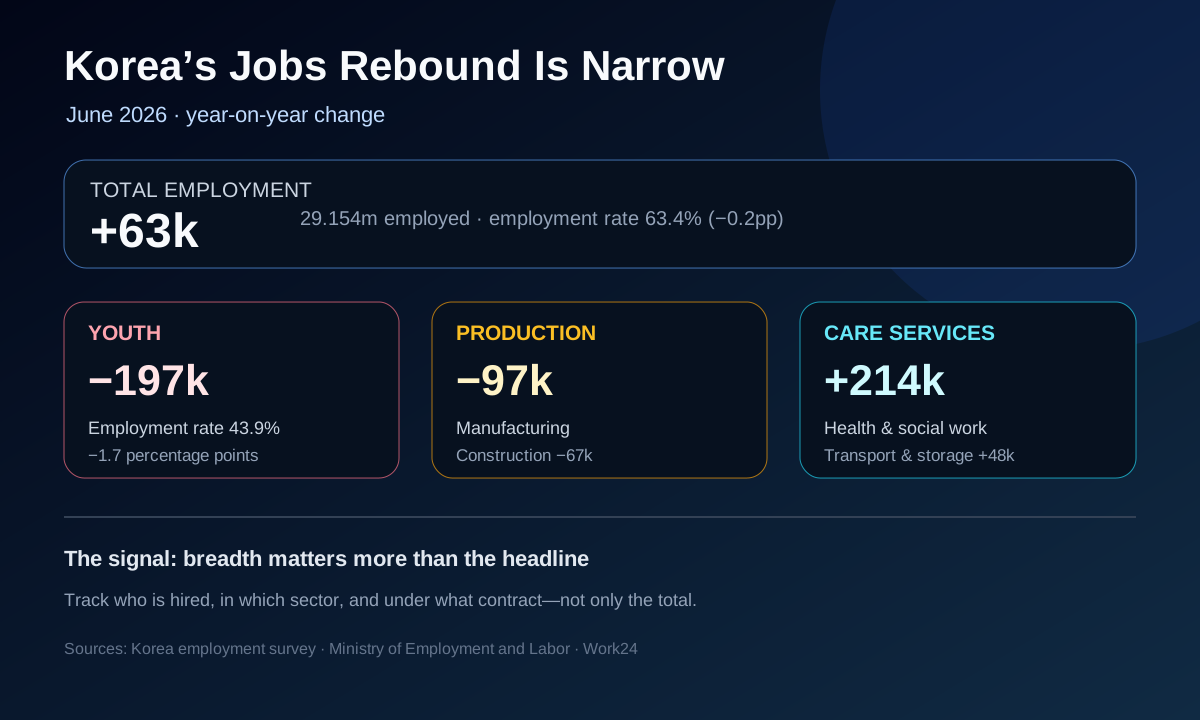
Korea added 63,000 jobs from a year earlier in June, reversing May’s 40,000 decline. That headline sounds like a bottom. The same release shows a 1.7-percentage-point fall in the youth employment rate to 43.9%, 97,000 fewer manufacturing jobs, and 67,000 fewer construction jobs. Health and social work added 214,000.
The decision-useful question is not simply whether jobs rose. It is where the jobs appeared, who gained access, and which incomes can support future demand. For a small company this affects hiring supply and customer spending; for an investor it affects the breadth of domestic earnings. A small aggregate rebound can coexist with a narrow labor market.
Confirmed facts: a positive total with weak entry points
- The official household survey counted 29.154 million employed people in June 2026, up 63,000 year over year after a 40,000 decline in May. The headline employment rate fell 0.2 percentage point to 63.4%; the age-15-to-64 rate fell 0.1 point to 70.2%. Unemployment was unchanged at 2.8%.
- Youth employment fell by 197,000. The youth employment rate dropped 1.7 points to 43.9%, the youth unemployment rate rose 0.9 point to 7.0%, and the broader youth underutilization measure edged up 0.1 point to 16.4%.
- The sector split was stark: health and social work added 214,000 jobs, arts, sports and recreation added 55,000, and transport and storage added 48,000. Manufacturing lost 97,000, agriculture and fisheries 95,000, and construction 67,000. Manufacturing employment has declined for 24 consecutive months.
- Permanent employees rose by only 16,000, while temporary workers fell by 51,000 and daily workers by 45,000. Employers who are self-employed increased by 95,000 and own-account workers by 72,000.
- The inactive population rose by 181,000 to 16.009 million. People classified as preparing for employment fell by 26,000 to 624,000; that decline can reflect hiring, but also movement out of active preparation.
- Administrative insurance data cover a different population. Insured workers rose by 264,000 to 15.855 million, driven by 279,000 service-sector additions, while manufacturing fell 9,000 and construction 8,000. Those two sectors have declined for 13 and 35 consecutive months respectively in the insurance series.
- Work24 recorded 183,000 new vacancies, up 21.4%, and 384,000 new job seekers, down 0.8%. Vacancies per registered seeker improved to 0.48 from 0.39, but remained below one.
Interpretation: the constraint is breadth, not only speed
The confirmed evidence ends with a small aggregate gain led by care-oriented services and continued weakness for young entrants, manufacturing, and construction. The interpretation is that Korea is running several labor cycles at once. Care and logistics demand can remain firm while production, building, and first-job pathways stay narrow.
A semiconductor-led export and investment boom need not create jobs in proportion to revenue. Capital-intensive companies can deliver strong output and profit with limited incremental hiring. “Exports are strong” and “young consumers have stronger income prospects” therefore require separate evidence.
The household survey and employment-insurance data are not contradictory. One includes self-employed, daily, and uninsured workers; the other observes insured payrolls. Reading both exposes movement between stable payroll work, self-employment, and short-duration jobs.
Market narrative: rebound or job-light growth?
Public debate is split between relief that employment is positive again and concern that AI and chip profits are not opening entry-level career paths. Both can be true. Officials noted that chip-led growth may have a relatively limited employment multiplier, but also cautioned that one monthly survey cannot isolate AI’s effect on jobs.
The 21.4% rise in vacancies is constructive, yet seasonality, sector mix, job quality, and completion rates matter. A vacancy is not automatically a suitable first job. If location, pay, experience requirements, and career path do not match applicants, openings can rise while youth employment falls.
Second-order effects for operators and investors
Delayed youth demand
Later first jobs and unstable income can postpone subscriptions, housing moves, appliances, education, and travel. Youth-facing products should watch conversion and churn, not only aggregate consumption.
An experience bias in hiring
Uncertain companies prefer immediately productive hires. Paid work trials, apprenticeships, and explicit 90-day outcomes can preserve a junior talent pipeline.
Sector-specific B2B risk
Care and logistics may sustain efficiency spending, while manufacturing and construction buyers may lengthen approval and payment cycles. Pipeline probabilities should differ by sector.
More self-employment competition
Rising employer and own-account counts can reflect opportunity or a fallback from wage work. Products for small merchants should track customer survival and cash collection.
Policy-counting risk
Training and short public jobs can enter labor statistics differently. Announced participant counts are not the same as durable income creation.
Risks and counterarguments
Year-over-year comparisons include demographics and base effects. A smaller youth population explains part, but not all, of a falling youth employment rate.
One month does not establish a recovery. Use at least a three-month view and seasonally adjusted data.
Do not assume care jobs are low quality. Without wage and hours data, this release cannot measure job quality.
Vacancies are not completed hires and may include repeat postings or mismatched terms.
This week’s operating checklist
Segment customers by labor-market temperature: youth consumption, care and logistics, and manufacturing or construction.
Compare one experienced hire with a paid project internship or a 90-day junior track.
Stress manufacturing and construction receivables with a 30-day contract delay and a 45-day payment delay.
Track youth employment, manufacturing and construction jobs, worker status, and vacancies per seeker—not only total jobs.
Avoid attributing the move to AI alone; verify industry, age, occupation, and contract status separately.
This article provides economic and market context for informational purposes only and is not financial advice. Make investment, hiring, and operating decisions independently based on your cash flow, horizon, and risk tolerance.