
Korea’s 18.7% Terms-of-Trade Jump: The Semiconductor Boom Does Not Erase the Cost Squeeze
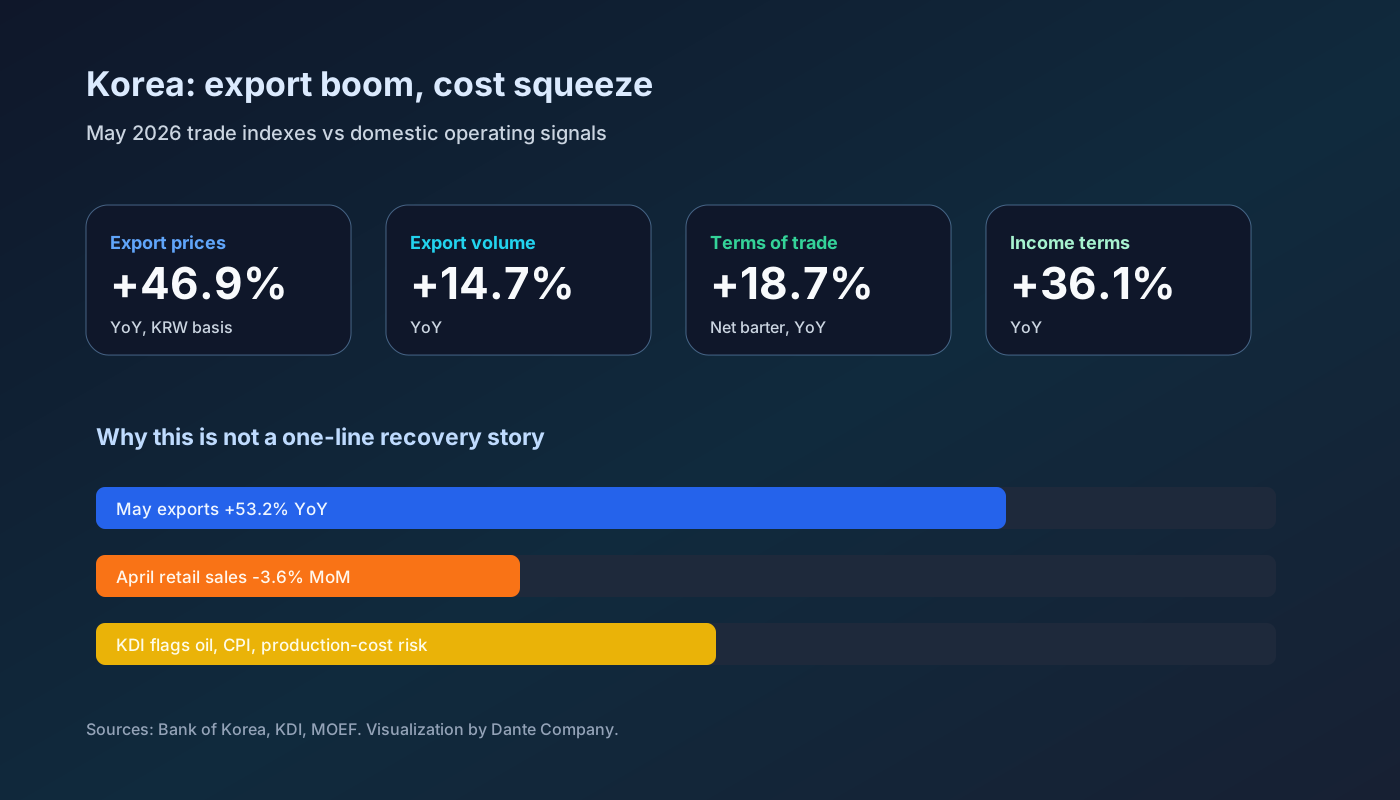
At the headline level, Korea looks like a clean semiconductor-boom story. On June 16, 2026, the Bank of Korea released May export/import price indexes and trade indexes: the net barter terms-of-trade index rose 18.7% year over year, the income terms-of-trade index rose 36.1%, and export volume rose 14.7%.
The practical question for founders, solo builders, and investors is narrower: when does that national-level improvement reach your customer, your margin, your FX bill, and your cash runway? The Ministry of Finance and Economy’s June current-economic report also showed April retail sales and facility investment down 3.6% month over month, while May employment fell by 40,000 from a year earlier. KDI described a modest semiconductor-led improvement, but it also flagged Middle East war risk, oil-shipping disruptions, higher inflation, and rising production costs.
Confirmed Facts
The Bank of Korea release is strong on trade prices. Export prices in Korean won rose 0.3% from the previous month and 46.9% from a year earlier in May 2026. Import prices fell 0.3% month over month but remained 24.8% higher year over year. Export volume increased 14.7%, while import volume rose 5.2%.
The Ministry of Finance and Economy reported that May exports climbed 53.2% year over year and average daily exports rose 60.7%. In the same June update, April overall industrial production fell 0.6% month over month, retail sales dropped 3.6%, and the consumer sentiment index improved to 106.1, up 6.9 points. The report still pointed to pressure from prices and slower employment growth.
KDI’s June Monthly Economic Trends summarized the economy as improving modestly, led by the semiconductor upcycle. It also warned that oil-shipping disruptions from the Middle East war were pushing up consumer inflation and production costs. In its first-half outlook, KDI projected 2026 GDP growth around 2.5%, CPI inflation around 2.7%, private consumption growth around 2.2%, and export growth around 4.6%.
Interpretation: Export Strength Must Become Cash Flow
A terms-of-trade jump is a real macro tailwind. It means the country earns more purchasing power from exports relative to imports. But it does not mean every company’s margin improves. Semiconductor prices can lift national averages while non-chip manufacturers, local service firms, online operators, and teams paying dollar-denominated cloud or AI bills experience a different cost curve.
For operators, the question is not simply “are exports strong?” The question is whether customer purchasing power and your cost base are improving at the same time. Semiconductor-adjacent B2B, equipment, logistics, and data-center suppliers may see faster budget flow. Consumer services, education, content, and subscriptions still need to verify actual conversion, downgrades, and churn.
| Signal | Confirmed fact | Decision read |
|---|---|---|
| External engine | Export prices +46.9% YoY; export volume +14.7% YoY; net barter terms of trade +18.7% YoY | A real macro tailwind, but concentrated around semiconductors and export winners |
| Domestic demand | April retail sales -3.6% MoM; consumer sentiment 106.1 in May after a 6.9-point rise | Sentiment improved, but actual spending and employment need separate checks |
| Cost risk | KDI flags oil-shipping disruptions, high oil prices, higher CPI, and production-cost pressure | Do not assume export strength automatically protects local margins |
Market Narrative Signal
The market narrative is leaning toward “the semiconductor supercycle is Korea’s macro shield.” A rebound in sentiment, rising stocks, and stronger export prices support that story. The other official signal is domestic-demand elasticity. If retail sales are soft and employment momentum weakens, the profit gains of export champions may take longer to reach local service demand.
The useful read is neither pure optimism nor pessimism. Korea’s external earning power has improved, but the mismatch between export winners and domestic cost pressure may widen by sector.
Second-Order Effects
First, dollar revenue and dollar costs can diverge. Export giants benefit from global demand and stronger prices, while small domestic teams still pay for cloud, AI APIs, ads, and overseas SaaS in dollars. Second, labor-cost pressure can become localized: semiconductor and AI-infrastructure roles can tighten while local service operators remain unable to pass through prices.
Third, investors should follow the transmission path, not just the export headline. Better terms of trade can support the current account and currency stability, but renewed oil stress or geopolitical risk can quickly return through production costs. Fourth, small businesses should update pricing, cost, and cash-flow assumptions more frequently instead of waiting for a broad recovery to arrive.
Checklist for Small Teams and Investors
• Separate customers exposed to semiconductor/export capex from customers exposed to domestic consumption, then track conversion and churn separately.
• Recalculate three-month cash flow under three FX scenarios for cloud, AI API, ad, and overseas SaaS costs.
• Test pricing through new plans, annual options, and usage-based components before broad increases.
• Prioritize B2B accounts near semiconductor, equipment, logistics, and data-center budgets where actual spending may arrive first.
• For investments, read Korea’s export boom together with terms of trade, oil, employment, and retail sales rather than as a single bullish line.
Risks and Counterarguments
The main counterargument is that the semiconductor boom may spread more broadly than expected. When export prices and volumes are both strong, investment, wages, equity wealth, and sentiment can reinforce one another. In that case, weak domestic indicators may simply be lagging.
The downside is also clear. If KDI’s oil-shipping and high-energy-cost risks persist, production costs and consumer prices can reaccelerate. May trade indexes also capture a specific month’s price and volume effects. A semiconductor price correction or a currency move would change the operating picture quickly.
Disclaimer: This article is for informational and economic interpretation purposes only. It is not financial advice, an investment recommendation, or legal or tax advice.