
OECD’s Energy Shock Warning: Even the AI Boom Has to Respect Cost Structure
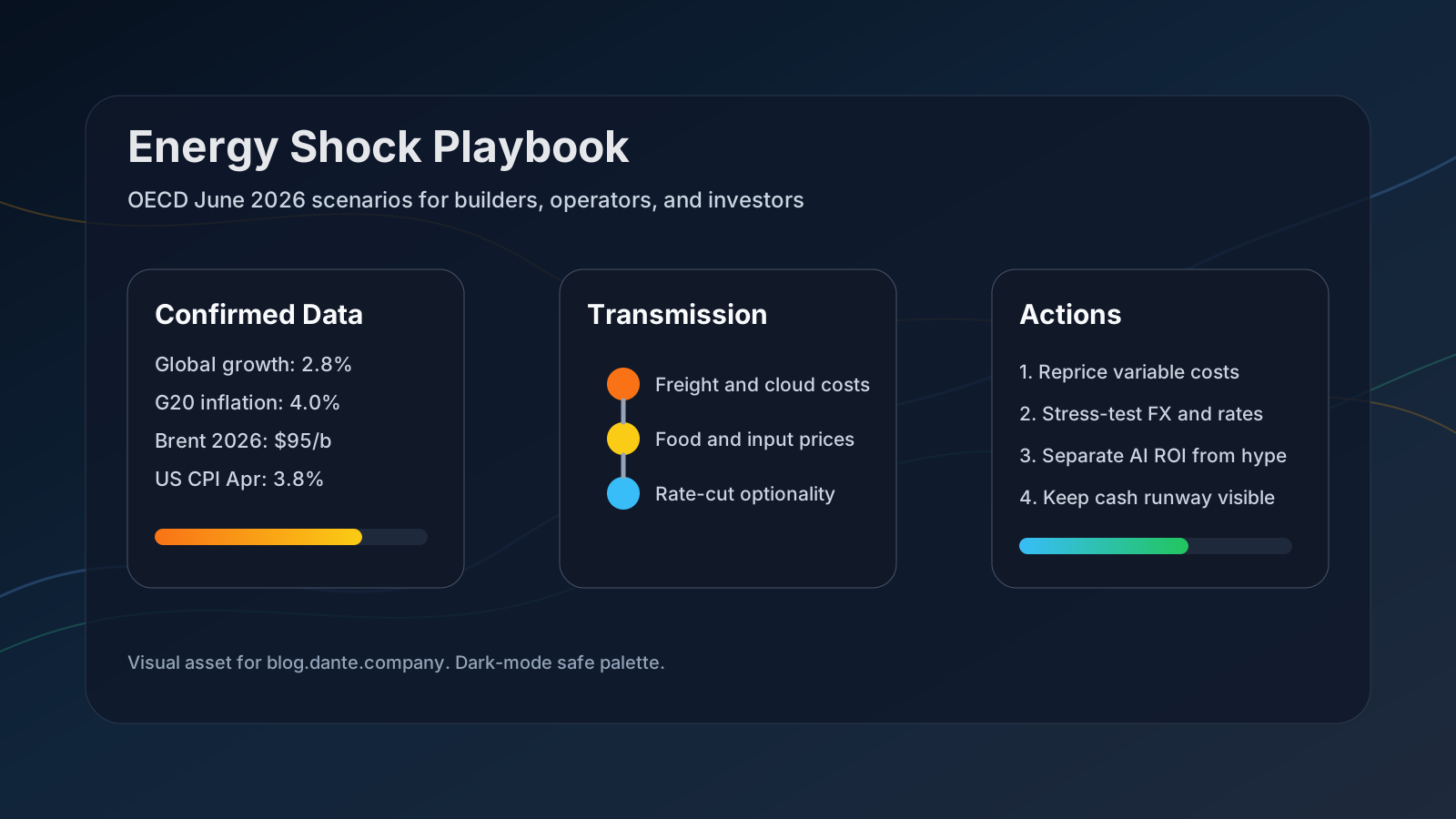
Markets like clean stories: inflation cools, central banks cut, risk assets re-rate, and AI capex keeps carrying growth. The OECD’s June 2026 Economic Outlook makes that story harder to run without a footnote. In its time-limited disruption scenario, global growth slows from 3.4% in 2025 to 2.8% in 2026, while G20 inflation rises from 3.4% to 4.0%. In the prolonged disruption scenario, global growth falls to 2.1% in 2026 and 1.8% in 2027.
The practical issue is not simply that oil is higher. It is the transmission path: energy into freight, electricity, food and fertiliser, cloud infrastructure, data-centre operating costs, rate expectations, and ultimately valuation multiples. For a solo builder paying dollar-denominated cloud bills, a SaaS team adding AI features, or an investor holding expensive growth assets, that path can hit cash flow before it shows up in a polished quarterly narrative.
Confirmed Facts
- The OECD time-limited disruption scenario projects global GDP growth of 3.4% in 2025, 2.8% in 2026, and 3.1% in 2027.
- The same scenario puts G20 consumer inflation at 3.4% in 2025, 4.0% in 2026, and 3.1% in 2027.
- The OECD prolonged disruption scenario lowers global growth to 2.1% in 2026 and 1.8% in 2027, with G20 inflation at 4.4% in both years.
- The EIA May 2026 STEO projects Brent crude at an average of $95/b in 2026 and $79/b in 2027, with prices around $106/b in May and June.
- U.S. April CPI rose 0.6% month over month and 3.8% year over year; the energy index rose 17.9% year over year. BEA reported the April PCE price index up 3.8% from a year earlier.
| Signal | Confirmed number | Operating read |
|---|---|---|
| OECD time-limited disruption | 2026 global growth 2.8%; G20 inflation 4.0% | Budget for slower demand and stickier costs. |
| OECD prolonged disruption | 2026 global growth 2.1%; 2027 growth 1.8% | Stress-test runway, credit, and high-multiple exposure. |
| EIA May STEO | Brent 2026 average $95/b; May-June around $106/b | Treat energy as an operating input, not a headline variable. |
| U.S. April inflation data | CPI and PCE price index both +3.8% year over year | Expect central banks to wait for cleaner evidence. |
Interpretation: cost pass-through now matters more than the rate-cut story
The confirmed facts point in one direction: lower growth, higher inflation. The harder question is whether central banks should look through a supply shock or react to second-round effects. The OECD says a supply-driven price rise can be tolerated if inflation expectations remain anchored, but policy adjustment may be needed if price pressures broaden or growth weakens significantly. That is not a simple “cuts are coming” setup. It is a narrower policy corridor.
AI does not sit outside this macro loop. The OECD launch statement flagged that energy accounts for around 60% of data-centre operating costs, making a prolonged shock a direct threat to one of the growth engines that has been offsetting weakness elsewhere. For AI product teams, the unit economics question becomes sharper: inference cost per active user, gross margin by feature tier, regional cloud pricing, and the payback period of free usage all matter more when energy is no longer a background variable.
Market and Community Narrative Signals
Public investing forums and pre-market notes are clustering around phrases such as “stagflation lite,” delayed rate cuts, and AI power costs. Those are not standalone facts. They are useful narrative signals: they show which risks people may try to price first. The factual base should remain primary sources such as the OECD, EIA, BLS, and BEA; the community layer is useful only for deciding which questions to pressure-test.
Likely Second-Order Effects
- Energy-importing economies in Asia and Europe face a tighter margin squeeze when fuel prices and currencies move against them together.
- The United States gets some offset from energy exports, but gasoline, electricity, and food prices still erode consumer purchasing power.
- AI infrastructure companies should be assessed not only on revenue growth, but also on power procurement, long-term energy contracts, and data-centre efficiency.
- Small teams may see cloud, payments, logistics, FX, and travel costs move before ad budgets or salaries can be adjusted.
Checklist for Small Teams, Builders, and Investors
- Split the next 90 days of expenses into fixed costs and usage-linked costs: cloud, API calls, shipping, travel, electricity, and FX fees deserve separate lines.
- If your costs are dollar-denominated, model base, 5% weaker local currency, and 10% weaker local currency cases against monthly cash flow.
- For AI features, track inference cost per user next to conversion rate and payback period. Free usage can quietly destroy gross margin.
- For portfolios, look first at discount-rate sensitivity, expensive growth exposure, private-credit risk, and cash allocation before chasing energy-shock beneficiaries.
- If pricing must change, start with overage usage, expensive regions, and premium AI features rather than a blunt across-the-board increase.
Counterarguments and Risks
The optimistic case is real. If the conflict eases and energy and fertiliser prices fall faster than assumed, inflation pressure can fade and growth can recover. The OECD estimates that an additional 10% decline in oil, gas, and fertiliser prices from the second half of 2026 would lift 2027 global growth by 0.1 percentage point and reduce global inflation by 0.3 percentage point. Faster AI productivity gains could also absorb part of the shock. The operating point, however, is simple: budgets should survive the cost-first scenario before they rely on the relief scenario.
Disclaimer
This article is informational economic commentary, not financial advice. It does not recommend buying, selling, or holding any specific asset.