
Oracle’s $638B Backlog Shows AI Cloud Is Now a Capital Game
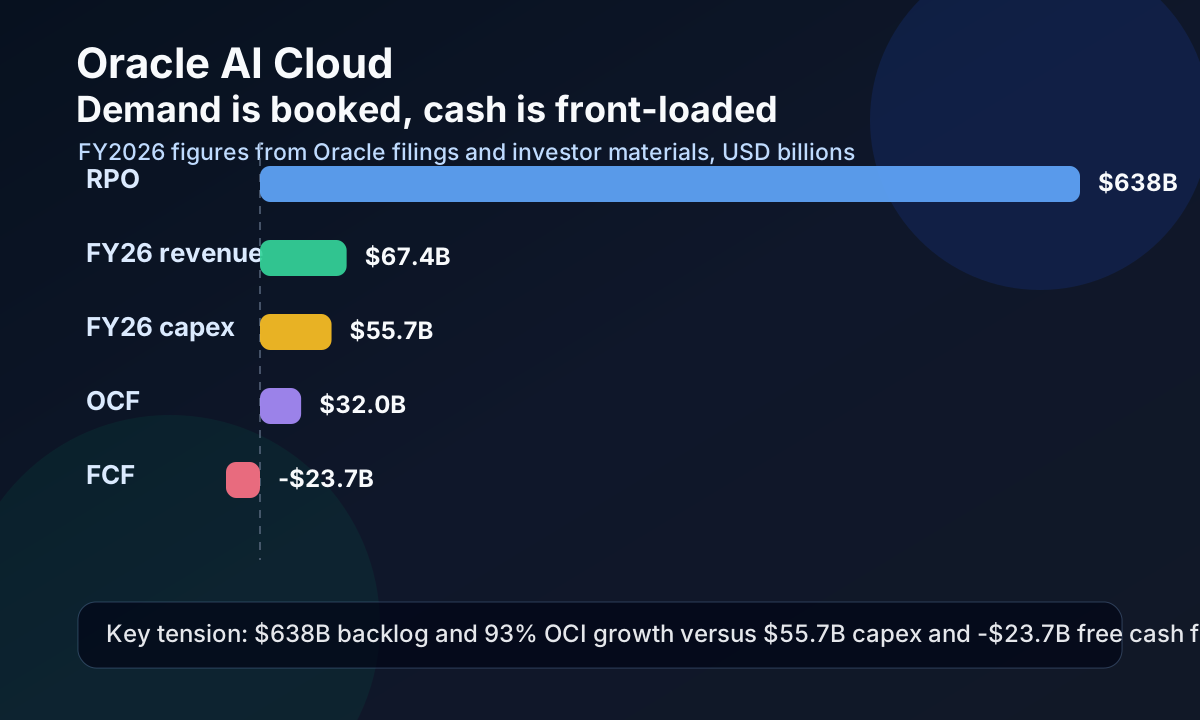
The important question in AI cloud is no longer just who has access to GPUs. It is who can finance, power, deploy and contract that capacity without breaking the economics. Oracle’s fiscal 2026 results make that shift visible. Demand is enormous, but converting that demand into revenue requires data centers, power, networking, GPUs, customer prepayments, debt and equity capital to move together.
This is not a stock recommendation. It is a practical read for founders, SaaS operators, small AI teams and investors who need to understand how the economics of AI capacity may flow into product pricing and vendor risk. The core point: AI cloud is sold like software, but it increasingly behaves like infrastructure project finance.
Confirmed facts
- Oracle reported Q4 fiscal 2026 results on June 10, 2026. Q4 revenue was $19.2 billion, up 21% year over year, and Q4 cloud revenue was $9.9 billion, up 47%.
- Q4 Cloud Infrastructure, or IaaS, revenue was $5.8 billion, up 93% year over year. Full-year fiscal 2026 Cloud Infrastructure revenue was $18.1 billion, up 77%.
- Fiscal 2026 total revenue was $67.4 billion, and total cloud revenue was $34.0 billion. Software revenue declined 1% for the full year to $24.5 billion.
- Remaining Performance Obligations, or RPO, rose from $553 billion at the end of Q3 to $638 billion at the end of Q4. Oracle reported RPO growth of 363% year over year.
- Oracle said most of the RPO increase in Q3 and Q4 came from large-scale AI contracts where customers prepaid Oracle to buy GPUs or bought and supplied GPUs to Oracle. The prepaid and customer-supplied hardware portions of those large AI contracts now total $75 billion.
- Fiscal 2026 operating cash flow was $32.0 billion, but free cash flow was negative $23.7 billion as Oracle invested in Cloud Infrastructure. Trailing-four-quarter capital expenditures were $55.663 billion.
- Oracle raised $43 billion of debt financing and $5 billion of equity financing in fiscal 2026. For fiscal 2027, it expects to raise about $40 billion through debt and equity, including a previously announced $20 billion at-the-market equity issuance.
Interpretation: backlog is not revenue; it is a promise to build
A $638 billion RPO balance is a powerful demand signal. But it is not the same thing as cash revenue. It is contract value that still needs to be delivered and recognized. In AI cloud, delivery means building or reserving data centers, electricity, GPUs, networking and operational capacity before the customer can fully consume the service. Oracle’s numbers therefore shift the question from “is there demand?” to “what balance-sheet structure turns demand into usable capacity?”
Customer-funded GPUs reduce that tension. If customers prepay for GPU purchases or supply the hardware themselves, Oracle does not need to fund the entire buildout alone. For smaller teams, however, that structure can still change how cloud capacity is sold downstream. Premium AI capacity may increasingly be allocated through reservations, minimum commitments, prepaid credits, regional limits, model restrictions and enterprise contracts rather than simple on-demand pricing.
That means AI product teams need to look beyond the API list price. They should understand how their vendors finance capacity, how commitments show up in contracts, and whether their own product creates sharp usage peaks. The bottleneck is no longer just GPU sticker price. It is the cost of capital and the structure of capacity allocation.
Market narrative: strong growth, heavy cash demand
The market read was mixed. Oracle showed strong cloud growth, fast OCI expansion and a huge RPO base. Investors also focused on capital expenditures and negative free cash flow. That reaction is not a source for the accounting facts, but it is a useful signal of what the market is trying to resolve: AI infrastructure can create revenue growth while pulling cash forward.
The recurring question is whether the backlog converts into profitable, recurring revenue fast enough to justify the buildout. A related question is whether customer prepayments reduce risk or increase dependence on a few very large AI buyers. These are not Oracle-only questions. They are the same pressures that eventually influence AI SaaS pricing, usage caps, contract length and vendor lock-in for smaller buyers.
Second-order effects for small teams
What operators should check now
• Contract shape: month-to-month usage, prepaid credits, reserved capacity and minimum commitments have very different risk profiles.
• Cost dashboard: separate inference cost by user, feature, peak hour, cache hit rate and failed agent loop.
• Supplier risk: dependence on one cloud, one model or one region weakens your negotiating power.
• Pricing policy: “unlimited AI” can damage gross margin when capacity is funded through longer and more rigid commitments.
• Customer contracts: if you resell AI-heavy features, make sure enterprise contracts let you pass through exceptional usage or infrastructure cost changes.
First, high-end AI capacity may start to look more like electricity capacity than normal software. If you reserve it and do not use it, it still costs money. If you do not reserve it, service quality can break during demand spikes. Second, AI pricing moves from token math alone to capacity reliability: can your vendor actually serve peak workflows at the price you promised customers? Third, the supplier’s cost of capital can indirectly affect your cloud bill through contract terms, discount structures and usage caps.
For founders, this is a product strategy issue. AI features need routing, caching, batching, usage limits and feature-level cost allocation from the beginning. For investors, it is an accounting interpretation issue. Large backlog is not automatically good, and negative free cash flow is not automatically bad. The decisive questions are conversion speed, customer prepayment durability and whether capital spending turns into high utilization.
Risks and counterarguments
The strongest counterargument is that Oracle’s structure may actually reduce risk. Customer prepayments and customer-supplied GPUs can make the buildout more defensible than speculative capacity expansion. A contracted RPO base is different from building data centers on hope. Oracle also has a large database and enterprise applications footprint that can pull AI workloads into existing customer relationships.
The risks are still real. RPO does not guarantee timing or margin. Customer concentration can shift negotiating power toward the largest buyers. Faster model efficiency could change how much capacity is needed for a given workload. If rates rise again or credit markets tighten, AI cloud expansion becomes a financing problem as much as a technology problem.
Disclaimer: This article is for informational purposes only and is not financial advice or a recommendation to buy, sell or hold any security. Make investment decisions independently based on your own financial situation and risk tolerance.