
Stablecoins just moved from payment innovation to regulated infrastructure: the cost small teams need to price in
The first cost is not gas. It is customer identification.
The stablecoin payments story no longer ends with faster transfers. On June 18, 2026, the Federal Reserve Board requested comment on a proposal that would require certain payment stablecoin issuers to maintain effective customer identification programs comparable to those required of banks and credit unions. On the same day, FinCEN said it had joined the OCC, Fed, FDIC, and NCUA in proposing a rule to implement the GENIUS Act customer identification requirement.
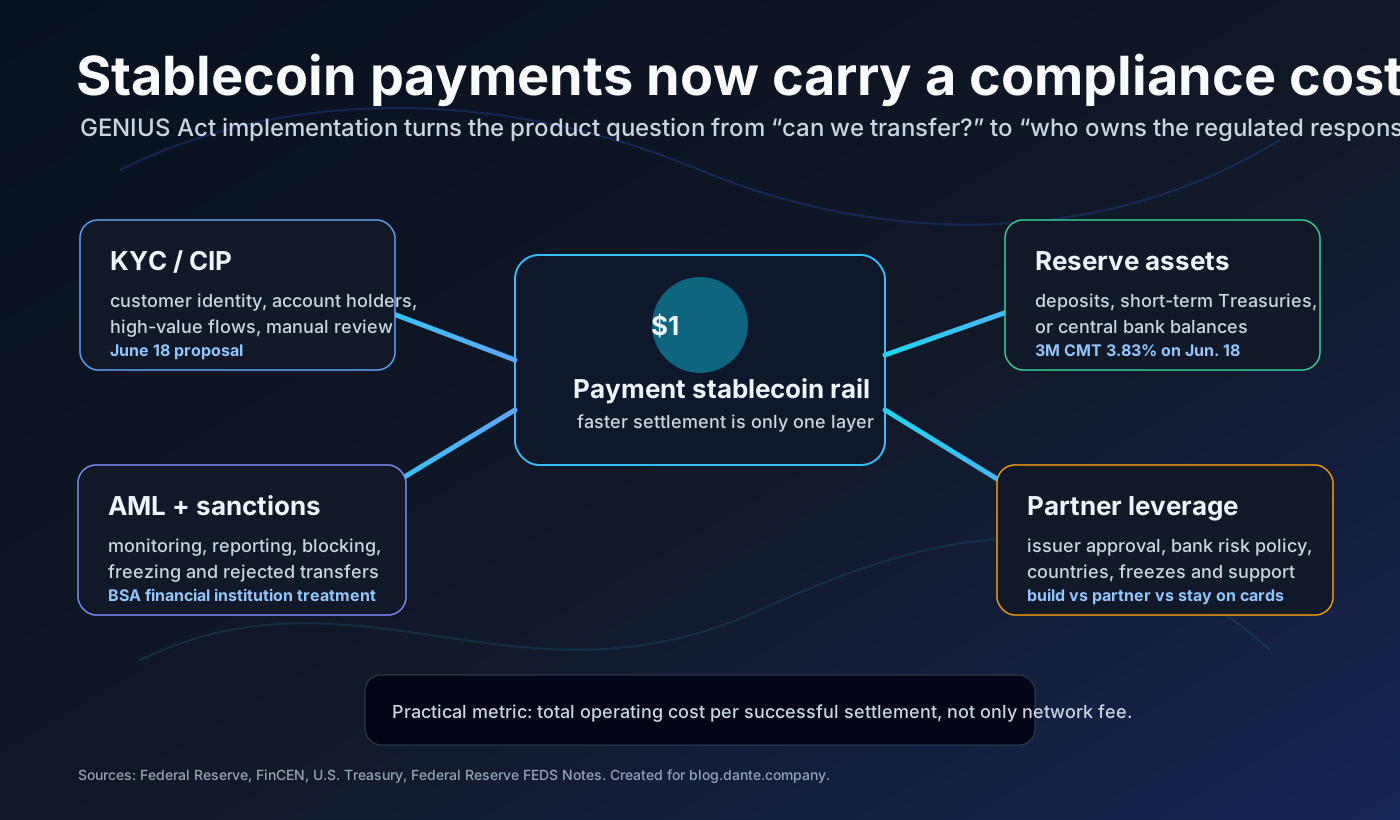
For small payment teams, global SaaS operators, creator payout platforms, and businesses paying overseas contractors, this is more practical than the slogan that crypto has gone mainstream. Stablecoin payments now need to be understood through customer identification, sanctions screening, suspicious-activity monitoring, reserve-asset economics, partner-bank exposure, and support operations.
The point is neither hype nor dismissal. Payment stablecoins may reduce cross-border payment frictions. But once they become a regulated payment rail, the operating model starts to look less like a lightweight API and more like financial infrastructure. Small teams need to decide whether they want to become an issuer, build on top of a licensed issuer, or keep using existing card and banking rails.
Confirmed facts
- On June 18, 2026, the Federal Reserve Board requested comment on a proposal to require certain payment stablecoin issuers to maintain effective customer identification programs. The Fed said the requirements would be comparable to customer identification program requirements for banks and credit unions.
- FinCEN said the proposal was issued jointly with the OCC, the Federal Reserve, the FDIC, and the NCUA to implement provisions of the GENIUS Act. FinCEN described the Act as directing that permitted payment stablecoin issuers be treated as financial institutions under the Bank Secrecy Act and maintain effective customer identification programs.
- The Fed said comments are due 60 days after publication in the Federal Register. This means the June 18 action is proposed rulemaking, not a final rule.
- On April 1, 2026, Treasury issued an NPRM on principles for deciding whether state-level payment stablecoin regulatory regimes are substantially similar to the federal framework. Treasury said payment stablecoin issuers with consolidated total outstanding issuance of no more than $10 billion may opt for state-level regulation if the state regime is substantially similar to the federal framework.
- Treasury and FinCEN separately proposed rules treating permitted payment stablecoin issuers as financial institutions for Bank Secrecy Act purposes, imposing anti-money-laundering obligations and requiring effective sanctions compliance programs.
- A March 2026 Federal Reserve FEDS Note explains that payment stablecoins must be backed by relatively safe assets such as deposits at depository institutions, short-term U.S. Treasury securities, and balances in Federal Reserve accounts. The note also says the law prohibits payment stablecoin issuers from directly paying interest.
- The Treasury data center showed Daily Treasury Par Yield Curve CMT Rates for June 18, 2026 of 3.83% for three months, 4.00% for one year, and 4.46% for ten years. When reserve assets can sit in short-term Treasuries, interest rates become part of the product economics.
Interpretation: this is payment infrastructure with regulatory cost inside
The biggest change is that the product pitch now has two sides. The old pitch emphasized 24/7 settlement, cheaper cross-border payments, and dollar-denominated balances. The new pitch must also answer who can be onboarded, who screens sanctions risk, who monitors suspicious activity, and who manages reserves and liquidity.
If issuers cannot directly pay interest, reserve-asset income becomes a strategic variable. In a short-rate environment around the 3% to 4% range, the economics between issuers and platforms matter. Customers may see lower transfer fees, while operators absorb KYC, AML, sanctions screening, bank partner fees, reserve operations, audits, legal review, and customer support.
The founder question is therefore not simply whether to add stablecoins. It is which layer of responsibility to own. Becoming an issuer may create a larger margin pool but brings regulatory and operational risk. Building on top of a licensed issuer can speed up launch but gives the partner leverage over revenue share, freezing policies, supported geographies, and approval rates. Staying with cards and banking rails is familiar but may lag in global settlement speed and cost.
Market and builder narrative signal
The market narrative is shifting from “the U.S. is embracing stablecoins” to “licensed issuers and bank-connected platforms may capture the regulated layer.” That is not a prediction of winners. It is a direction created by the policy design. As customer identification and AML obligations become more important, capital, legal capacity, banking relationships, and risk systems become competitive advantages.
Builder questions are shifting as well. The useful questions are no longer only which chain or wallet to integrate. Teams now have to ask whether a non-custodial wallet user is a customer, how to handle foreign-customer KYC failure, how to screen high-risk jurisdictions in real time, and how to explain settlement delays or blocked transfers in the product.
Second-order effects: lower payment fees can still mean higher operating complexity
First, SaaS teams and marketplaces with cross-border payouts should not look only at transaction fees. Faster settlement can still produce customer-support costs when onboarding fails, transfers are delayed, accounts are frozen, or sanctions filters generate false positives. The better metric is total operating cost per successful settlement.
Second, licensed issuers and bank partners may gain bargaining power. If a small team cannot carry the regulatory burden directly, partner fees, risk policies, supported countries, and API reliability become the real payments infrastructure. Differentiation may come less from the blockchain chosen and more from onboarding, settlement explanations, dispute handling, and accounting reports.
Third, short-term Treasury yields become part of stablecoin economics. Higher reserve yields can support issuer profitability, but because direct interest payments are prohibited, how users benefit depends on product design and regulatory interpretation. If short rates fall, a hidden subsidy behind low-cost payments can weaken.
Fourth, investors should not value stablecoin revenue by transaction volume alone. The better checklist includes outstanding issuance, reserve-asset mix, bank partner concentration, regulatory jurisdiction, onboarding conversion, monitoring costs, freeze and refund policies, and auditability.
Checklist for founders, operators, and investors
• Before adding stablecoin payments, document which roles you own: issuer, payment processor, wallet, custody, FX, reconciliation, and customer support.
• Review a partner issuer’s regulatory status, supported geographies, KYC failure process, account-freeze procedure, sanctions-screening responsibility, and API incident terms.
• Model KYC failure rates, manual-review time, customer-support tickets, refund handling, and dispute costs beside headline payment fees.
• For global SaaS products, put country eligibility, onboarding limits, and settlement-delay explanations inside the product flow.
• For investments, prioritize net revenue after compliance cost, dependence on reserve income, partner concentration risk, and auditable internal controls before headline transaction volume.
Counterarguments and risks
There is a strong counterargument. Clear rules can make large enterprises, banks, and payment networks more comfortable adopting stablecoins. If customer identification and AML processes become standardized, institutional customers may face less legal uncertainty, and businesses with expensive cross-border settlement may still save real money.
The June 18 customer identification action is also proposed rulemaking, not a final rule. Scope, definitions, timing, and implementation details can change after public comment. The immediate job for small teams is not to assume a specific final rule, but to stop treating stablecoin payments as a regulation-free fast lane.
The same applies to investors. The payments innovation story is real, but regulated payments businesses compound through compliance capacity and operating leverage, not volume alone. Stablecoins may still be a large opportunity, but the opportunity now has to be priced on top of a more financial-institution-like cost structure.
This article is informational commentary about markets, regulation, and business strategy. It is not financial advice or a recommendation to buy or sell any security.
Sources
- Federal Reserve Board, payment stablecoin customer identification proposal, June 18 2026
- FinCEN, agencies propose GENIUS Act customer identification program rule, June 18 2026
- U.S. Treasury, GENIUS Act state-level regulatory regime NPRM, April 1 2026
- U.S. Treasury, GENIUS Act illicit-finance rule proposal, April 2026
- Federal Reserve FEDS Notes, Payment Stablecoins and Cross Border Payments, March 30 2026
- U.S. Treasury data center, Daily Treasury Par Yield Curve CMT Rates, June 18 2026