
Vercel eve turns agents into folders: the operating contract teams should define first
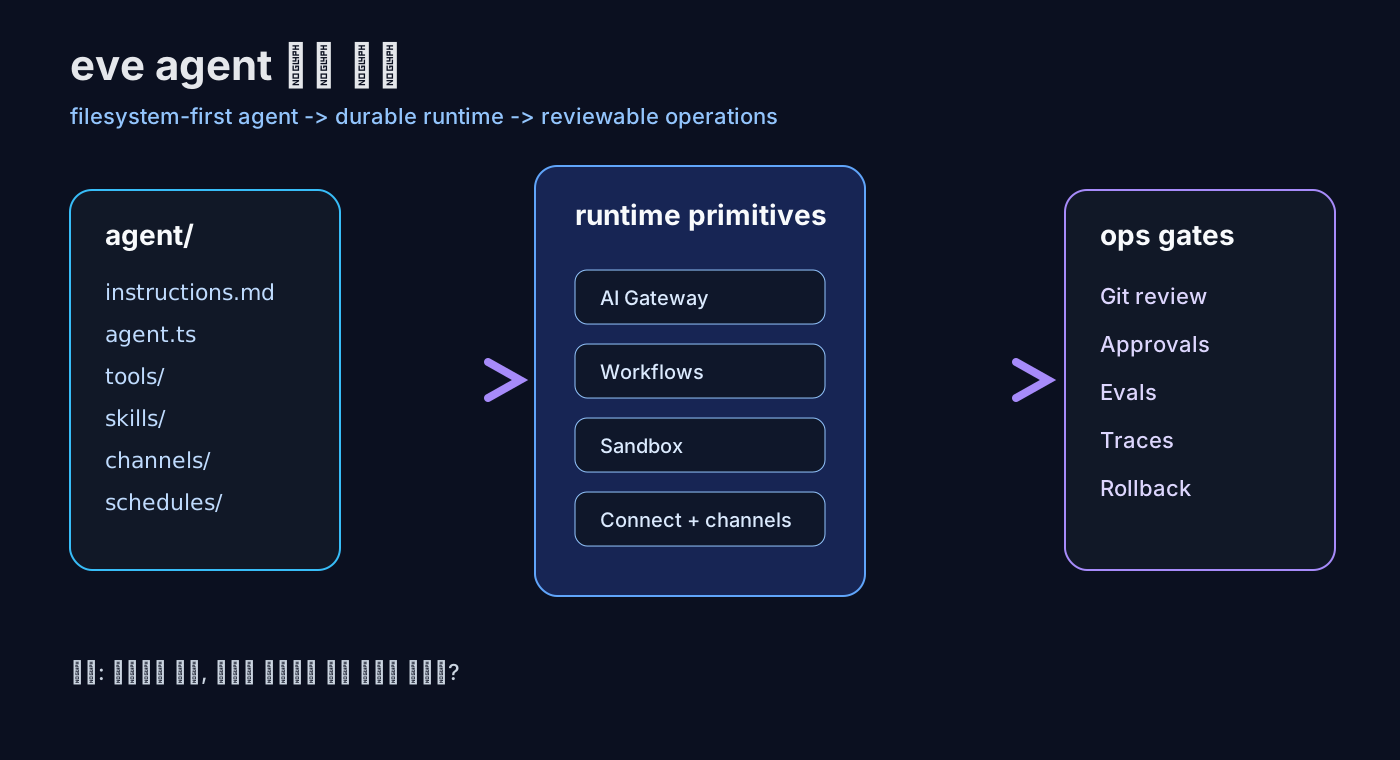
The riskiest part of adopting AI agents is rarely model selection. It is not knowing who can call which tool, whether a failed run can be replayed, or whether a prompt edit is a production change or an invisible chat tweak. Vercel’s new eve framework addresses that problem with a deliberately simple claim: an agent should be a directory.
What happened
Vercel introduced eve around June 17, 2026 as an open-source framework for building, running, and scaling agents. The core convention is straightforward: put instructions.md, agent.ts, tools/, skills/, channels/, schedules/, and subagents/ inside an agent/ directory, then let the framework compile that structure into a runnable agent application.
The product page positions eve as “like Next.js for web apps, but for agents.” Markdown holds instructions and reusable skills; TypeScript defines callable tools. Under the hood, eve is designed to connect to Vercel AI primitives: AI Gateway for model calls, Workflows for durable execution and resumes, Sandbox for isolated compute, and Connect for authenticated access to external services.
The GitHub README uses the same framing: eve is a filesystem-first framework for durable AI agents, with capabilities in conventional locations so projects are easier to inspect, extend, and operate. The repository also labels eve as beta, so teams should expect API and behavior changes before general availability.
Why it matters for working developers
The industry question has shifted from “can we build an agent?” to “can we operate one safely?” A Slack content assistant, a GitHub issue triage bot, a data analyst agent, or a scheduled executive summary agent all have the same hard parts: tool permissions, state, identity, approvals, observability, evaluation, and rollback.
eve is interesting because it pulls the agent’s identity, tools, knowledge, channels, and schedules into files that can live in Git. A change to instructions.md becomes a commit, diff, review, and rollback candidate. A file such as tools/run_sql.ts becomes an audit surface for what the agent can actually do.
That mirrors the way frontend frameworks made routing and build behavior legible through filesystem conventions. Once file location becomes a runtime contract, new engineers can inspect the system faster and coding agents can generate or review changes against stable expectations. As agent counts grow, that readability becomes a governance surface, not just developer experience.
Community signal
The public developer reaction is still early, but the first questions are useful. A Hacker News discussion asked whether eve can deploy outside Vercel. A reply pointed to multiple sandbox backends and the possibility of implementing another backend because the project is open source. The signal is clear: developers care about deployment portability and runtime coupling as much as authoring convenience.
Another related signal is Vercel’s same-week Workflow SDK update for inflight cancellation. It adds support for AbortController and AbortSignal across workflow and step boundaries. For production agents, starting work is not enough. Teams need cancellation, timeout behavior, replay, and traceability when the agent is halfway through an expensive or risky action.
Operational impact
An eve agent should be treated less like a prompt wrapper and more like a small backend service. It can call APIs, run code, create files, wait for humans, and wake up on schedules. That means backend-level operating standards should apply.
First, define the permission model. Which connections/ and tools/ touch external systems? Where do user-scoped tokens end and shared service credentials begin? Second, define the sandbox policy. File access, network egress, and process execution should be intentional rather than inherited from defaults.
Third, require observability. Vercel’s launch material emphasizes traces and evals so teams can replay what the agent did instead of reconstructing behavior from scattered logs. Fourth, treat prompt and skill changes as deployable changes. They affect production behavior and deserve staged rollout, review rules, and rollback. Fifth, define cost controls. Model routing, long-running workflows, sandbox resources, and retries are all spend surfaces.
운영 계약 체크포인트
• 1. Put owner, purpose, forbidden actions, and allowed tools at the top of every `instructions.md`.
• 2. Treat `tools/` as the permission boundary. Require approval for database writes, payments, deploys, email sends, and destructive actions.
• 3. Document the sandbox backend and network allowlist. Do not let production secrets become available by default.
• 4. Run agent changes through normal pull requests. Prompts and skills are testable behavior, not copywriting.
A practical checklist
1. Put owner, purpose, forbidden actions, and allowed tools at the top of every instructions.md.
2. Treat tools/ as the permission boundary. Require approval for database writes, payments, deploys, email sends, and destructive actions.
3. Document the sandbox backend and network allowlist. Do not let production secrets become available by default.
4. Run agent changes through normal pull requests. Prompts and skills are testable behavior, not copywriting.
5. Build a minimal eval suite around dangerous failures first: unauthorized tool use, refusal cases, data leakage, and incorrect writes.
6. Decide how long traces are retained and how sensitive fields are masked. Model inputs, tool outputs, and file contents are audit material.
7. If portability matters, test deployment paths and sandbox backend substitution during the proof of concept rather than after adoption.
Risks and counterarguments
The first risk is beta maturity. The GitHub repository states that eve is currently in beta and may change before GA. Before making it core infrastructure, teams should validate local development, deploy behavior, tracing, evals, rollback, and file layout on a narrow use case.
The second risk is platform coupling. eve fits Vercel’s AI primitives very closely. That can be a productivity advantage, but it may duplicate or conflict with existing investments in Temporal, Step Functions, Kubernetes sandboxes, LangGraph, Mastra, or internal workflow systems.
The third counterargument is that putting agents in folders does not automatically solve agent operations. Correct. The directory convention is the starting point. Real safety still comes from permission design, eval data, incident response, budget limits, and human approval UX. But eve is a useful marker that the agent framework race is moving from model abstraction toward operational contracts.
Bottom line
The practical takeaway is not that every team should standardize on eve today. It is that production agents need to become reviewable operating units. When choosing an agent stack, ask less “which model does it support?” and more “do permissions, replay, approvals, cancellation, evals, and deployment leave a code-reviewable record?”