
The -4.5% Durable Goods Drop Is Noisy: The Capex Signal Is Under Transportation
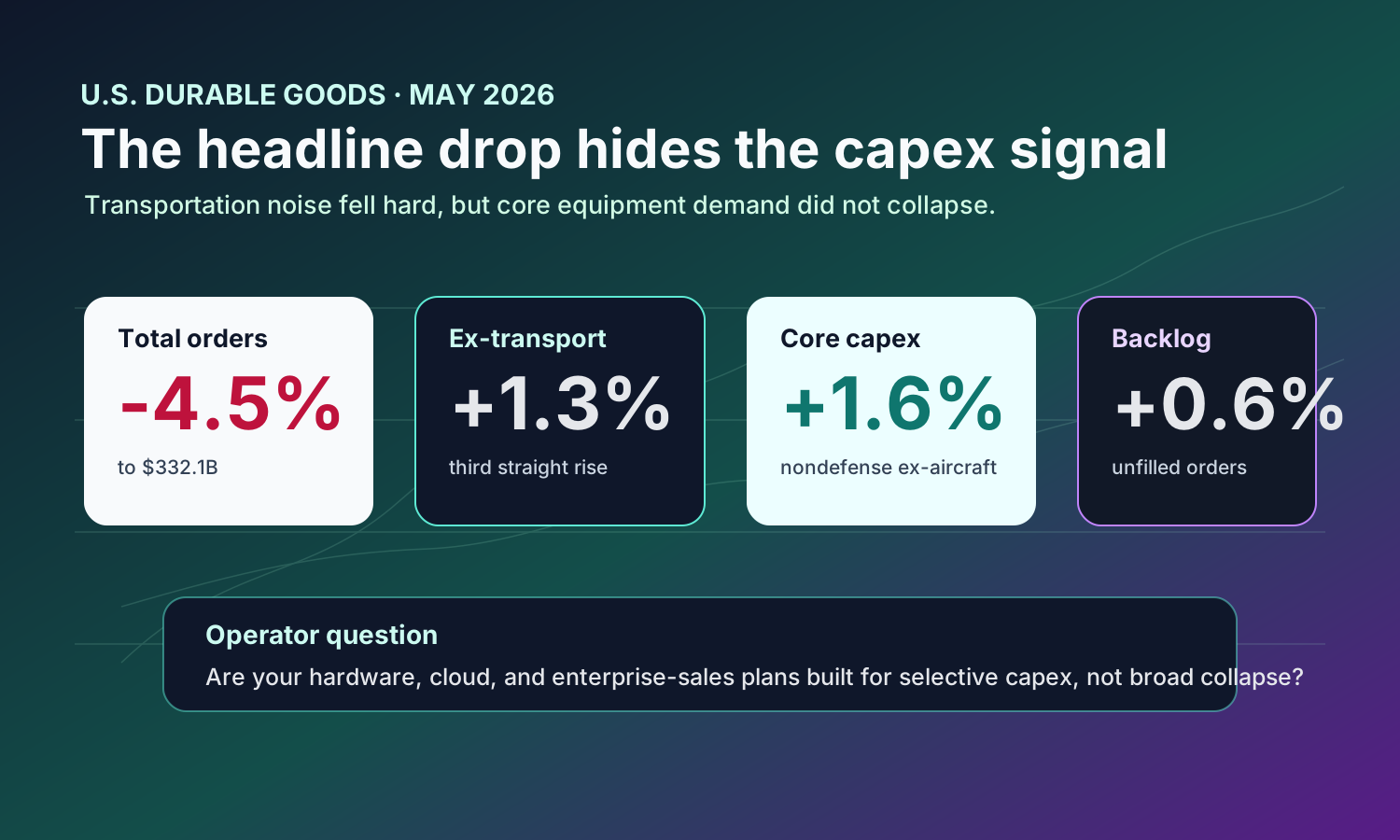
The May U.S. durable goods headline looks ugly. The Census Bureau reported that new orders for manufactured durable goods fell 4.5% to $332.1 billion. Read alone, that invites the easy sentence: U.S. manufacturing demand is rolling over. The same release says something more complicated. Orders excluding transportation rose 1.3%, and nondefense capital goods orders excluding aircraft rose 1.6%.
That split matters for founders, solo builders, and investors. Aircraft orders are volatile, and transportation plus defense categories can move with contract timing rather than broad demand. Machinery, communications equipment, computers, electrical equipment, and core capital goods excluding aircraft are closer to the real question: are firms still spending on productivity, automation, servers, hardware supply chains, and operating leverage?
The macro backdrop makes the read harder. On the same day, BEA reported May PCE inflation at 4.1% year over year and core PCE at 3.4%. Real PCE rose 0.3% month over month, while personal income and spending each rose 0.7%. The Fed had just held rates at 3.50%-3.75% while saying activity remains solid and inflation is still above target. That is not a clean demand-collapse setup. It is a selective-capex setup under a high cost of capital.
Confirmed Facts
- Census: May new orders for manufactured durable goods fell 4.5%, or $15.6 billion, to $332.1 billion.
- April orders had increased 8.5%, so the May decline partly follows a sharp prior-month jump.
- Excluding transportation, durable goods orders increased 1.3%.
- Transportation equipment orders fell 14.0% to $113.5 billion, and nondefense aircraft and parts orders fell 51.8%.
- Nondefense capital goods excluding aircraft rose 1.6% to $84.0 billion, a commonly watched proxy for business equipment investment.
- Machinery orders rose 1.9%; computers and related products rose 1.6%; communications equipment rose 0.8%; electrical equipment, appliances, and components rose 0.3%.
- Total unfilled orders increased 0.6% to $1.579 trillion, while total inventories rose 0.2% to $600.0 billion.
- BEA: May personal income and PCE each rose 0.7%; real PCE rose 0.3%; the PCE price index rose 0.4% on the month and 4.1% from a year earlier.
- BEA’s Q1 third estimate put real GDP growth at 2.1% annualized, while real final sales to private domestic purchasers were revised down to 1.7%.
- The Fed held the federal funds target range at 3.50%-3.75% on June 17 and said inflation remains elevated relative to its 2% goal.
From Numbers to Action
| Signal | Number | Practical read |
|---|---|---|
| Total durable goods orders | -4.5% | Do not read the headline without aircraft and transportation context. |
| Orders excluding transportation | +1.3% | Broad equipment demand looks firmer than the headline. |
| Core capital goods ex-aircraft | +1.6% | Business equipment investment has not disappeared. |
| Unfilled orders | +0.6% | Backlogs can support revenue, but also hide delivery and working-capital risk. |
| PCE inflation | 4.1% YoY | Capex decisions still face a high cost-of-capital backdrop. |
Interpretation: this is not collapse; it is a quality-of-orders market
First, the durable goods headline is hypersensitive to aircraft and transportation. One month of aircraft contracts, cancellations, or delivery timing can pull the whole series around. Hardware startups, manufacturing SaaS vendors, automation suppliers, and data-center investors should read the -4.5% headline beside the +1.3% ex-transport and +1.6% core-capex numbers.
Second, orders are not the same thing as profitability. Machinery and electronics demand can hold up while the economics of serving that demand deteriorate. At 4.1% PCE inflation and a 3.50%-3.75% funds-rate range, inventory financing, working capital, customer approvals, and receivables become more expensive.
Third, AI capex and manufacturing capex are connected. AI infrastructure is not only GPUs. It also needs racks, networking, power gear, cooling, communications infrastructure, and automated operations. The modest gains in communications equipment and computer-related products do not look like an economy where productivity capex has stopped.
Fourth, resilient consumption does not mean easy enterprise sales. BEA’s real spending data was positive, but Q1 private domestic final sales were revised lower. The practical read is not “customers are gone.” It is “customers will ask for tighter ROI proof.”
Market Narrative Signals
Market commentary is splitting the release into two stories. One says durable goods orders plunged and manufacturing is slowing. The other says the ex-transport and core capital-goods details still show business investment. Public operator discussions are asking whether AI infrastructure capex can keep carrying hardware demand, whether high rates will slow industrial orders, and how much aircraft noise to strip out. Those are useful narrative signals, but the factual base remains Census, BEA, and Fed data.
Second-Order Effects
- B2B vendors selling into manufacturing may face stricter ROI review rather than a vanished budget.
- Hardware and IoT teams should expect customers to scrutinize inventory risk, delivery timing, and cancellation terms.
- AI product teams can take the capex signal seriously, but higher rates make free usage and inference-cost payback more important.
- Investors should not treat aircraft, defense, automation, electrical equipment, and semiconductor equipment as one manufacturing trade.
- A mix of resilient demand and high inflation can keep dollar funding and dollar-denominated software bills expensive for longer.
Checklist for Small Teams, Builders, and Investors
•Split U.S. manufacturing pipeline by aircraft/transport, machinery, electronics/communications, defense, and general industrial exposure.
•Move sales collateral toward payback period, labor savings, inventory reduction, and downtime reduction.
•Do not raise hardware inventory only because orders are positive; check unfilled orders, customer deposits, and cancellation clauses.
•For AI features, calculate gross-margin payback including model, server, networking, power, and support costs.
•In portfolios, separate aircraft, defense, automation, electrical equipment, and semiconductor-equipment exposure before using broad industrial labels.
•Watch the next durable goods advance release, the July 30 PCE/GDP update, and the July 29 FOMC together.
Counterarguments and Risks
There is a real counterargument. The Census advance durable goods report is preliminary and subject to revision. A 1.6% rise in core capital goods excluding aircraft does not prove the whole manufacturing cycle is strong. Rising unfilled orders can also reflect supply bottlenecks or delivery delays, not only demand. But reading the -4.5% headline as a broad recession signal is equally risky. The point is dispersion, not one clean direction.
Disclaimer
This article is informational economic and market commentary, not financial advice. It does not recommend buying, selling, or holding any specific asset.
Sources
- U.S. Census Bureau, Monthly Advance Report on Durable Goods Manufacturers’ Shipments, Inventories and Orders, May 2026
- U.S. Bureau of Economic Analysis, Personal Income and Outlays, May 2026
- U.S. Bureau of Economic Analysis, GDP third estimate, 1st quarter 2026
- Federal Reserve, FOMC statement, June 17, 2026
- Axios, Hot inflation, strong economy: the Fed’s new test