
U.S. Online Spending at 16.9%: Growth Is Real, but Strip Out the Price Illusion
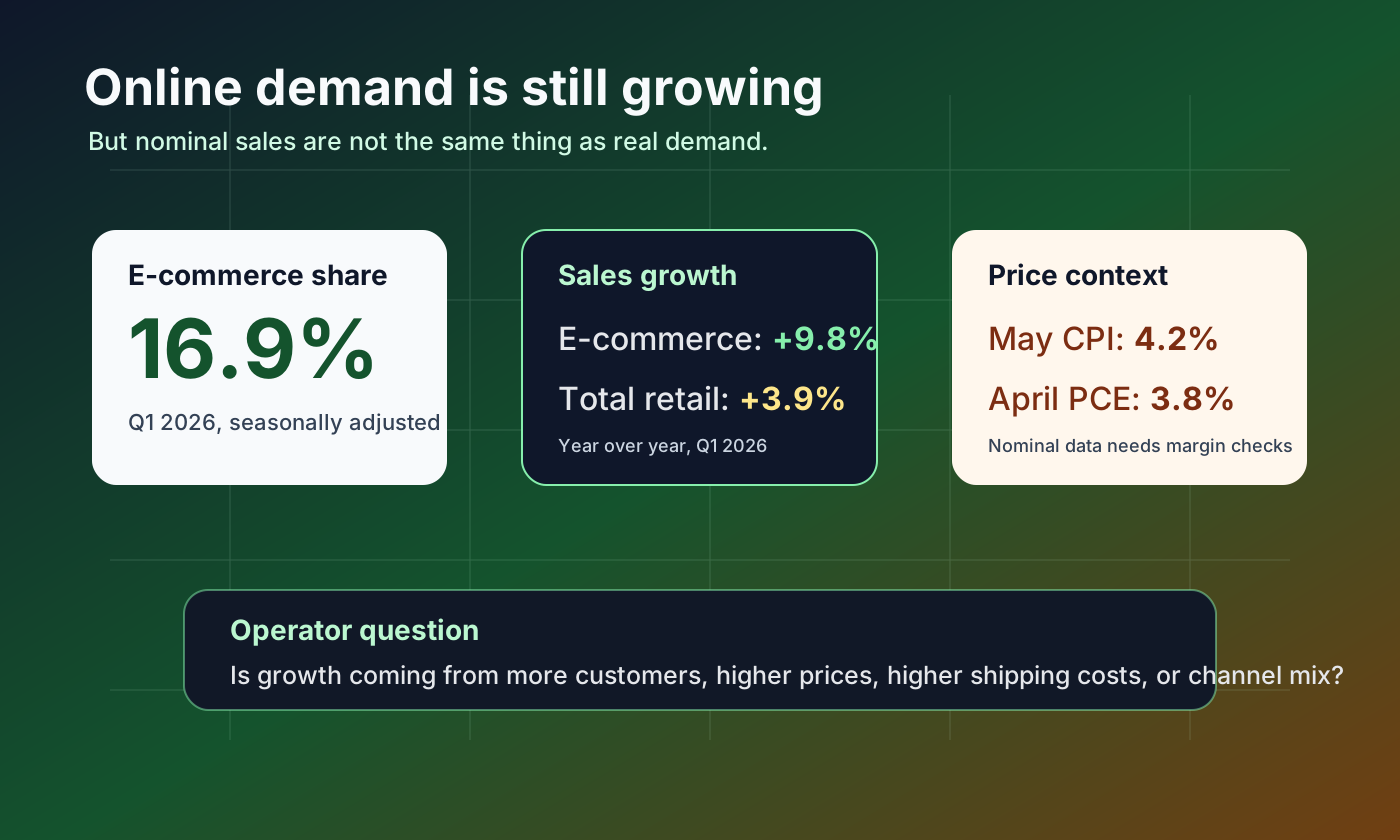
The U.S. consumer is not sending one clean signal. The first-quarter Census e-commerce release says online demand is still gaining share: seasonally adjusted U.S. retail e-commerce sales were $326.7 billion in Q1 2026, up 2.7% from Q4 and 9.8% from a year earlier. Total retail sales were $1.929 trillion, up 1.5% quarter over quarter and 3.9% year over year. E-commerce accounted for 16.9% of total retail sales.
That sounds like a straightforward online-growth story. It is not. The Census figures are nominal sales, not adjusted for price changes. Around the same window, May CPI was up 4.2% year over year and the April PCE price index was up 3.8%. Higher sales can reflect more units, higher prices, shipping pass-through, fuel costs, fees, or currency effects. For a small team, a digital operator, or an investor, the practical question is not simply whether online retail is growing. It is how much of that growth converts into real demand and gross margin.
Confirmed Facts
- Census: Q1 2026 U.S. retail e-commerce sales were $326.7 billion, up 2.7% quarter over quarter and 9.8% year over year.
- Census: total retail sales were $1.929 trillion, up 1.5% quarter over quarter and 3.9% year over year.
- Census: e-commerce represented 16.9% of total retail sales in Q1 2026 on a seasonally adjusted basis.
- Census: April retail and food services sales were $757.1 billion, up 0.5% from March and 4.9% from April 2025; nonstore retailers were up 11.1% year over year.
- Census schedule: May 2026 advance monthly retail sales are scheduled for release on June 17, 2026, at 8:30 a.m. ET.
- BLS: May 2026 CPI-U rose 4.2% year over year. BEA: the April 2026 PCE price index rose 3.8% year over year.
- Federal Reserve: the June 2026 FOMC meeting is scheduled for June 16-17.
Decision Table
| Signal | Meaning | Action |
|---|---|---|
| E-commerce share: 16.9% | Channel shift is real | Recalculate logistics, payment fees, returns, and ad payback |
| E-commerce +9.8% vs total retail +3.9% | Online is outgrowing total retail | Do not assume every platform captures the same margin |
| CPI 4.2% and PCE 3.8% | Nominal sales can overstate real demand | Separate price, volume, shipping, and FX effects |
| May retail release on June 17 | Next data point can move rate and demand narratives | Read category mix before reacting to the headline |
Interpretation: online growth is real, but nominal sales can mislead
First, the online channel is still structurally strong. A 9.8% year-over-year increase in e-commerce sales is well above the 3.9% increase in total retail sales. April nonstore retail sales also rose 11.1% from a year earlier. The data does not support a simple “consumers went back offline” story.
Second, nominal sales do not separate price from volume. Census explicitly notes that the e-commerce estimates are not adjusted for price changes. In a 3%-4% inflation environment, part of sales growth can come from price, shipping, fuel, processing fees, and currency rather than more real demand.
Third, small teams should manage contribution margin, not headline revenue. Online revenue can rise while cash flow deteriorates if customer-acquisition costs, returns, free-shipping thresholds, payment fees, cloud bills, or AI inference costs rise at the same time.
Market and Community Narrative Signals
Market notes and founder communities are mixing three narratives: the consumer is not dead, lower-income consumers are under pressure, and AI search or marketplaces are changing ad efficiency. Those are not factual sources. They are useful signals of which questions operators are asking. The factual base should remain Census, BLS, BEA, and Federal Reserve releases.
Second-Order Effects
- A more useful operating assumption is not “the consumer collapsed,” but “price-sensitive consumers are changing channels and basket composition.”
- A rising e-commerce share forces another look at logistics, payment, returns, and ad-cost leverage.
- A strong May retail release could make rate-cut hopes more cautious; a weak release could amplify margin-defense and demand-slowdown narratives.
- Non-U.S. teams with dollar costs may feel exchange-rate and billing-cycle pressure before they feel the U.S. retail cycle directly.
- AI commerce tools can lift conversion while increasing inference and experiment costs.
Checklist for Small Teams, Builders, and Investors
•Break the last 90 days of revenue into price increases, order count, average order value, shipping pass-through, and FX effects.
•Measure ad spend by contribution-margin payback per new customer, not only as a percentage of sales.
•Calculate how free shipping, returns, and coupons affect margin by SKU or plan.
•For AI features, put inference cost and conversion improvement in the same table.
•After the May retail release, separate nonstore retail, food services, autos, and gasoline before drawing conclusions from the headline.
•Investors should screen for companies that can handle consumer softness, inflation, ad costs, payment fees, and logistics costs together.
Counterarguments and Risks
The counterargument is straightforward: e-commerce is still only one slice of retail, and offline spending remains the majority. The Q1 e-commerce estimate is preliminary and can be revised. Strong channel growth also does not guarantee margin expansion for any particular platform or retailer. The point is not to overstate online demand. It is to separate nominal sales growth from real demand and margin.
Disclaimer
This article is informational economic and business commentary, not financial advice. It does not recommend buying, selling, or holding any specific asset.
Sources
- U.S. Census Bureau, Quarterly Retail E-Commerce Sales, 1Q 2026
- U.S. Census Bureau, Advance Monthly Retail Trade Report, April 2026
- U.S. Census Bureau, Monthly Retail Trade release schedule
- U.S. Bureau of Labor Statistics, Consumer Price Index, May 2026
- U.S. Bureau of Economic Analysis, PCE Price Index
- Federal Reserve, FOMC meeting calendars and information
- FRED, E-Commerce Retail Sales as a Percent of Total Sales