
The U.S. LEI Rose 0.1%, but the Real Signal Is Cost Discipline
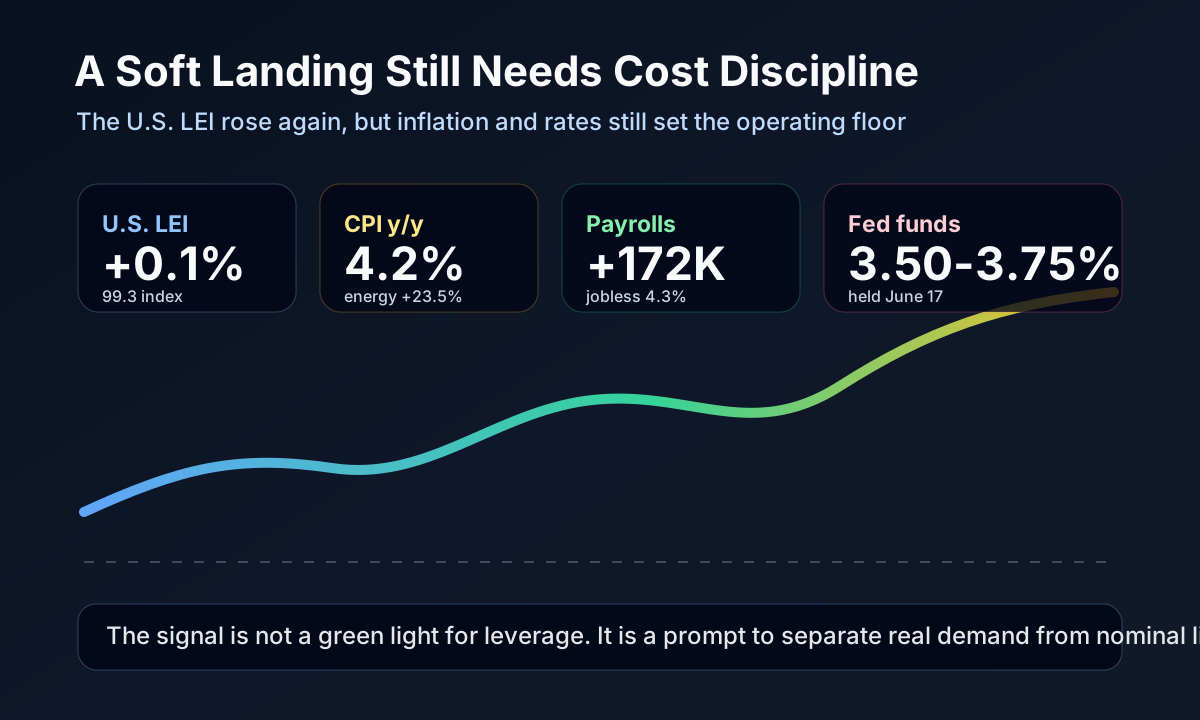
The U.S. leading index has risen for two consecutive months. On the surface, that is a welcome signal. The Conference Board reported that the U.S. Leading Economic Index rose 0.1% in May 2026 to 99.3, after a 0.2% gain in April. That weakens the simple recession narrative.
But founders, solo operators, investors, and working professionals should not read this as an all-clear for aggressive expansion. The same data week sits next to a 4.2% year-over-year CPI reading, a 23.5% jump in energy prices, a 4.3% unemployment rate, and a Federal Reserve target range still at 3.50% to 3.75%. Demand has not collapsed, but the price of money and the cost of daily life remain high.
The key question is not whether revenue can grow. It is whether that revenue converts into cash after discounts, energy costs, financing costs, wages, cloud spend, and customer fatigue. A soft-landing story can lift confidence, but a small team lives or dies on unit economics.
Confirmed Facts
- The Conference Board said the U.S. LEI increased 0.1% in May 2026 to 99.3, following a 0.2% increase in April.
- The six-month change from November 2025 to May 2026 was still negative at -0.3%, although that was a smaller decline than the prior six-month contraction of -1.3%.
- The Conference Board attributed May's increase entirely to positive financial components, especially stock prices and the interest-rate spread. It also said consumer expectations remained a major drag.
- The Coincident Economic Index rose 0.2% to 114.6, while the Lagging Economic Index slipped 0.1% to 120.5.
- BLS reported May CPI up 0.5% month over month and 4.2% year over year. Energy was up 23.5% year over year, gasoline 40.5%, and core CPI 2.9%.
- May nonfarm payroll employment increased by 172,000, and the unemployment rate was unchanged at 4.3%.
- Census reported May retail and food services sales of $763.7 billion, up 0.9% from April and 6.9% from May 2025. The retail sales figures are nominal, not inflation-adjusted.
- The Federal Reserve kept the federal funds target range at 3.50% to 3.75% on June 17, 2026.
Interpretation: Better Financial Conditions Are Not the Same as Better Customer Economics
The LEI is useful because it tries to catch turning points before they are obvious. But the composition matters. If a monthly gain leans heavily on financial components, it may say more about market pricing than about customer purchasing power. A public-market rally can make a dashboard look healthier before a small business sees better conversion, lower churn, or faster payback.
That distinction matters because inflation is still visible where households feel it most. A 4.2% CPI print with energy up 23.5% means customers are still budgeting around gas, electricity, groceries, housing, commuting, and travel. Core inflation may look less alarming, but customers do not buy only the core basket. They decide whether to upgrade software, book a trip, hire a freelancer, or buy a subscription after paying the unavoidable bills.
For operators, the correct response is not panic. It is segmentation. Which customers are still spending because their own revenue is tied to AI, data centers, automation, enterprise budgets, or high-income households? Which customers are using discounts, delayed payments, or shorter commitments? The average can hide the entire story.
| Indicator | Latest verified signal | Operational read |
|---|---|---|
| U.S. LEI | +0.1%, 99.3 | Recession fear eased, but a finance-led gain is not yet proof of broad real-demand recovery. |
| CPI | 4.2% y/y, energy +23.5% | Price resistance, freight, travel, and customer disposable income still need stress tests. |
| Labor market | +172,000 payrolls, 4.3% unemployment | Hiring costs may not fall quickly even if growth slows. |
| Retail sales | +0.9% m/m, +6.9% y/y nominal | Separate higher receipts from higher real volume. |
| Fed funds | 3.50% to 3.75% | Do not build a cash plan that requires immediate rate relief. |
The Market Narrative: Soft Landing and Margin Pressure Can Both Be True
The public narrative is split. One camp sees the LEI rebound, payroll growth, and nominal retail sales as evidence that the U.S. economy is still on a soft-landing path. Another camp sees energy inflation, sticky rates, and weak consumer expectations as evidence that the headline economy is healthier than the household experience. Both can be true at the same time.
AI and data-center investment can keep business spending strong while households pull back on discretionary purchases. Enterprise software, infrastructure tooling, and automation vendors may hold up better than low-margin consumer businesses. That does not mean the whole economy is strong. It means the economy is becoming more uneven.
Checklist for Small Teams
What to Check After This LEI Rebound
• Pricing: measure whether customers still buy without discounts, not just whether gross sales rose.
• Cash runway: model the business with the Fed funds range staying at 3.50% to 3.75% longer than hoped.
• Demand quality: split nominal revenue into orders, net revenue retention, refunds, receivables, and payment delays.
• Costs: track energy, logistics, travel, cloud, and wage pressure at the product or customer-segment level.
• Segmentation: do not average AI-infrastructure beneficiaries together with cost-squeezed consumers.
Investors can apply the same filter. A rising LEI can support risk appetite, but if the improvement depends on financial components, earnings quality matters more than revenue growth. In an energy-sensitive inflation environment, the winners are often the companies with pricing power, low leverage, flexible cost bases, and customers whose own budgets are still expanding.
Founders should be even more concrete. Before raising ad spend, confirm that conversion quality has improved rather than nominal basket size. Before hiring, check retention and payback. Before cutting prices, calculate whether the discount creates durable demand or simply pulls forward exhausted demand.
Risks and Counterarguments
The defensive reading can go too far. Two monthly LEI gains, a rising CEI, and steady employment do reduce the odds of an abrupt downturn. If AI-driven capital spending improves productivity, business investment could keep the expansion alive longer than a household-focused view implies. Teams that stay too cautious may lose share.
Still, the burden of proof is on cash conversion. The next BEA Personal Income and Outlays release, CPI, jobs, and housing data need to confirm that income and real demand are improving together. Today's LEI is a useful early signal. It is not enough to pull every growth lever at once.
Bottom Line
The 0.1% rise in the U.S. LEI is good news. It is not permission to ignore the cost floor. The better read is that recession fear has eased while financing, energy, and household-budget pressure remain high. For small teams and investors, the right dashboard is cash conversion, pricing power, and sensitivity to rates and energy.
Disclaimer: This article is for informational purposes only and is not financial advice, investment advice, or a recommendation to buy or sell any asset. Make business and investment decisions based on your own circumstances and qualified professional advice.
Sources
- The Conference Board: US Leading Indicators, May 2026
- U.S. Bureau of Labor Statistics: Consumer Price Index, May 2026
- U.S. Bureau of Labor Statistics: Employment Situation, May 2026
- Federal Reserve: FOMC statement, June 17, 2026
- U.S. Census Bureau: Advance Monthly Retail Sales, May 2026
- U.S. Bureau of Economic Analysis: Personal Income and Outlays 2026 release dates