
U.S. Crude Stocks Are 7% Below Normal: Lower Oil Prices Do Not Mean a Bigger Cost Buffer
When oil prices fall, markets exhale quickly. Bond yields can soften, inflation anxiety fades for a session, and the story shifts toward relief. The latest inventory data from the U.S. Energy Information Administration asks a more useful operating question: not whether prices moved down today, but whether the system has enough inventory buffer to absorb the next shock.
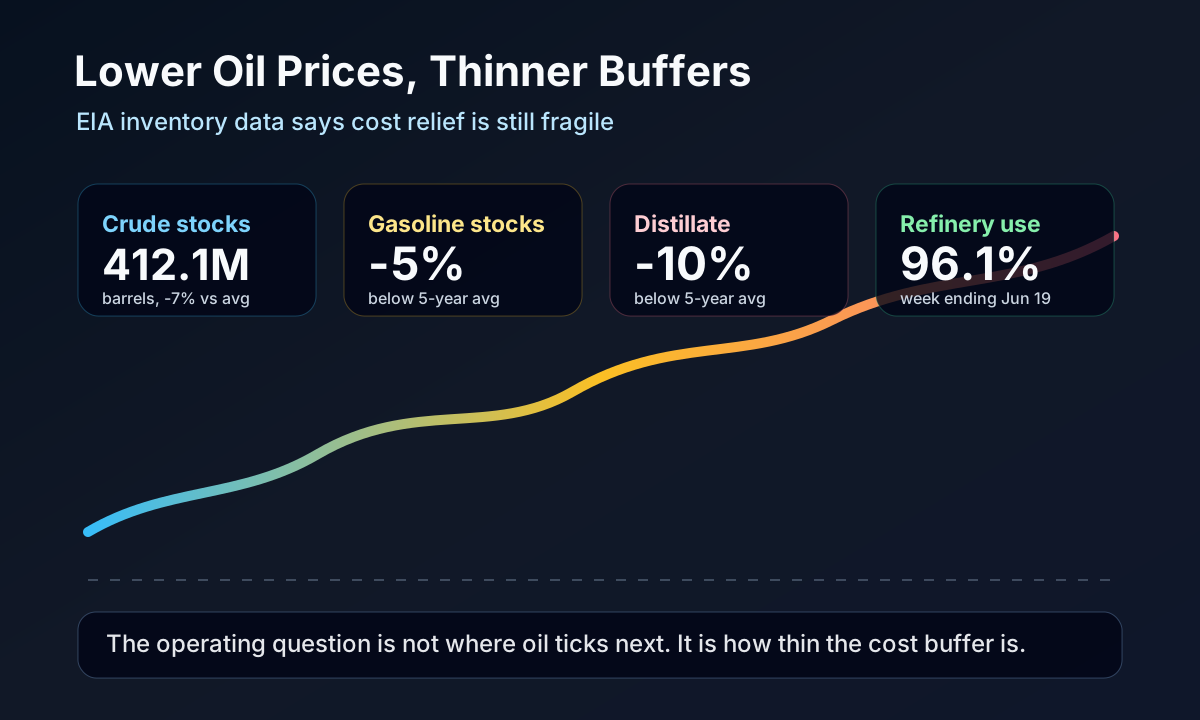
The answer is still uncomfortable. For the week ending June 19, 2026, EIA said U.S. commercial crude inventories fell by 6.1 million barrels to 412.1 million barrels, 7% below the five-year average. Gasoline stocks rose by 2.1 million barrels but remained 5% below the five-year average. Distillate stocks rose by 3.1 million barrels but were still 10% below average. Refineries processed 17.1 million barrels per day of crude and operated at 96.1% utilization.
The practical signal is not “oil must go up.” That would be a forecast, and this article is not a trading note. The signal is that energy cost relief has a thin buffer. If your business depends on shipping, field service, travel, refrigeration, packaging, or customers with fuel-sensitive budgets, one calmer week in oil is not enough evidence to loosen pricing, discounts, or cash planning.
Confirmed Facts
- EIA reported that U.S. refineries processed 17.1 million barrels per day of crude in the week ending June 19 and ran at 96.1% capacity utilization.
- Commercial crude inventories, excluding the Strategic Petroleum Reserve, fell by 6.1 million barrels to 412.1 million barrels, 7% below the five-year average.
- Gasoline inventories increased by 2.1 million barrels but remained 5% below the five-year average.
- Distillate inventories increased by 3.1 million barrels but remained 10% below the five-year average.
- Propane and propylene stocks increased by 2.6 million barrels and stood 35% above the five-year average, so not every energy category is tight.
- Over the latest four weeks, total product supplied averaged 20.5 million barrels per day, up 2% from a year earlier. Gasoline implied demand fell 3% to 8.8 million barrels per day, while distillate implied demand rose 3% to 3.6 million barrels per day.
- The Federal Reserve held the federal funds target range at 3.50% to 3.75% on June 17 and said inflation remains elevated partly because supply shocks have raised prices in sectors including energy.
- BLS reported May CPI up 4.2% year over year, with the energy index up 23.5% and gasoline up 40.5%.
Interpretation: Inventories Matter More Than the Daily Oil Quote
Energy costs look simple when you watch the price chart. Operators need a wider dashboard. If crude stocks are below their five-year average and refineries are already running at 96.1%, the system may have less room to absorb disruptions. That is one reason freight providers, airlines, warehouses, and local service vendors do not instantly cut quotes when crude prices fall for a few days.
The distillate line is especially important. Gasoline is the consumer-facing symbol of energy inflation, but distillate is closer to logistics and industrial activity. Distillate stocks rose on the week and were still 10% below the five-year average. That combination tells small teams not to confuse a weekly build with a durable cost cushion.
The counterweight is propane and propylene. Stocks there are far above normal, which means the energy complex is not one single trade. A disciplined operator should build a cost map by product, region, and contract rather than making one broad “energy is better” assumption.
| Indicator | Latest confirmed reading | Practical read |
|---|---|---|
| Commercial crude stocks | 412.1 million barrels, 7% below five-year average | Lower oil prices do not prove that the supply buffer is comfortable. |
| Refinery utilization | 96.1% | When the system is already running hard, disruption capacity can be narrower. |
| Gasoline stocks | +2.1 million barrels on the week, 5% below average | Consumer mobility and local-service demand still carry energy sensitivity. |
| Distillate stocks | +3.1 million barrels on the week, 10% below average | Diesel, freight, heating, and industrial costs can lag and then hit margins. |
| Propane and propylene | +2.6 million barrels on the week, 35% above average | Energy risk is uneven; do not generalize from one product to all costs. |
Market Narrative: Relief and Policy Tension Can Coexist
The market narrative is split. The Wall Street Journal noted on June 24 that falling crude prices helped ease inflation fears and contributed to lower Treasury yields. At the same time, the market was waiting for U.S. activity and inflation data, while the Fed had just kept policy restrictive and explicitly referenced energy-related supply shocks. Short-term market relief and a cautious policy backdrop can be true at the same time.
That distinction matters for small teams. Markets reprice every day. Operating costs reprice through contracts, vendor quotes, delivery windows, wage expectations, and customer budgets. A founder who immediately locks in lower shipping promotions, restores travel budgets, or assumes cheaper inputs may be moving faster than their own cost structure.
Checklist for Small Teams
What to check this week
• Shipping: review fuel surcharges, parcel rates, cross-border freight, and the lag between oil moves and vendor quotes.
• Pricing: avoid making permanent discounts based only on expected energy relief; add a 30-day review clause.
• Travel and sales: separate airfare, car rental, and field-visit costs from headline pipeline growth.
• Supply contracts: reread energy-linked clauses in raw materials, packaging, refrigeration, and warehouse agreements.
• Investing: for energy-sensitive companies, look first at gross margin, working capital, and inventory days rather than revenue alone.
For investors, the point is not to turn this into a simple energy-stock call. The better question is how companies discuss energy costs in earnings. Firms with pricing power can pass through part of the pressure. Firms without it may keep revenue stable while margins compress. The same top-line growth can produce very different cash-flow quality.
For founders, the exercise is even more granular. Decide whether energy is a direct cost, an indirect hit to customer purchasing power, or a discount-rate variable that changes investor appetite. Local commerce should watch delivery and consumer mobility. SaaS should watch customer budget pressure and infrastructure costs. Consulting and content businesses should watch travel and currency exposure.
Risks and Counterarguments
The strongest counterargument is that some inventories did rise. Gasoline and distillate stocks increased on the week, and propane and propylene stocks are well above their five-year average. If geopolitical tension cools and demand softens, energy prices could stabilize further. In that scenario, today’s caution could prove too conservative.
But risk management is not a price prediction. It is the discipline of defining what the business can survive if the price relief does not last. With some inventories below average, some above average, and the Fed still worried about energy-linked supply shocks, teams should separate temporary relief from structural cost improvement.
Bottom Line
The EIA data is not a directional oil call. It is a reminder that the cost buffer is still thin. Crude inventories are 7% below normal, distillate is 10% below normal, and refineries are running hard. Even on days when oil prices fall, operators should keep pricing, freight, cash flow, and customer purchasing power under conservative review.
Disclaimer: This article is for informational purposes about markets and economic indicators. It is not financial advice or a recommendation to buy or sell any asset.
Sources
- U.S. Energy Information Administration: U.S. commercial crude oil inventories have decreased in June
- U.S. Energy Information Administration: Weekly Petroleum Status Report
- Federal Reserve: FOMC statement, June 17, 2026
- Federal Reserve: H.15 Selected Interest Rates, June 24, 2026
- U.S. Bureau of Labor Statistics: Consumer Price Index, May 2026
- Wall Street Journal: Treasury yields fall ahead of U.S. activity, inflation data