
PCE at 4.1% and spending up 0.7%: the nominal-growth trap for margins
Resilient consumers do not automatically give you pricing power
The May U.S. Personal Income and Outlays release looks straightforward at first. Personal income rose 0.7%, disposable personal income rose 0.7%, and current-dollar PCE also rose 0.7%. The easy headline is that the consumer is still spending. The more useful operating detail is that real PCE rose only 0.3%, the PCE price index rose 0.4% on the month and 4.1% from a year earlier, and the personal saving rate sat at 3.0%.
That combination matters for founders, operators, and investors because revenue can look better while the underlying customer is becoming more price-sensitive. Consumers are still paying, but that does not mean the cost-of-living problem has disappeared. The University of Michigan survey said June sentiment improved as gasoline prices moderated, yet more than half of consumers still spontaneously mentioned high prices weighing on their personal finances.
The practical question is not whether the U.S. consumer is strong or weak. It is whether a team is mistaking nominal revenue growth for real demand. With the federal funds target range still at 3.50% to 3.75% and inflation above the Fed’s goal, small teams need to prioritize margins, cash conversion, retention, and price resistance over headline sales growth.
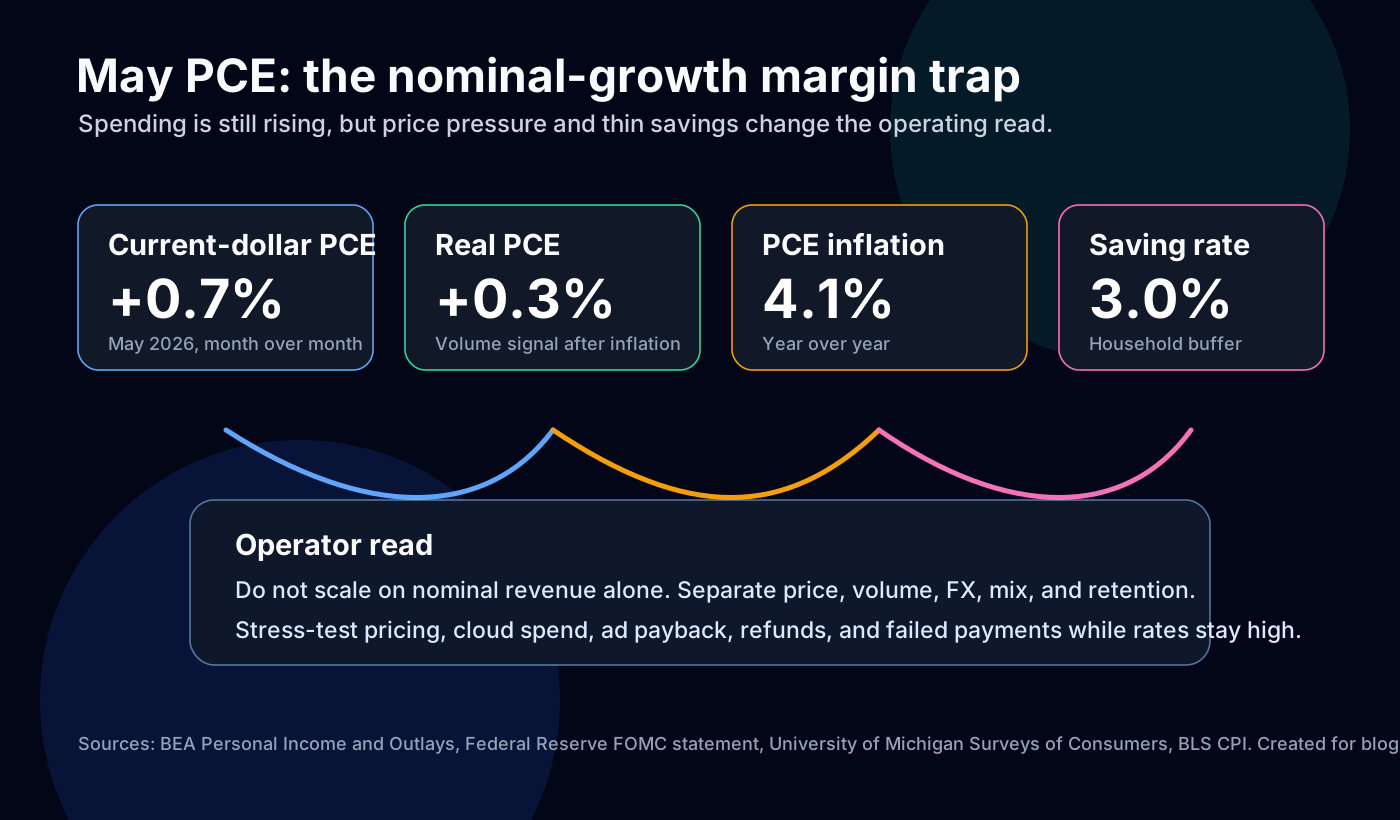
Four numbers operators should read together
- Current-dollar PCE +0.7%: the headline spending number
- Real PCE +0.3%: the closer demand-volume signal
- PCE inflation +4.1%: the pricing-pressure backdrop
- Saving rate 3.0%: a thin household buffer
Confirmed facts
- BEA said on June 25, 2026 that May personal income increased by $181.6 billion, or 0.7% at a monthly rate. Disposable personal income increased by $164.9 billion, also 0.7%.
- Current-dollar personal consumption expenditures increased by $156.1 billion, or 0.7%. The increase reflected $94.3 billion more spending on services and $61.8 billion more spending on goods.
- Real PCE increased by $43.8 billion, or 0.3% at a monthly rate. The gap between 0.7% nominal PCE and 0.3% real PCE shows that price increases are lifting the spending number.
- The PCE price index rose 0.4% from the previous month and 4.1% from a year earlier. Excluding food and energy, core PCE rose 0.3% on the month and 3.4% from a year earlier.
- BEA reported personal saving of $704.2 billion in May and a personal saving rate of 3.0% of disposable personal income.
- The Federal Reserve kept the federal funds target range at 3.50% to 3.75% on June 17, 2026. The FOMC statement said economic activity was expanding at a solid pace but inflation remained elevated relative to the 2% goal.
- The University of Michigan Surveys of Consumers said June sentiment rose about 10% from May as gas prices moderated, but the cost of living remained front of mind. Year-ahead inflation expectations slipped from 4.8% to 4.6%, still elevated.
- BLS reported May CPI up 0.5% on the month and 4.2% over 12 months. Energy accounted for more than 60% of the monthly all-items increase.
Interpretation: part of nominal growth may be the price environment, not product strength
Reading nominal spending up 0.7% beside real spending up 0.3% makes the phrase “strong demand” less simple. Consumers spent more, but part of that increase paid for higher prices rather than more units or more services. SaaS, commerce, education, content, travel, ads, and local services all need to separate these effects.
The dangerous operating mistake is to treat revenue growth as proof of durable pricing power. In a 4.1% PCE inflation environment, checkout totals, subscription revenue, ad pricing, and GMV can all receive a nominal tailwind. If real purchasing power is not improving at the same speed, the stress often returns through retention, refunds, downgrades, failed payments, and slower renewals.
A 3.0% saving rate adds another warning. Spending can continue while household buffers stay thin. Price increases may not cause an immediate cancellation wave; they can show up first as plan downgrades, lower usage, shorter contract terms, avoidance of annual prepayment, or more aggressive discount requests.
For investors, the same logic applies. Nominal revenue growth can overstate business quality during inflationary periods. The more useful questions are volume, gross margin, working capital, refund and delinquency rates, marketing efficiency, and how much of growth comes from real usage rather than pricing and currency effects.
Market and consumer narrative signal
The market narrative is split between two true statements: spending has not collapsed, and inflation is still too high for an easy policy pivot. This PCE release supports both. Income and spending rose, while the inflation rate and saving rate make fast monetary easing harder to assume.
The consumer narrative is also two-sided. Michigan’s survey points to better sentiment as gasoline prices moderated, but it also says high prices remain a major burden. That is not a consumer in free fall. It is a tired consumer still spending.
For builder communities, the lesson is concrete. A resilient consumer is not permission to scale customer acquisition blindly. It is a signal to tighten pricing pages, billing cycles, refund terms, discount ladders, free-plan limits, and annual-plan incentives.
Second-order effects: pricing, rates, and savings move into the operating model
First, revenue metrics need real-usage companions. If payments, GMV, or MRR rise while order counts, active seats, usage minutes, repeat purchases, or net retention fail to improve, the growth may be mostly nominal.
Second, pricing changes should be narrower and easier to explain. In a cost-of-living environment, usage-based limits, higher-tier features, annual-plan incentives, and protected core functionality may work better than broad price increases.
Third, the Fed’s hold means the downside in discount rates is limited for now. As long as policymakers see inflation above target, growth companies need to explain cash-flow conversion and capital efficiency more clearly.
Fourth, teams spending heavily on AI, cloud, ads, or labor should not over-read nominal demand. If customers keep paying today but downgrade later, prepaid infrastructure and hiring plans can quickly pressure margins.
Fifth, non-U.S. teams with dollar costs should stress-test FX and funding. Sticky U.S. inflation can keep dollar rates higher for longer, affecting cloud, software, ad, and contractor costs priced in dollars.
Checklist for founders, operators, and investors
- Split revenue growth into price, volume, upsell, FX, and mix effects instead of treating it as one number.
- Track conversion, failed payments, refunds, downgrades, and support tickets for at least 30 days before and after a pricing change.
- Test usage limits, annual-plan incentives, bundle design, and seat-count adjustments before broad price increases on low-tier customers.
- Approve marketing spend on payback period and net cash conversion, not nominal revenue alone.
- For public or private investments, compare gross margin, working capital, price pass-through, retention, and refund trends during high-PCE periods.
- For dollar-cost-heavy teams, run a stress case with the policy rate at 3.50% to 3.75%, inflation near 4%, and no immediate FX relief.
Counterarguments and risks
The bullish counterargument is real. Income and spending both rose 0.7%, and real PCE still increased 0.3%. That means the consumer has not disappeared. Products with clear ROI, essential workflows, or strong differentiation may still have pricing power.
Energy-driven headline inflation can also cool if geopolitical risk and gasoline prices ease. Michigan’s long-run inflation expectations falling from 3.9% to 3.3% is a positive sign. If energy stabilizes, the Fed’s burden could decline.
The practical operating rule still stands. Consumers can keep spending while becoming more price-sensitive. Revenue can rise while real demand grows less. Rates can stay on hold while capital costs remain high. Small teams should raise the speed of pricing experiments and cost-sensitivity analysis before raising the size of the growth plan.
This article is informational commentary about markets, inflation, and business strategy. It is not financial advice or a recommendation to buy or sell any security.