
Vercel CLI 55: --yes no longer guesses your deployment target
A green CI job is still a failure if it deployed to a same-named project under the wrong team. An agent that runs vercel --yes and silently creates a new project is not autonomous; it is operating without a target contract. Vercel CLI 55 removes that ambiguity. In a non-interactive account with multiple teams, the CLI no longer guesses from global state. It stops with action_required: missing_scope. The practical change is bigger than a flag: deployment identity must now be treated as an input alongside code and credentials.
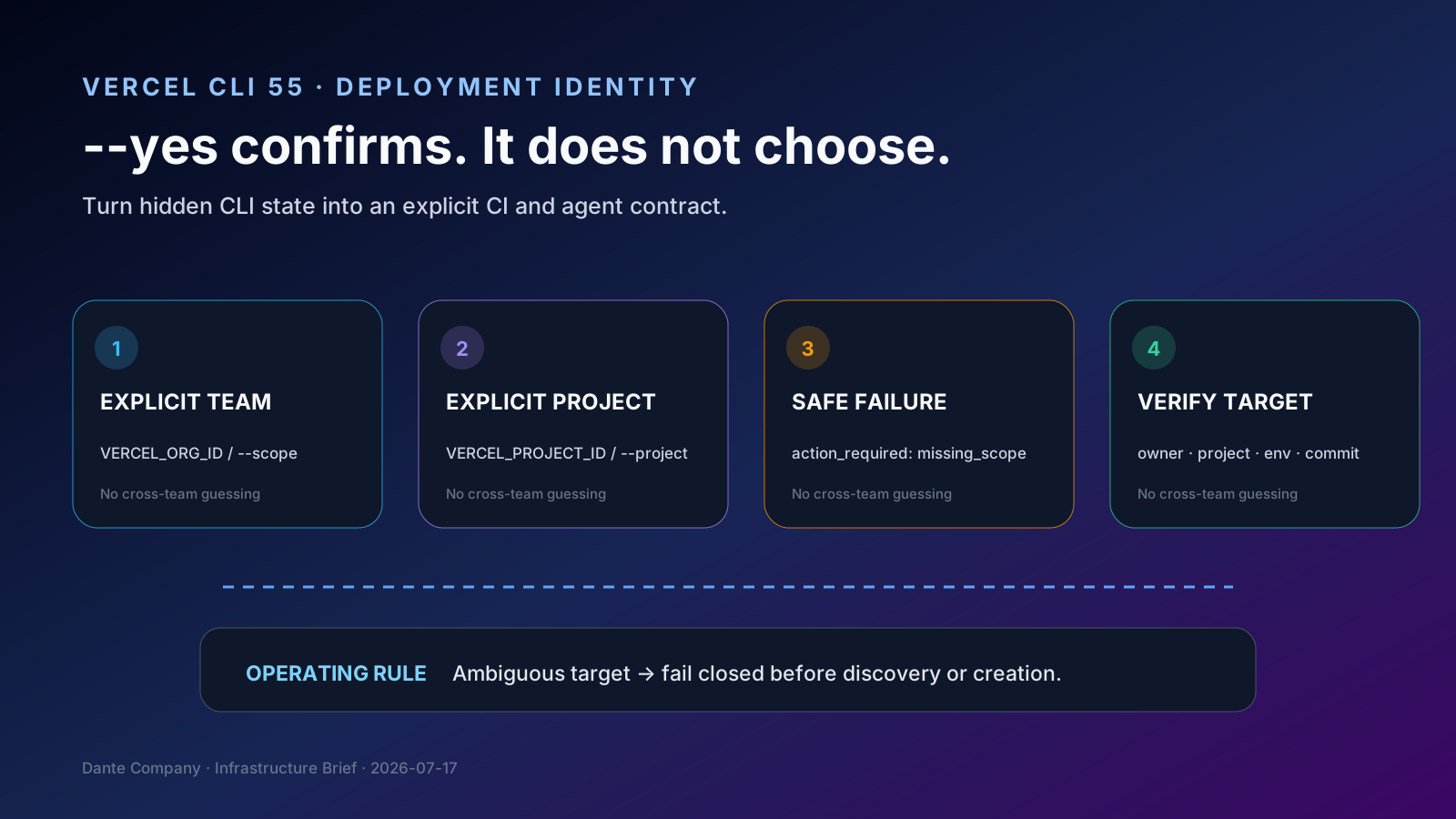
What changed: --yes confirms, but it does not choose a team
Vercel says link, deploy, pull, dev, and git connect now share one flow: resolve a team first, then discover projects only inside that team. Non-interactive runs no longer inherit the globally selected vc switch team or sweep every accessible team.
A team resolves from --team or --scope, vercel.json scope, VERCEL_ORG_ID, or a single available team. With multiple teams and no signal, the command fails before project discovery, creation, or deletion of an existing local link.
--yes now answers confirmations only. An explicit project name does not eliminate the owner decision; project identity is an owner-project pair.
Why it matters: target guessing is hidden mutable state
A human can correct an interactive picker. CI runners, ephemeral containers, and coding agents cannot rely on a remembered login default. Reused runners, account changes, or a newly added team can change the result without changing the pipeline definition.
Same-named projects and monorepos make folder-name inference especially fragile. A successful exit code is incomplete unless owner, project, and environment match the intended postcondition.
CLI 55 fails closed when identity is ambiguous. That may break a pipeline once, but it limits damage compared with silently pulling the wrong environment or deploying to the wrong production project.
The minimum CI and agent contract: pin owner and project together
The strongest path is to provide VERCEL_ORG_ID and VERCEL_PROJECT_ID together. The release notes say vercel link confirms that exact pair without prompting and does not fall back to another candidate if it cannot be resolved.
For readable configuration, pass --team your-team-slug or --scope together with --project. A token authenticates access; it should not implicitly select the target.
Agent wrappers should accept structured required fields such as deploy({ orgId, projectId, environment, commitSha }). Production should add an allowlist and approval or policy gate. A project name in natural-language instructions is not an execution contract.
Migration sequence: pin, rehearse, verify
Check whether CI pulls global latest or pins the Vercel CLI in a lockfile. Because 55 is a major release, rehearse link, pull, build, and deploy on a preview branch before promotion.
Inventory expected org, project, environment, and root directory per job. In a monorepo, test each app-directory-to-project mapping rather than assuming one repository has one Vercel target.
After deployment, compare deployment metadata with expected owner, project, environment, and commit. Treat missing_scope as a configuration error, not a transient failure to retry with a guessed scope.
Community signal: project selection has long been a source of friction
Community questions have repeatedly asked how vercel pull selects a specific project and how VERCEL_PROJECT_ID, --scope, and --project interact. These posts are audience signals, not authoritative product documentation. They show the cognitive cost created by hidden scope.
CLI 55 does not solve the problem with smarter guessing. It removes guessing and makes the owner decision happen first. Reliable automation is not a command that always succeeds; it is a command that cannot succeed against an ambiguous target.
Internal examples and runbooks should therefore show account, team, project, and environment—not just vercel --yes. Reproducibility requires the target context.
Practical checklist
1. Find every non-interactive link, pull, deploy, dev, and git connect invocation.
2. Rehearse CLI 55 on a preview branch.
3. Set VERCEL_ORG_ID and VERCEL_PROJECT_ID as a pair for each job.
4. If using names, provide both team/scope and project.
5. Treat tokens as least-privilege credentials, not selectors.
6. Keep monorepo app-to-project mappings reviewable.
7. Classify missing_scope as configuration failure.
8. Add a production target allowlist and approval gate.
9. Verify owner, project, environment, and commit after deploy.
10. Use the same target contract for rollback.
Risks and counterarguments
Explicit IDs add configuration. That complexity already existed; CLI 55 makes it visible and reviewable. IDs are not authentication secrets by themselves, but keeping them beside scoped credentials reduces copy and logging mistakes.
Single-team accounts may notice little difference. Templates still benefit from explicit identity because they may later run under multi-team accounts.
CLI 55 cannot prevent a valid but incorrect ID, an overprivileged token, or a mistaken production flag. Deterministic resolution complements authorization, approval, and post-deploy verification; it does not replace them.
Minimum contract for a non-interactive deployment
# Pin the exact owner-project pair in CI
export VERCEL_ORG_ID="$VERCEL_ORG_ID"
export VERCEL_PROJECT_ID="$VERCEL_PROJECT_ID"

vercel pull --yes --environment=preview --token="$VERCEL_TOKEN"
vercel build --token="$VERCEL_TOKEN"
vercel deploy --prebuilt --token="$VERCEL_TOKEN"
Do not print IDs; log target aliases and verification outcomes rather than raw values.
Vercel CLI 55 migration checkpoint
✓Find every non-interactive link, pull, deploy, dev, and git connect invocation.
✓Rehearse CLI 55 on a preview branch.
✓Set VERCEL_ORG_ID and VERCEL_PROJECT_ID as a pair for each job.
✓If using names, provide both team/scope and project.
✓Treat tokens as least-privilege credentials, not selectors.
✓Keep monorepo app-to-project mappings reviewable.
✓Classify missing_scope as configuration failure.
✓Add a production target allowlist and approval gate.
✓Verify owner, project, environment, and commit after deploy.
✓Use the same target contract for rollback.
Bottom line
Vercel CLI 55 does not merely make --yes less permissive; it makes automation more deterministic. Pin team and project, fail ambiguity with missing_scope, and verify the actual target after deployment. CI and agents then become a reviewable deployment control plane rather than a shell that deploys somewhere.