
VS Code Agents window and BYOK: teams now need an agent operating model
If you read the latest VS Code AI updates as “Copilot got a few new features,” you miss the larger shift. The important change is that agentic development is moving from a chat box into an operating model: dedicated agent surfaces, bring-your-own-key models, remote sessions, terminal safeguards, browser context, and review gates are starting to behave like one workflow.
What changed
GitHub’s June 3, 2026 changelog summarizes a busy May and early June for Copilot in VS Code, covering releases v1.120 through v1.123. The notable items are not isolated. Agents window reached Stable as a preview, remote agents continued to expand, GitHub pointed to ongoing work on Agent Host Protocol, sessions became easier to sync and revisit, BYOK gained more flexibility, and terminal behavior received safety and efficiency updates such as output compression, command risk assessment, sensitive prompt handling, and the VSCODE_AGENT environment variable.
VS Code 1.122 reinforces the same direction. The Custom Endpoint provider is now in Stable, BYOK configuration is broader, and the integrated browser has better device emulation and screenshot support for web debugging. The Agents window documentation describes an agent-first surface that can manage Copilot CLI, Copilot Cloud, and Claude agent sessions, including remote connections over SSH or Dev Tunnels through Agent Host Protocol.
Why it matters
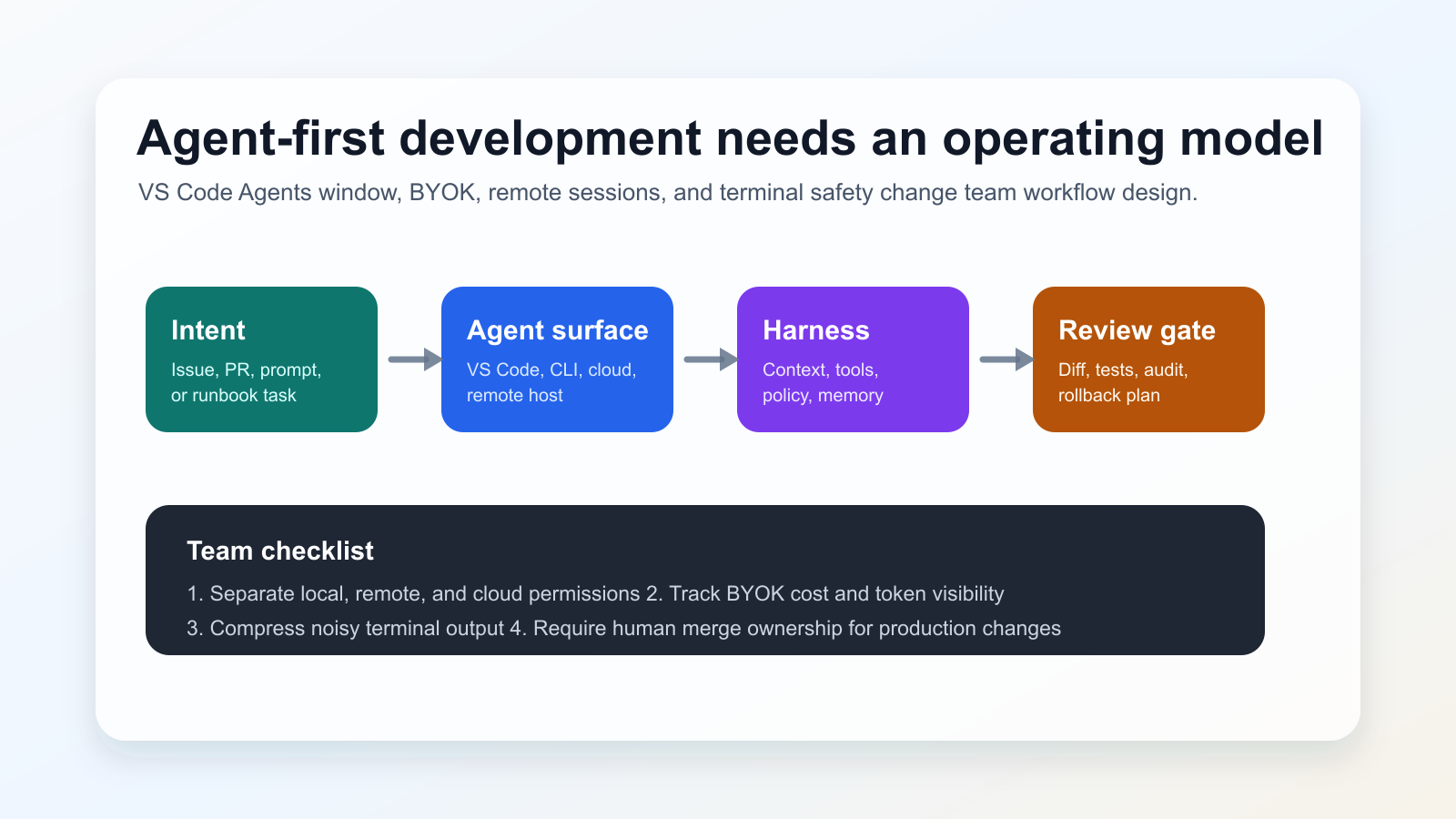
The VS Code team’s post on the coding harness is the key framing. A model does not edit files, execute tests, or inspect the browser by itself. The harness assembles context, exposes tools, validates and executes tool calls, and feeds results back into the loop. That means real-world agent quality depends on the model and on the surrounding product system: prompts, tools, permissions, memory, terminal behavior, browser integration, and evaluation.
For engineering teams, this is a process change. Once agents can run locally, continue in the background, connect to remote machines, and delegate work to cloud sessions, the team needs explicit rules. Which tasks may run unattended? Which commands require confirmation? Which secrets should never enter a model context? Which generated changes require a human owner before merge? These are not philosophical questions; they are day-to-day reliability and compliance decisions.
Community signal
Developer discussions show the shape of the confusion. The r/GithubCopilot thread around VS Code 1.122 focuses on BYOK, custom endpoints, and whether model choice will make agent workflows more predictable. Local-model communities ask a different version of the same question: if the IDE supports more model endpoints, how much dependence on account policy, connectivity, and provider limits remains? I treat those threads as audience signals, not factual sources. The factual claims in this article come from the official GitHub and VS Code materials linked below.
Operational impact
- Agent surfaces need classification. A local interactive session, a background CLI session, a remote host, and a cloud agent have different blast radii.
- BYOK creates both optionality and responsibility. Teams gain model choice, but they also inherit cost tracking, data boundary review, outage handling, and utility-model governance.
- The terminal becomes an audit boundary. Compression and risk summaries help, but teams still need their own record of agent-initiated commands and generated diffs.
- Browser context improves frontend loops. Screenshots and integrated browser state can make UI bugs easier to reproduce, but they should complement, not replace, visual regression tests.
Practical checklist
- Define separate defaults for local edits, remote execution, cloud delegation, and production-adjacent work.
- Put test commands, forbidden commands, secret-handling rules, and pull request expectations in
AGENTS.mdor an equivalent project instruction file. - If BYOK is allowed, document provider terms, fallback behavior, budget alerts, and who owns model configuration changes.
- Make agent-executed terminal commands and generated diffs visible in pull requests or automation logs.
- Split long-running agent work into small reviewable changes and keep human merge ownership explicit.
Risks and counterarguments
The first risk is over-delegation. Remote and cloud sessions are useful for long-running work, but vague requirements and architectural decisions still need human judgment. The second risk is treating BYOK as only a cost-control feature. More providers can also mean more variance, more policy surfaces, and more debugging paths when something fails.
The counterargument is valid: blocking agent workflows entirely is no longer realistic for many teams. The better response is not blanket adoption or blanket prohibition. It is an operating model that says which work agents can start, which work they can finish, and which work cannot merge without a human reviewer taking responsibility.
Bottom line
The center of gravity in AI developer tooling is moving from “which model is smartest?” to “which harness, permissions, context, and review loop make the model useful inside our workflow?” VS Code Agents window and BYOK bring that question directly into the editor. Teams that answer it explicitly will get more value from agents with less operational surprise.
Sources
- GitHub Changelog: GitHub Copilot in Visual Studio Code, May releases
- Visual Studio Code 1.122 release notes
- VS Code documentation: Use the Agents window
- VS Code documentation: Using agents in Visual Studio Code
- VS Code Blog: The Coding Harness Behind GitHub Copilot in VS Code
- Community signal: VS Code 1.122 discussion on r/GithubCopilot
- Community signal: local model and Agents window discussion on r/LocalLLaMA