
The 2.5% Global Growth Warning: Cash Flow Comes Before Revenue Forecasts
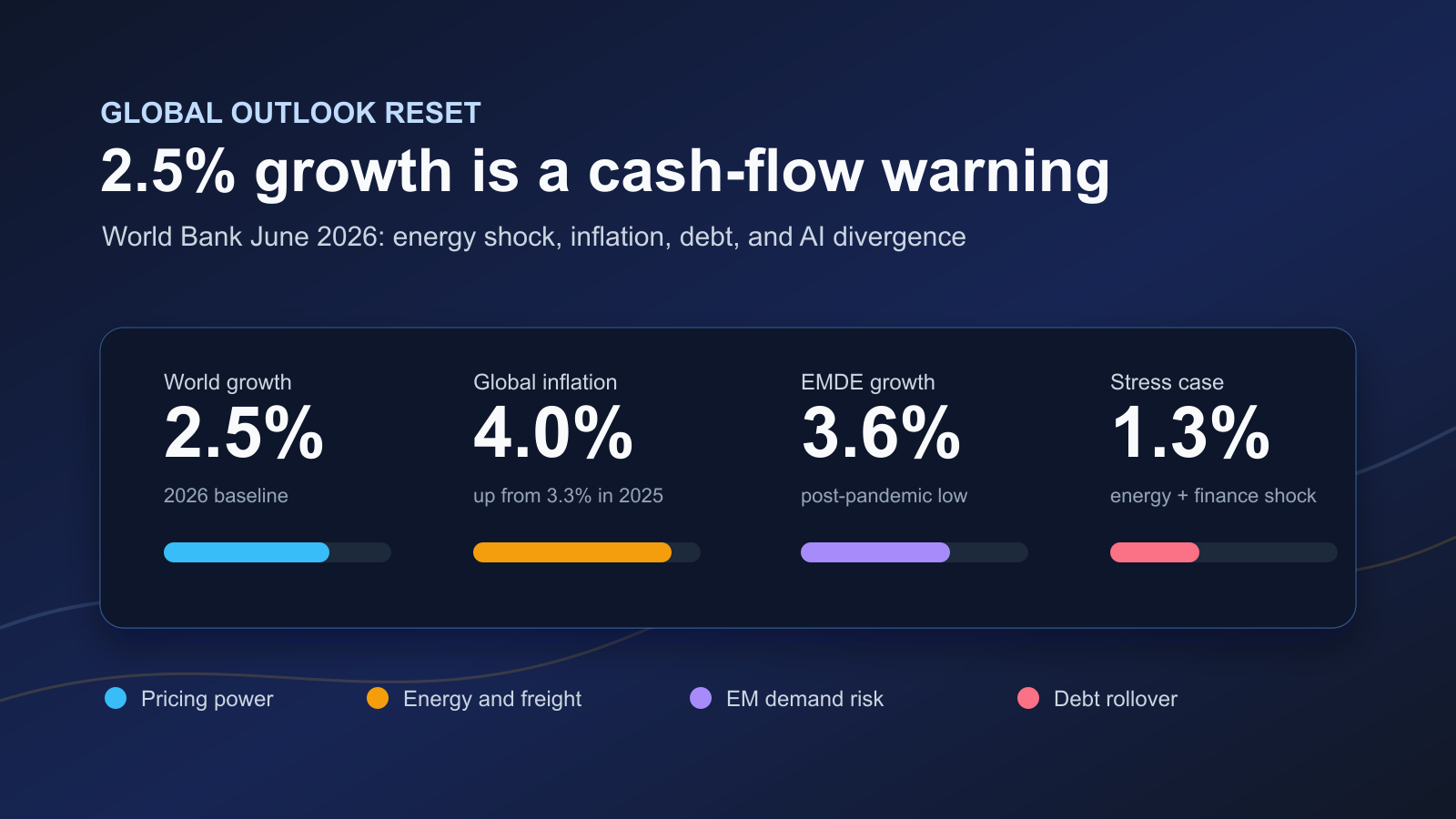
The headline from the World Bank’s June 2026 Global Economic Prospects is simple: global growth is projected to slow to 2.5% this year. The practical message is less simple and more useful. When energy prices, inflation, borrowing costs, and weaker emerging-market demand move together, small teams usually feel the shock in cash flow before they see it in reported revenue. Costs reset first. Customers hesitate later. Investors price the gap in between.
This is not a recession call. It is a planning note for founders, solo builders, operators, and investors who have to decide whether 2026 budgets still make sense. The right question is not whether the global growth forecast is exactly right. The right question is whether your pricing, runway, cloud commitments, AI usage, FX exposure, and customer mix can survive a world where growth is slower while inflation is not yet dead.
Confirmed Facts
- The World Bank forecasts 2.5% global growth in 2026, down from 2.9% in 2025 and the lowest rate since the onset of the COVID-19 pandemic.
- Global growth is expected to recover to 2.8% in 2027, but that would still be 0.4 percentage point below the average pace of the 2010s.
- Forecasts for about two-thirds of economies were downgraded relative to January. Growth in emerging market and developing economies is projected to slow from 4.4% in 2025 to 3.6% in 2026.
- The World Bank baseline assumes Brent crude averages $94 per barrel in 2026. The U.S. EIA expects Brent to average $105 per barrel in June and July under near-term Strait of Hormuz constraints.
- Global inflation is expected to rise from 3.3% in 2025 to 4.0% in 2026, with energy and fertilizer shocks feeding into food and living costs.
- If energy disruptions worsen and financial stress rises, the World Bank downside scenario puts 2026 global growth at only 1.3% and inflation at 4.4%.
- The ECB raised its 2026 inflation projection to 3.0% in its June 11 decision, and the Federal Reserve’s next FOMC meeting is scheduled for June 16-17.
| Metric | Previous base | New signal | Meaning |
|---|---|---|---|
| World GDP growth | 2.9% in 2025 | 2.5% in 2026 | World Bank baseline |
| Global inflation | 3.3% in 2025 | 4.0% in 2026 | renewed energy pressure |
| EMDE growth | 4.4% in 2025 | 3.6% in 2026 | post-pandemic low |
| Downside growth case | baseline 2.5% | 1.3% in 2026 | energy disruption plus financial stress |
| Brent oil | 2026 avg. $94/bbl | June-July $105/bbl | World Bank baseline and EIA STEO |
| Euro area growth | 1.4% in 2025 | 0.8% in 2026 | World Bank table |
| Japan growth | 1.1% in 2025 | 0.7% in 2026 | World Bank table |
| U.S. growth | 2.1% in 2025 | 2.2% in 2026 | AI and energy resilience |
Interpretation: the cash-flow order matters more than the headline growth number
A 2.5% global growth forecast does not mean the world stops. It means demand becomes less forgiving. U.S. activity may remain relatively resilient because of energy production and AI investment, while Europe, Japan, and many emerging markets face a tighter mix of fuel costs, imported inflation, and weaker household purchasing power. A small software or commerce company can still grow in that world, but the margin of error is smaller.
The common planning mistake is to haircut revenue but leave the cost base unchanged. In a shock like this, ad prices, foreign SaaS subscriptions, card fees, freight, cloud commitments, travel, packaging, and contractor rates can adjust before customers formally churn. That is why cash-flow sequencing matters. The first task is to identify which costs reprice automatically and which prices require a customer conversation.
The AI angle is also two-sided. The World Bank treats broader AI adoption as a potential upside for global growth, but the benefits are unlikely to arrive evenly. Firms and countries with power, data, chips, cloud discounts, and institutional capacity can turn AI into productivity. Smaller teams that treat AI as an unlimited free feature can turn it into a new variable cost. The practical question is where AI reduces cash burn, not where it looks impressive in a product demo.
Market and Community Narrative Signals
The market conversation has shifted from “when do central banks cut?” to “how long does the energy shock delay easier policy?” The ECB has already folded a higher energy path into its 2026 inflation projection. The Fed’s June SEP meeting now has to explain growth, inflation, and rate expectations in the same week that investors are digesting CPI, PPI, oil, and global growth downgrades.
In operator communities, the questions are concrete: will international payment failures rise, should annual discounts be reduced, can AI features remain bundled, should prices be dollar-based or localized, and which geographies deserve less paid acquisition until demand stabilizes? The World Bank report is useful because it turns those scattered questions into a planning framework.
Second-Order Effects
- Demand will fragment: U.S. AI and energy resilience can coexist with weaker European, Japanese, and EM purchasing power.
- Pass-through will lag: energy and fertilizer shocks can show up later in food, packaging, freight, travel, and delivery costs.
- FX exposure matters more: teams with local-currency revenue and dollar cloud costs need margin by currency, not just blended revenue.
- AI costs will split winners: large buyers can negotiate infrastructure, while small teams may absorb retail API pricing and usage spikes.
- EM payment risk rises: weaker currencies and higher local rates can delay B2B renewals and increase subscription failures.
Checklist for Small Teams, Builders, and Investors
• Rebuild the next three months of revenue by region, not just by product line.
• Separate cloud, AI API, ads, payments, logistics, and contractor costs by currency and repricing date.
• Add price-adjustment clauses for FX, energy, and API usage to annual contracts.
• For investments, compare growth with gross margin, free cash flow, debt maturity, inventory, and dollar-cost exposure.
• Split AI work into paid customer value and internal automation; cap free usage before usage spikes become a margin problem.
Risks and Counterarguments
The counterargument is straightforward: forecasts change. The downside case is conditional, and if energy supplies normalize without financial stress, global growth can recover in 2027. Lower oil and fertilizer prices would reduce food inflation pressure. AI investment and trade deals could also lift productivity and demand.
But operators should not build budgets that require the optimistic path. The useful response is not to predict the macro cycle perfectly. It is to make pricing, costs, and cash flow durable enough to survive six to twelve months of slower growth, sticky inflation, and volatile currencies.
Disclaimer
This article is for economic and market context only. It is not a recommendation to buy or sell any asset and is not financial advice.
Sources
- World Bank: Global Economic Prospects June 2026 press release
- World Bank: Global Economic Prospects report site
- World Bank: Chapter 1 highlights, The Global Outlook
- U.S. EIA: Short-Term Energy Outlook, June 2026
- European Central Bank: Monetary policy decisions, 11 June 2026
- Federal Reserve: 2026 FOMC meeting calendar
- AP: World Bank lowers global growth forecast, used as market narrative signal