
VS Code Agents window と BYOK: チームにはエージェント運用モデルが必要になる
最近の VS Code 更新は、Copilot の機能追加だけではありません。Agents window、BYOK、リモートセッション、統合ブラウザー、ターミナル安全策が、ひとつのエージェント型開発フローになりつつあります。
何が変わったか
GitHub’s June 3, 2026 changelog groups VS Code v1.120-v1.123 updates: Agents window in Stable preview, remote agents, Agent Host Protocol work, BYOK improvements, terminal output compression, risk assessment, and the VSCODE_AGENT environment variable. VS Code 1.122 also moves the Custom Endpoint provider into Stable and improves browser-based debugging support.
なぜ重要か
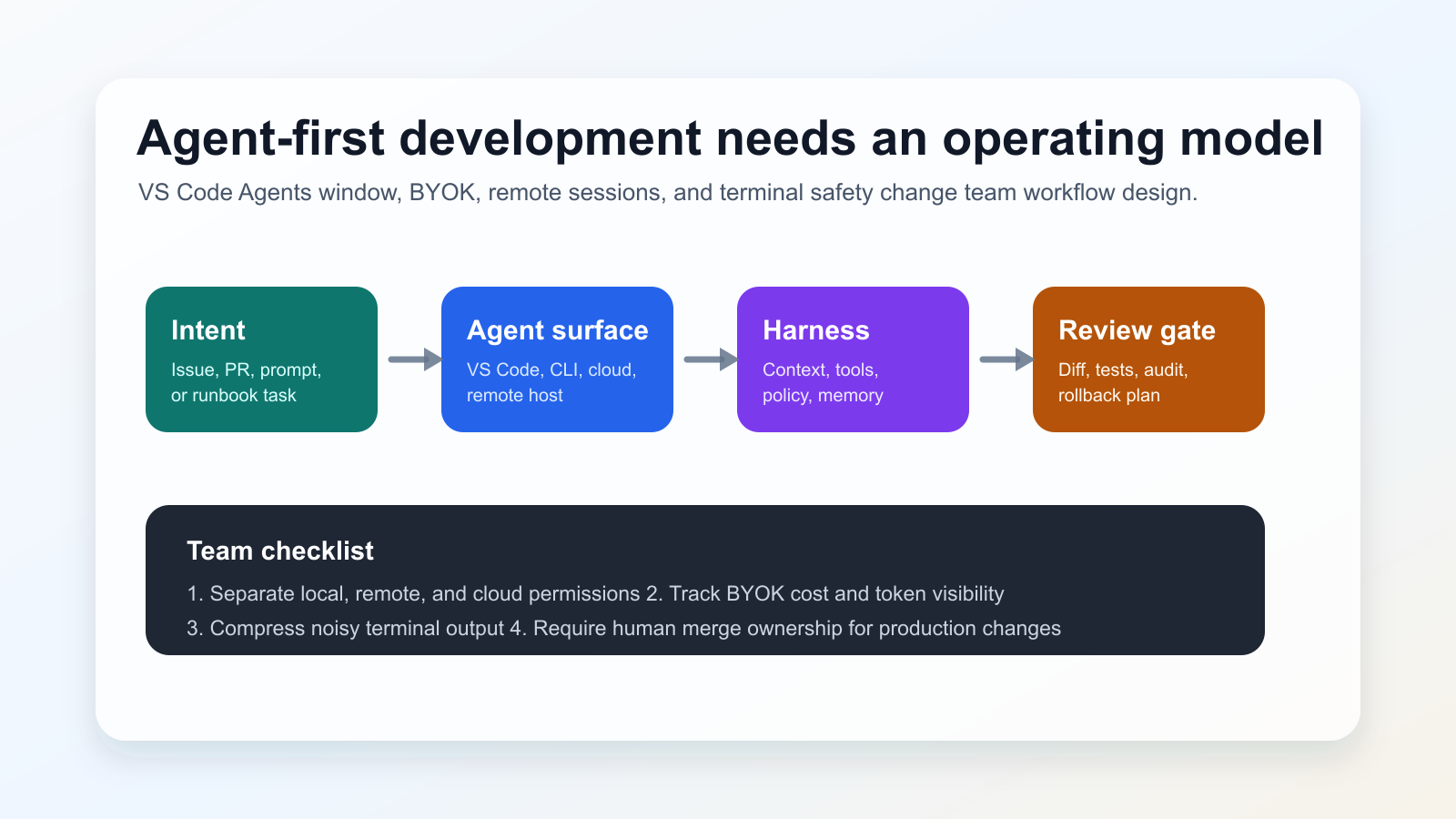
品質を決めるのはモデルだけではありません。harness がコンテキスト、ツール、権限、実行結果を管理します。したがってチームは agent を開発プロセスの一部として設計する必要があります。
コミュニティのシグナル
Developer discussions around VS Code 1.122 and local-model workflows show interest in BYOK and custom endpoints, but also concern about cost predictability, account policies, connectivity, and how much work should be delegated. These discussions are used here only as signals; factual claims rely on the official links below.
実践チェックリスト
- ローカル、リモート、クラウド agent の権限を分ける。
- BYOK のコスト、データ境界、fallback を文書化する。
- agent が実行したコマンドと diff を PR に残す。
- merge の責任は人間が持つ。
リスク
The main risk is over-delegation: long remote or cloud sessions can amplify unclear requirements. BYOK also increases operational responsibility because every provider adds policy, logging, quality, and failure-mode questions. Blocking all agent workflows is rarely practical, so teams need clear boundaries instead.
出典
- GitHub Changelog: GitHub Copilot in Visual Studio Code, May releases
- Visual Studio Code 1.122 release notes
- VS Code documentation: Use the Agents window
- VS Code documentation: Using agents in Visual Studio Code
- VS Code Blog: The Coding Harness Behind GitHub Copilot in VS Code
- Community signal: VS Code 1.122 discussion on r/GithubCopilot
- Community signal: local model and Agents window discussion on r/LocalLLaMA