
Before September US CPI: food and energy stay in your budget
Would a calmer core inflation reading immediately make next month's living costs easier? A household with substantial food and energy spending cannot assume that. BLS schedules September US CPI for October 14 at 08:30 US Eastern Time, or 21:30 KST the same day. As of October 11, this article does not forecast the release. It prepares the questions that should accompany the numbers, especially when a headline is about to become a budgeting decision.
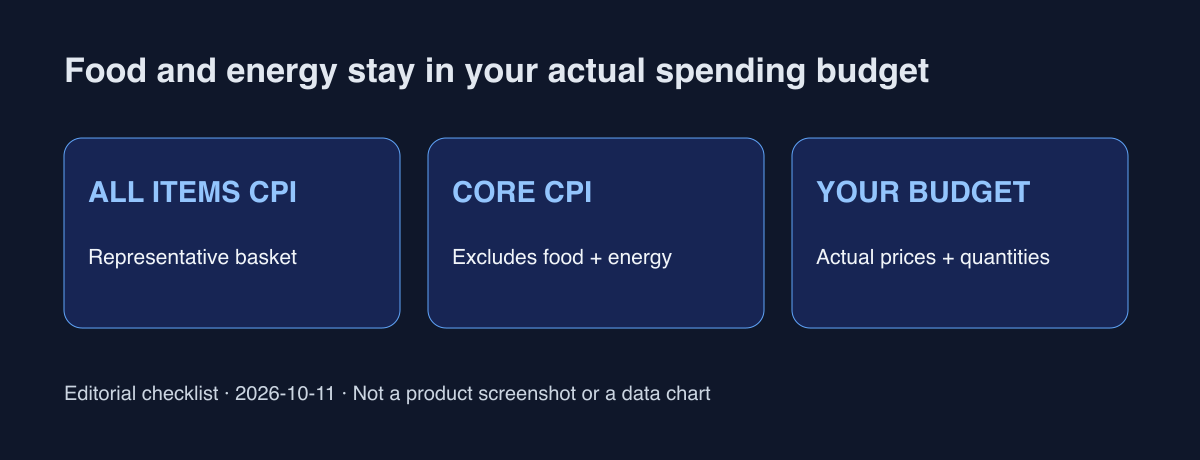
All-items and core cover different baskets
BLS publishes an index excluding food and energy alongside all-items CPI. Some users look at it to examine underlying inflation with less exposure to volatile categories. Removing those items from an index does not remove their importance or their cost. Compare matching periods for both measures, but do not turn the direction of their difference into a definite policy outcome or a forecast of next month's bill. The two measures answer related questions with different coverage.
Keep actual spending shares in the budget
CPI describes average price change for a representative consumer basket, rather than a particular household's experience. For a budget review, separate food, energy and other spending, then ask whether each amount changed because of unit prices or quantities. This is the author's proposed check. If electricity spending rose, compare the unit price at equivalent usage and the actual usage separately. That prevents a larger bill caused by more consumption from being treated as price inflation alone.
Check small-team costs through contracts and usage
This article does not recommend mechanically linking cloud services, software subscriptions or office costs to core CPI. Start with the contract's payment currency, renewal date, usage and adjustment clauses. When a Korean team uses US consumer data to think about dollar-denominated bills, keep exchange-rate effects as a separate assumption. CPI is not a direct index of that team's invoice structure. A spending review can use macro context without pretending that context is the team's actual procurement evidence.
Write the decision trigger before the release
After publication, record the comparison period and seasonal-adjustment labels for all-items, core, food and energy readings. Then specify which change would trigger a budget review and which records would verify the actual cost. It is also excessive to discard an average index because it differs from an individual experience. Keep the macro explanation beside the spending check, so one headline does not simultaneously rewrite pricing, payroll and customer-demand assumptions. This is a way to make decisions traceable, not a forecast that every category will move together.
A useful market question is which cost and period a number describes, rather than which number is more real. This article predicts no interest-rate, equity or exchange-rate direction. Once September results are released, check the confirmed values and adjustment or correction status; today's process is not a judgment about future results.
Sources and verification basis
Official BLS materials checked on October 11, 2026. For information only, not financial advice. Budget checks and operational interpretations are the author's proposals.