
Before U.S. import prices: an index excluding duties is not your landed cost
A headline saying import prices fell can sound like a promise that your next shipment of equipment will cost less. That inference skips the question of what the statistic measures and what your invoice contains. Ahead of next week’s U.S. import and export price release, check the treatment of duties before trying to predict the direction. For a small team buying physical equipment or materials, a useful decision starts with the quotation’s included items, payment currency, and delivery terms. A broad index can inform that conversation without settling the purchase.
The schedule and the confirmed scope
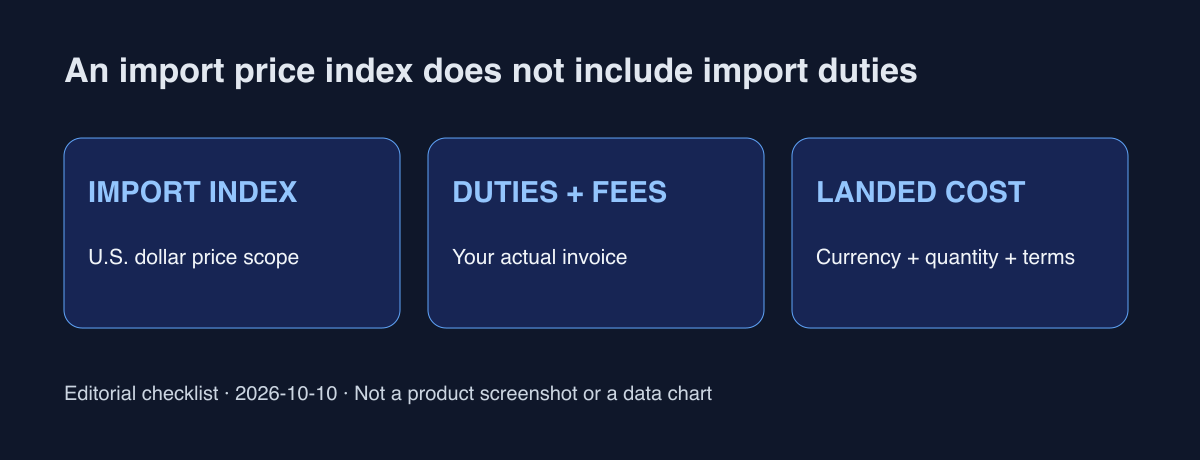
The current BLS release schedules September import and export prices for October 16, 2026 at 8:30 a.m. Eastern Time, or 9:30 p.m. KST that day. As of October 10, those results are not yet available. The BLS FAQ states that prices used to calculate the import and export price indexes exclude duties. Import prices are based on U.S. dollar prices paid by the U.S. importer. The technical note also states that these indexes are not seasonally adjusted. Keep those scope labels next to the reference month when you read the eventual result.
Excluding duties does not mean tariffs have no effect
Not adding the tariff amount directly is different from claiming tariffs cannot change transaction prices. BLS explains that stockpiling, substitution, and pass-through behavior can affect prices around tariff announcements or implementation. A rise or fall in one index therefore cannot settle the total burden of a particular policy. This article does not estimate current tariff rates or predict the upcoming figure. Use the methodological distinction to ask a more precise question, rather than treating an index move as a verdict on every buyer and supplier.
Keep three layers in the procurement note
Record the relevant U.S. import-price trend, the price terms in your contract or quotation, and the amount your team will actually pay as separate layers. Check applicable duties, fees, delivery terms, exchange rates, and quantity alongside the goods price. Read included charges carefully so that freight or tax already in the quote is not added twice. For a Korean team paying in won, applying the U.S. dollar index’s percentage change directly to its budget would also conflate different markets and settlement conditions. A category trend should prompt invoice questions, not overwrite invoice evidence.
Use the index to frame a negotiation question
An easing index may not reduce an invoice when the contract is fixed or the category differs. A rising aggregate does not require every individual supplier to change its quote either. Ask about quote validity, renewal timing, and whether taxes are included instead of calling the statistic proof that the supplier is wrong. The index describes movement across transactions; it is not one company’s price list or a complete cost sheet for a specific shipment. Comparing a matching category can be informative, but its usefulness depends on how closely the purchase and index scope align.
After the release, record the reference month, release date, non-seasonally-adjusted label, and category alongside your actual quote. The BLS schedule and methodology are confirmed facts; the three-layer purchasing note is this article’s operational suggestion. A debate about tariff burdens is not evidence of a new figure or a measured effect. This article is informational and is not financial advice.
Official sources
Before ordering equipment or materials, distinguish charges already included in the quote from charges payable separately.