
Before September US CPI: slower inflation is not a lower team bill
A headline about slower inflation can sound like a promise that next month's bills will fall. Prices increasing more slowly and invoices getting smaller are different events. A small team should record that distinction explicitly before changing its budget assumptions.
The BLS calendar schedules September 2026 US CPI for October 14 at 08:30 Eastern Time. As of October 5, the actual result of that release is not available. The diagram proposes a path from a headline to a team's invoices; it is neither a forecast nor a chart of actual CPI readings.
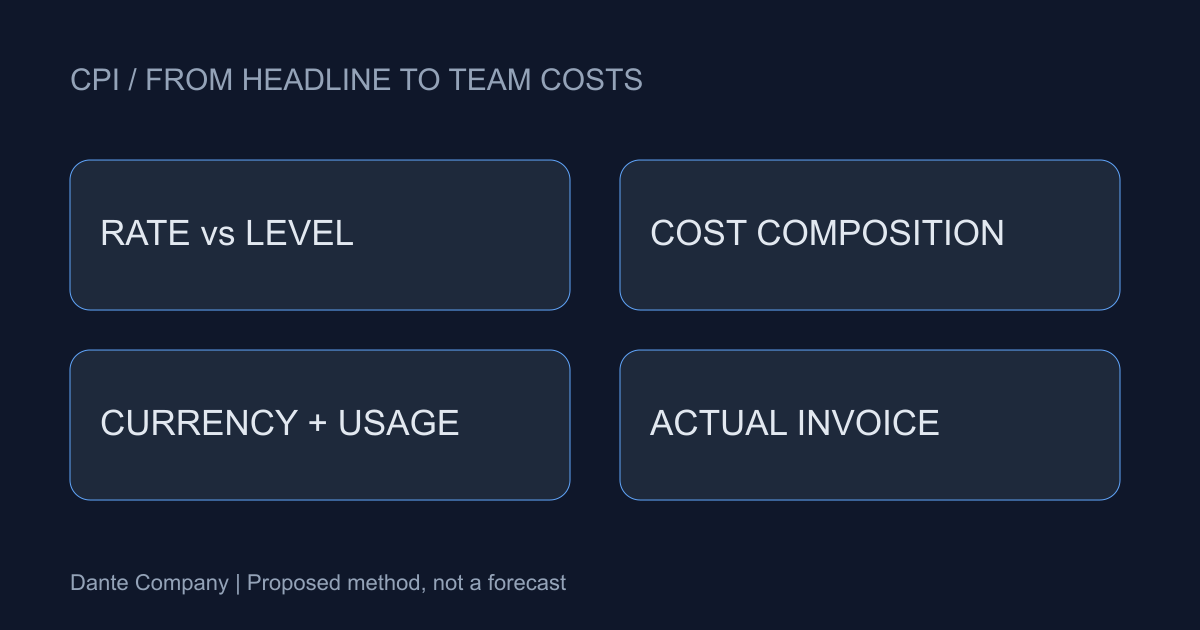
Put the rate and the level in separate fields
Prices can keep their elevated level even when they rise more slowly. Do not read moderation as a reversal of earlier increases. Record the reference month, comparison period, index, and rate of change separately to make the release easier to interpret.
Month-over-month and year-over-year also answer different questions: a recent monthly movement versus a twelve-month comparison. Label the comparison in the team's document rather than merging near-term movement with the annual burden. This article does not estimate the unreleased September reading.
The average consumer basket is not a team ledger
BLS describes CPI as average price change for a representative basket of consumer goods and services, rather than the experience of a particular household. It also does not directly measure a software team's servers, contractor mix, or currency exposure. Different cost compositions can produce different burdens under the same headline.
We therefore propose a separate internal cost ledger. For each item, record billing currency, renewal date, usage, unit price, and whether the cost is fixed, then compare with actual invoices. This is a team observation tool, not an official indicator. Do not invent values before real evidence is available.
Read currency and usage alongside foreign bills
A dollar-denominated service can have an unchanged unit price while its cost in local currency changes with exchange rates or usage. Calling all three movements inflation makes the response unclear. Compare the previous and current invoice for the same item and identify which variable changed first.
For a server-cost increase, inspect the tariff and usage separately and keep the conversion currency consistent. This is a proposed method, not a claim that a particular provider raised prices. Record renewal timing too: a contract-based cost may not change on the same day as an economic release.
Update observations before rewriting conclusions
After the October 14 release, read the actual reference period and comparison in the original source, then review relevant ledger items. A surprise does not immediately establish a change in your demand or revenue. Update observations first and record evidence for any subsequent budget-assumption change.
The official average helps explain the broader environment without automatically deciding one team's pricing, hiring, or investment. A team ledger is narrower and cannot describe the economy as a whole. Read both according to their scope. This is informational interpretation, not financial or investment advice.