
The Big One reeling guide: lower tension alone does not land a fish

You release the control because the line looks dangerous, yet the fish moves farther away. Reeling in The Big One asks you to alternate between relieving tension and bringing the fish closer. Watching only the safe-looking gauge can hide whether the catch is actually progressing.
On October 5, 2026, we checked the reeling implementation matching public iOS 1.3.3. The image is currently listed on the Korean App Store. Its capture date and build are undisclosed, so it is not presented as a verified capture of the latest build. The interface is Korean.
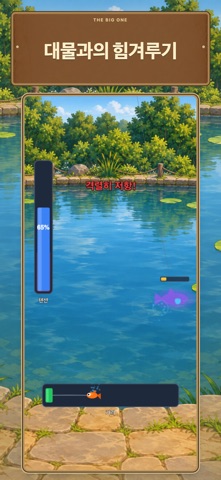
Read two different questions first
Tension indicates pressure on the line; remaining distance indicates how close the fish is. One helps you judge immediate danger, while the other shows progress toward landing. A fall in tension does not automatically mean a fall in distance.
During one encounter, deliberately move your attention between the two indicators. Check distance after reacting to a warning and see which direction the fish moves while you recover. These are separate measurements, rather than interchangeable scores for how well you are playing.
Holding and releasing do different jobs
In ordinary reeling, holding raises tension and releasing lowers it. Fish strength and behavior, equipment, and the hook result affect the changes. A single rhythm measured in seconds therefore does not fit every fish. Read the current response instead of repeating one long hold.
Releasing helps recover from danger but does not complete the catch for you. Once the line becomes safer, check distance and behavior again before choosing the next input. Looking away for a long period after releasing removes the evidence you need for that next decision.
Behavior changes the meaning of the same input
In the public version, ordinary reeling responds differently to fighting, swimming, and resting. A hold that felt comfortable on the previous fish is not guaranteed to work on the next one. Check the behavior indicator and danger feedback before assuming the pattern will repeat.
A resting phase can be a chance to read the screen and adjust your input. It does not guarantee that waiting without interacting will land the fish. The useful habit is to verify both that danger is easing and that distance is moving toward the catch.
Practice one observation on the next fish
For this attempt, replace a record chase with three observations: distance before holding, danger before releasing, and the direction of distance when you hold again. If you change the release interval, keep equipment stable so you can understand what changed. A failed attempt can still reveal when pressure became difficult to control.
This is not a guaranteed equipment combination or a universal winning rhythm. It is a way to read two indicators after the bite and hook stages. Continue with the related groundbait and Fishpedia guides below, and use the official video to connect the steps into the complete fishing loop.