
US openings 7.1m, hires 5.2m: why their ratio is not a conversion rate
If there are 7.1 million openings and 5.2 million hires, is hiring conversion about 73%? The arithmetic is possible, but calling the result an applicant's chance of employment or a company's posting conversion rate gives it a meaning the observations cannot support.
In the August JOLTS release published by BLS on September 29, 2026, seasonally adjusted openings were about 7.1 million and hires about 5.2 million, both little changed. This reading guide uses official material checked on October 4. The team examples below are interpretation, not reported results or forecasts for a particular company.
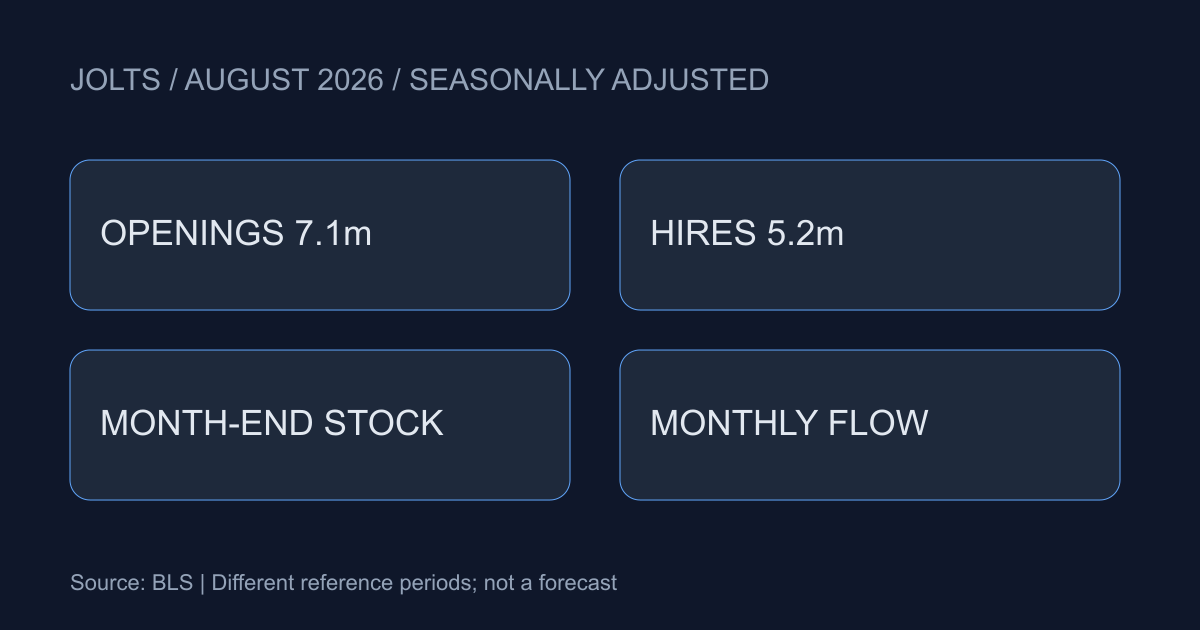
Openings are a point in time; hires span a month
Openings count positions available on the last business day of the month. Hires count additions to payroll throughout the month. A vacancy filled early in August and one still open at month-end do not occupy the same observation window. Because numerator and denominator do not track the same candidate cohort, their ratio is not hiring conversion.
The official openings rate was 4.3% and the hires rate 3.3%. These are also separately defined indicators. Keep the table's unit, seasonal-adjustment status and reference month attached to the numbers. Avoid mixing August JOLTS with September employment-report figures simply because the releases appeared close together.
A small team's funnel needs its own denominator
To calculate conversion, follow candidates who entered the same hiring path in a defined period. Distinguish application, interview, offer, acceptance and start dates, and decide how still-active candidates are handled. Two national totals cannot replace the numerator and denominator of that internal funnel.
A long-lived posting can have several operational explanations: a skills mismatch, pay terms, delayed approval or negotiation over a start date. Treat those as hypotheses to investigate. The aggregate openings level alone cannot establish the share of ghost jobs or your hiring difficulty; compare it with vacancy duration and candidate movement in your own records.
Read hiring alongside separation flows
BLS reported roughly 5.1 million total separations, 3.1 million quits and 1.6 million layoffs and discharges in August. Distinguish small numerical movements from the agency's description of little change. Do not assume that hires minus separations must always equal the employment report's net payroll change.
For operations, looking at how quickly positions reopen can add context to new hiring. National stability nevertheless does not guarantee stability for a particular engineering role or small business. JOLTS does not publish occupational openings estimates, so a claim about developer hiring needs separate evidence rather than a relabelled national chart.
Three notes for this week's plan
Write the reference month and release date beside the data, separate official facts from internal hypotheses, and review revisions and the next release. July estimates were revised in this publication. An initial observation is useful, but treating it as permanently final can make later comparisons inconsistent.
Rather than freeze hiring or change pay from one headline, a team can review the approved role budget, interview capacity and expected start date. This article provides economic context for information, not financial advice. Two indicators alone do not forecast rates, share prices or an individual's employment probability.