
The RRP Buffer Is Nearly Empty: Dollar Funding Risk Is Now a Plumbing Story
If you only watch the next Fed headline, you can miss the more practical story in dollar funding: the pipes are becoming more sensitive. The question is no longer just whether the FOMC cuts later. It is whether cash moving between money funds, the Fed, Treasury, dealers, and bank reserves still has a thick enough buffer.
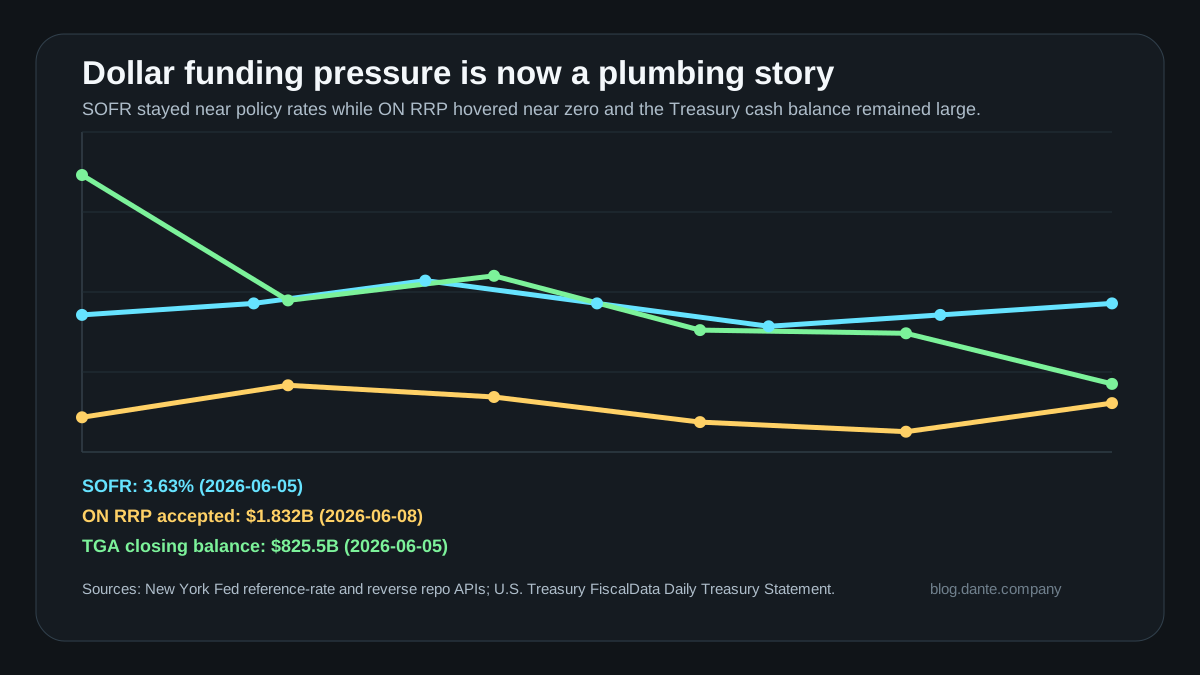
The latest official numbers frame the issue. New York Fed SOFR was 3.63% on 2026-06-05, with $3.1 trillion in underlying repo volume. The same New York Fed data show overnight reverse repo take-up at only $1.832 billion on 2026-06-08, across 16 accepted counterparties. Treasury FiscalData show the Treasury General Account closing balance at $825.5 billion on 2026-06-05.
Confirmed Facts
- New York Fed SOFR was 3.63% on 2026-06-05; the 1st-to-99th percentile range was 3.58% to 3.71%.
- ON RRP accepted amount fell to $0.761B on 2026-06-05 and stood at $1.832B on 2026-06-08. The offering rate was 3.50%.
- The TGA closing balance moved from $903.9B on 2026-05-29 to $825.5B on 2026-06-05, a decline of roughly $78.3B.
- The Federal Reserve calendar lists the next FOMC meeting for June 16-17, 2026, with a press conference.
- Treasury TBAC material and Reuters coverage show that Treasury cash investment in repo has become an active policy discussion. That is not a trading signal; it is evidence that cash management and repo plumbing are now part of the policy conversation.
Why It Matters
For years, ON RRP acted like a shock absorber. When Treasury rebuilt cash balances or bill issuance settled, part of the drain could come out of reverse repo balances rather than directly from bank reserves. Once RRP take-up is measured in low single-digit billions, the same Treasury cash swing can matter more for repo rates, reserve scarcity, and short-term dollar pricing.
This does not automatically mean risk assets must fall. The practical point is narrower: floating-rate loans, money-market yields, short-dated Treasuries, USD invoices, cloud infrastructure bills, and AI compute financing all sit closer to the same funding pipe than many operators assume.
Market Narrative Signal
Public commentary splits into two camps. One says a drained RRP is bullish because cash has returned to private markets. The other says the buffer is gone, so QT, Treasury issuance, or TGA swings now hit reserves more directly. The official data do not prove a crisis, but they support the second camp’s caution: after the buffer is thin, the market has less room to absorb the next calendar shock.
Second-Order Effects
First, funding stress can show up before policy rates move. Watch SOFR percentiles and repo volumes, not just the headline average. Second, sticky U.S. front-end rates can support the dollar, affecting teams that earn in local currency but pay for cloud, ads, tooling, or debt in USD. Third, Treasury cash management can become a valuation input for tech because discount rates are partly built from observable short-term funding prices.
Practical Checklist
- Review every contract priced at SOFR plus a spread, including debt, supplier financing, and floating-rate credit lines.
- Map cash dates rather than only yield: payroll, cloud invoices, taxes, FX conversions, and debt payments should sit on the same calendar.
- For investors, monitor SOFR upper percentiles, TGA jumps, Treasury settlement weeks, and repo usage around the FOMC window.
- For small teams, run a three-month stress test with a stronger dollar, higher overnight rates, and delayed customer collections.
Risks and Counterarguments
The counterargument is real: average SOFR is not spiking, and the Fed has standing repo tools that did not exist in the same form before the 2019 repo episode. Calling today’s setup a dollar liquidity crisis would be too aggressive.
The better interpretation is operational. A thinner buffer means founders, solo builders, finance leads, and investors should shorten the review cycle for USD cash needs and floating-rate exposure. The goal is not to predict a funding accident; it is to make sure one would not immediately become a product, payroll, or runway problem.
Interpretation: The message is not “the Fed must act now.” It is “cash calendars and funding terms deserve more attention when the money-market buffer is this thin.”
This article is for informational economic context only and is not financial advice. It is not a recommendation to buy, sell, or hold any asset.
Sources
- New York Fed SOFR API / SOFR reference-rate page
- New York Fed reverse repo operation results API / Repo and reverse repo explanation
- U.S. Treasury FiscalData: DTS operating cash balance API / Daily Treasury Statement description
- Federal Reserve monetary policy calendar
- U.S. Treasury TBAC Q2 2026 repo investment charge deck
- Reuters narrative signal on Treasury repo-investment discussion