
The trap inside a 54.0 services PMI: growth is alive, but price pass-through is not over
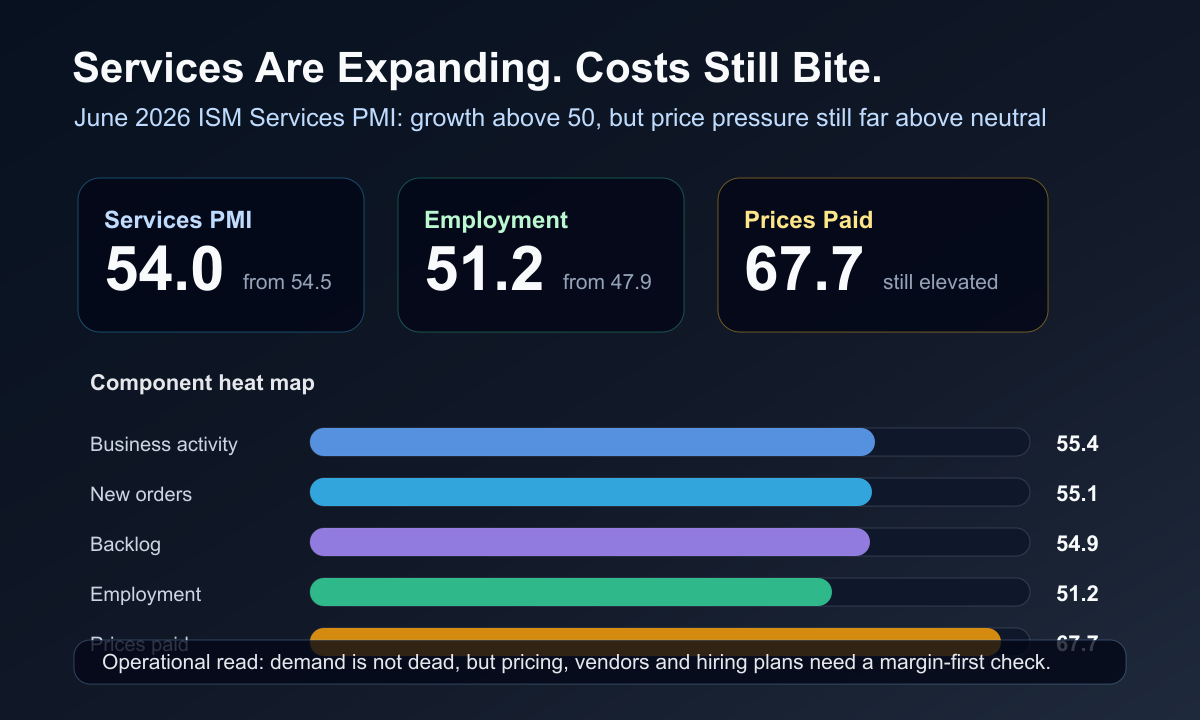
If you read the U.S. services data in one line, the message is simple: the economy is still expanding. The June 2026 ISM Services PMI printed 54.0, down from 54.5 in May but still above the 50 expansion threshold. New orders were 55.1, business activity was 55.4, backlog was 54.9, and employment moved back into expansion at 51.2.
The second line is less comfortable. The prices index cooled to 67.7 from 71.3, but prices paid by services organizations still rose for the 109th consecutive month. Sixteen industries reported higher prices, and none reported lower prices. That is why “growth is slowing, so costs will soon feel easy” is too neat a story.
Confirmed Facts
- ISM reported the June 2026 Services PMI at 54.0, still in expansion territory.
- New orders were 55.1, business activity was 55.4, and backlog rose to 54.9.
- The employment index rose to 51.2 from 47.9, returning to expansion.
- The prices index fell to 67.7, but remained elevated; ISM said services prices had increased for 109 consecutive months.
- The imports index slipped to 49.4, with respondents pointing to energy-linked import costs, tariffs and regional sourcing shifts.
- BLS summarized June nonfarm payroll growth at +57,000 and unemployment at 4.2%; May CPI was 4.2% year over year and final-demand PPI was 6.5% year over year.
- The Federal Reserve kept the target range for the federal funds rate at 3.50%-3.75% on June 17 and said inflation remained above its 2 percent goal.
Interpretation: The hard environment is not always recession
A 54.0 services PMI is not a collapse signal. It says demand is still present. But a 67.7 prices index is not a relief signal either. For a small team, the painful environment is often not a clean recession. It is an expansion in which customers still ask for service, support, uptime, implementation and faster delivery while wages, vendor prices, insurance, payments, logistics and software subscriptions keep grinding higher.
The employment component matters because it pushes against the “labor costs will quickly loosen” assumption. If service firms are hiring again after several months of caution, the pricing of talent and contractors may remain firm. For B2B SaaS, agencies, consultancies and tools selling into health care, education, logistics, hospitality or professional services, the immediate risk is not that every customer disappears. It is that every customer becomes more selective about payback period, contract flexibility and measurable cost savings.
Market Narrative: Rate hopes are less useful than pricing power
Market commentary often compresses PMI into a single question: did the number beat or miss? Operators need a different question: who still has pricing power? Services are sticky because their cost base includes labor, rent, insurance, software, data, compliance and card fees. Once those costs reset higher, they rarely reverse quickly. The drop in the prices index is encouraging, but 67.7 is still a high reading.
The confirmed fact is that demand remains in expansion while price pressure has eased but not disappeared. The interpretation is that this combination forces small teams to review price packaging, customer segments, vendor contracts and hiring plans at the same time. It is a margin management signal, not a simple risk-on or risk-off signal.
| Indicator | June reading | Why it matters |
|---|---|---|
| Services PMI | 54.0 | Demand is not dead; sales opportunities still exist. |
| New orders | 55.1 | Pipeline is alive, but customers may demand faster payback. |
| Employment | 51.2 from 47.9 | Do not build plans on a fast fall in wage or contractor costs. |
| Prices | 67.7 from 71.3 | Price pass-through is not over; packaging and contract terms matter more than blanket discounts. |
| Imports | 49.4 | Tariffs, energy and regional sourcing can still move the cost sheet. |
Checklist for Builders and Investors
What to check this week
• Pricing: audit renewal increases, usage overage, annual prepayment and discount governance before cutting headline prices.
• Hiring: reprice core roles and contractor capacity instead of assuming labor relief is imminent.
• Vendors: check cloud, payments, data, logistics and insurance contracts for automatic escalators.
• Sales: sell shorter payback periods and measurable cost reduction to services customers.
• Investing: compare revenue growth with gross margin, operating leverage and evidence of pricing power.
The second-order effect is consumer price fatigue. A services company may still be able to raise prices, but if the end customer cannot absorb them, orders can weaken with a lag. Founders should ask whether their customer can pass through costs without losing retention, not merely whether the customer operates in a growing category.
The third effect is the Fed reaction function. The June FOMC statement held rates steady but kept the inflation warning explicit. If services prices remain elevated, the market may have to wait longer for easier financial conditions. That touches funding costs, valuation multiples and customer budget approvals.
Counterarguments and Risks
There are limits. PMI is a diffusion index, not a direct measure of revenue, inflation or profit. A reading above 50 does not mean every company is growing. A high prices index does not mean every company can pass through costs. June also included energy, tariff, geopolitical and seasonal effects that may fade.
Still, the signal is useful. Services demand is alive, employment is firmer, and price pressure remains high. Small teams do not need to abandon growth plans, but they should install margin protection before growth turns expensive. In this environment, the price sheet and contract structure deserve the same attention as the sales pipeline.
Disclaimer: This article is for informational purposes only and is not financial advice. It is not a recommendation to buy, sell, or hold any security, bond, real estate asset, currency, or financial product.