
Vercel Sandbox Drives: Persistent Workspaces Are Becoming Agent Infrastructure
The next bottleneck for AI coding agents is not whether they can write code. It is whether they can keep enough working state to finish real work without becoming unsafe. If every run starts from a fresh clone, reinstalls dependencies, loses intermediate artifacts, and forgets what the previous sandbox produced, the demo looks fast while the operating model stays slow.
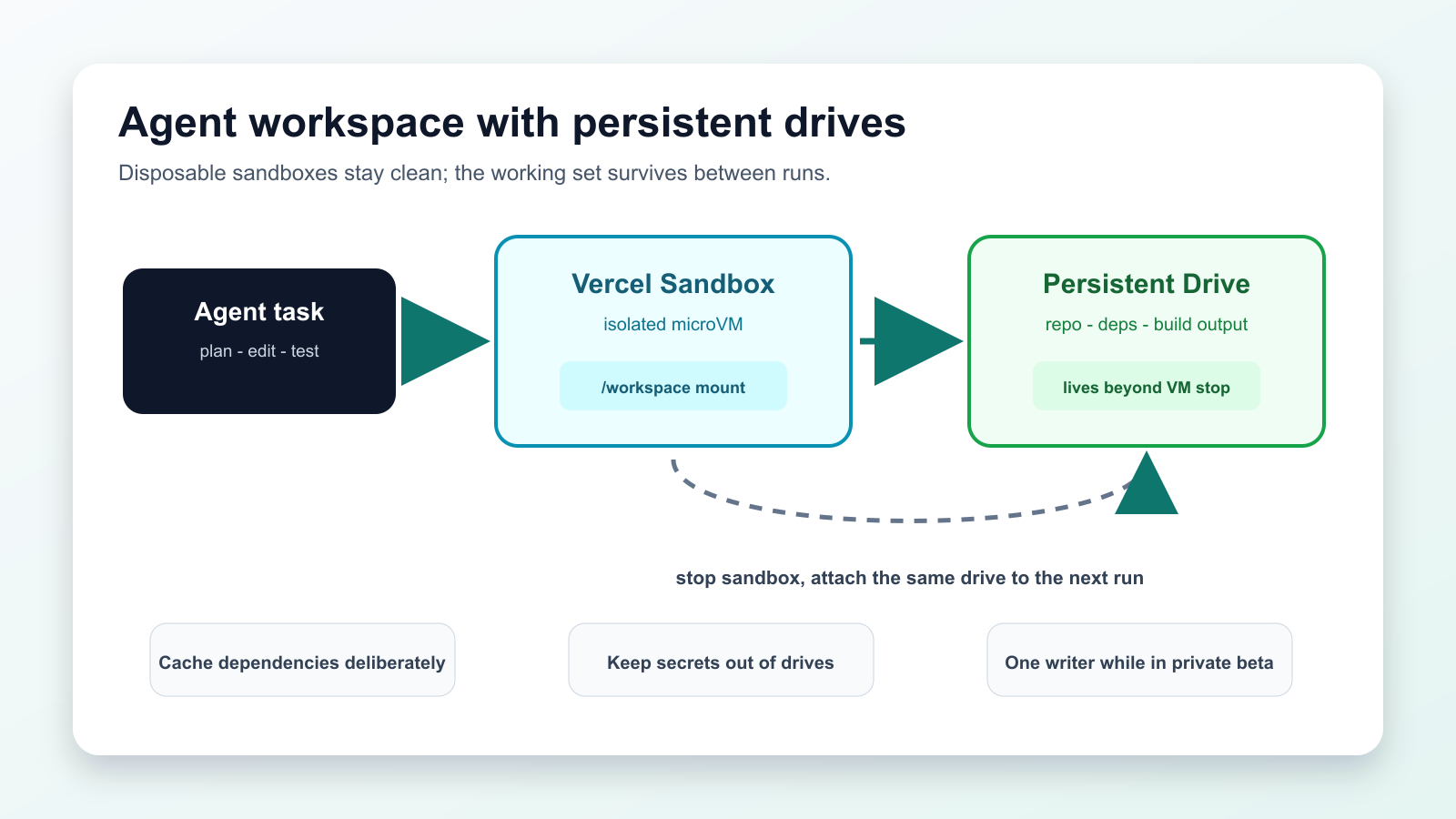
Vercel’s June 5, 2026 announcement of Vercel Sandbox Drives in private beta is important because it separates two concerns that agent builders often mix together: disposable execution and durable workspace state. The sandbox can remain short-lived and isolated, while a drive can survive across runs and be mounted into the next sandbox.
What changed
According to Vercel’s changelog, Sandbox Drives are persistent, attachable storage resources with a lifecycle independent from any sandbox. The beta SDK and CLI expose a flow where a drive is created with Drive.getOrCreate() and mounted through Sandbox.create(), for example at /workspace in read-write mode.
The intended use cases are concrete: keep agent workspaces across disposable sandboxes, retain cloned repositories, dependencies, and build outputs, and manage data independently from the sandbox lifecycle. The caveats matter just as much. During the private beta, one drive can be mounted read-write by one sandbox at a time, and Vercel says drives should not be used for production data while in private beta.
Why this matters
Agent workflows are becoming longer and more operational. GitHub’s Copilot app announcement emphasized custom agent skills, MCP server connections, and configurable Actions workflows. OpenAI’s Codex updates similarly point toward agents connected to team tools, role-specific plugins, annotations, and shareable internal apps. In that world, an agent is less like a single chat response and more like a worker executing a multi-step job.
Once agents operate over files, state becomes part of product quality. Losing dependencies increases latency and cost. Losing build output forces repeated validation. Losing run artifacts makes review and audit harder. Drives are interesting because they do not require the execution environment itself to become long-lived; they turn the workspace into an explicit resource.
Community signal
Before this official beta, Vercel Community posts such as sandbox-volume showed developers building their own continuity layer by syncing Sandbox files to external storage such as Vercel Blob. Reddit and community discussions around sandbox infrastructure often circle the same practical question: how do agents preserve repositories, dirty files, dependencies, and artifacts across turns or restarts? Treat those conversations as demand signals, not product guarantees. The authoritative constraints are still the Vercel changelog and docs.
Development and operations impact
- Agent products: per-user, per-repository, or per-task drives can let background tasks resume with the same working tree and artifacts.
- CI-adjacent workflows: dependency and build reuse can reduce repeated setup, but stale caches can contaminate tests if invalidation is weak.
- Security: durable storage expands the lifetime of mistakes. Secrets, OAuth tokens, customer data, and downloaded private files need explicit exclusion and cleanup rules.
- Cost control: separating compute from storage can reduce repeated work, but teams need lifecycle policies for old drives and failed task workspaces.
A practical checklist
- Pick the drive boundary: user, repository, task, or environment.
- Keep source, lockfiles, dependency caches, and build artifacts in
/workspace; keep secrets out. - At the end of every agent run, persist
git status, test results, and an artifact manifest. - Assume one read-write writer during the beta and design parallel agents around separate drives or read-only copies.
- Add TTL cleanup for abandoned workspaces, old dependency caches, and failed builds.
- Do not store production data in drives while the feature remains in private beta.
Risks and counterarguments
Not every workload needs a persistent workspace. Short lint jobs, one-off code execution, and clean-room verification may be safer and simpler in fully ephemeral sandboxes. It is also easy to confuse snapshots, automatic persistence, and drives. A snapshot restores a filesystem point in time; a drive makes workspace state a named resource that can outlive the VM. If a team has not decided which state is safe to reuse, persistence can turn speed into contamination.
The larger lesson is that agent runtime design now includes more than model choice and prompt quality. Teams shipping agentic products need sandbox boundaries, durable workspace policy, secret handling, audit trails, and cleanup jobs. Vercel Sandbox Drives are a strong signal that persistent agent workspaces are becoming first-class infrastructure.