
GitHub AI Scan enablement: distinguish a setting from analysis evidence
An increase in enabled repositories can help an organization track security adoption. It does not, by itself, establish that a critical change was analyzed or that someone reviewed the findings. When using GitHub’s latest visibility update, a small team should first decide which evidence supports each of those claims. A target percentage is much less useful if its readers cannot follow the path from a repository setting to the change they actually care about.
What changed on October 6
GitHub’s October 6, 2026 changelog says organization and enterprise administrators can see AI Scan for pull requests enablement in the Security overview coverage view. The summary counts enabled and not-enabled repositories; individual rows show effective status. CSV exports also include a Code Scanning AI Scan for pull requests column.
Use code-scanning-ai-scan-pr-scan:enabled or code-scanning-ai-scan-pr-scan:not-enabled to filter the view. The immediate benefit is visibility across repositories. This announcement does not establish improved detection accuracy or faster execution. It also answers a different question from our earlier article about scheduled analysis of inactive repositories: here the issue is what the adoption status actually allows an operator to conclude.
Do not guess why a repository is not enabled
GitHub Docs describes enabled as the effective outcome after enterprise policy, organization configuration, prerequisites and repository opt-out are applied. Not enabled can include repositories that are ineligible, and this view does not distinguish the reason. Turning that entire list into overdue work for repository owners could therefore misclassify legitimate exceptions as failures.
Try a small inventory containing repository, owner, displayed status, observation time, policy checked and exception reason. When a reason is unknown, write pending investigation rather than supplying a plausible explanation. An enterprise restriction, an ineligible repository and an intentional exclusion need different owners and different next steps. Separating them gives the status list operational value without pretending the interface supplies information it does not display.
Separate configuration, analysis and review evidence
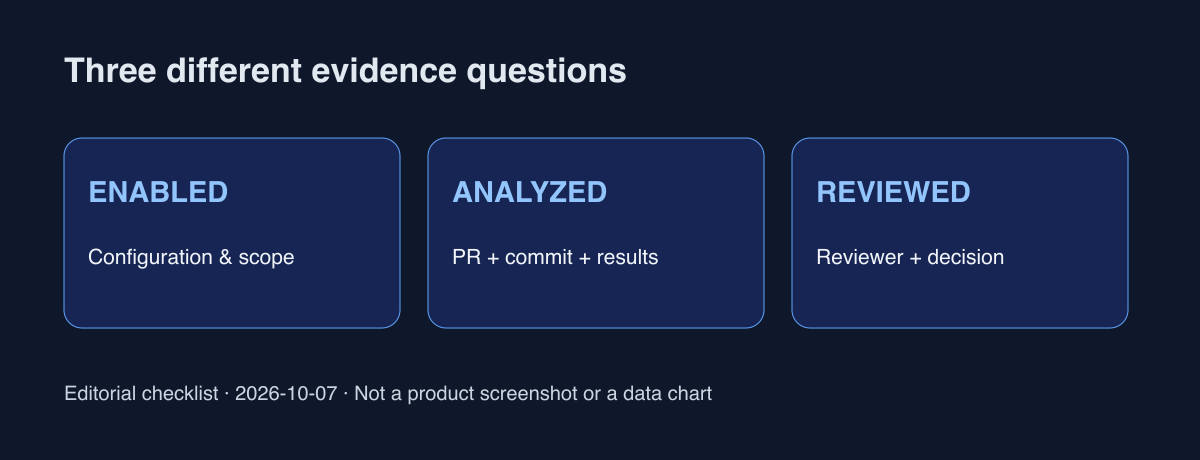
Our proposed operating record has three groups. Configuration evidence captures coverage status and scope. Analysis evidence links the PR, commit and relevant results actually checked. Review evidence identifies who assessed a finding and what they decided. This is an editorial workflow proposal, not a newly guaranteed GitHub capability. The key is to avoid copying one enabled value into all three completion fields.
For a PR changing a payment path, do not stop after confirming that its repository is enabled. Link whatever analysis results you can verify for that change. If findings exist, record whether they require a fix, a false-positive assessment or further investigation. If results cannot be found, mark analysis unverified. Even when there are no alerts, describe the checked scope and limitations rather than treating absence of warnings as proof of safety.
Use adoption visibility within a stable scope
Start with the active repositories owned by one team instead of an organization-wide percentage. Keep a CSV for that defined scope. When a later snapshot differs, check repository additions, transfers and archives alongside configuration changes. A changing denominator should not become a claimed improvement in security effectiveness. In the report, unresolved reasons and their next owners often matter more than a bigger headline count.
The GitHub Community discussion linked by the announcement is a feedback channel for AI security detections. Its small number of public comments cannot establish developer-wide satisfaction or adoption. Inside a team, use it as a prompt to ask which changes and results underpin an experience report. Reproducible feedback on false positives or missed issues starts with a defined comparison, not an assumed community consensus.
Keep enablement from becoming a completion claim
There is a reasonable objection: three new documents for every PR could create excessive overhead. Begin by linking existing PRs, analysis results and issues in one place rather than copying them into new forms. Test whether a reviewer can actually follow the evidence for a few important changes before expanding the scope. The goal is a decision that another person can reassess, not the largest possible archive.
Today’s practical step is to connect one important repository’s status reason with analysis and review evidence for a recent change. Confirmed enablement can complete the adoption check while unverified analysis remains pending. Permission or eligibility changes deserve separate review. This preserves the value of the new management view without overstating what it proves or overlooking the work still required.
Sources and verification scope
Checked October 7, 2026. Official documentation supports product behavior; the operating checklist is this article’s proposal. Begin with evidence links for one important repository.